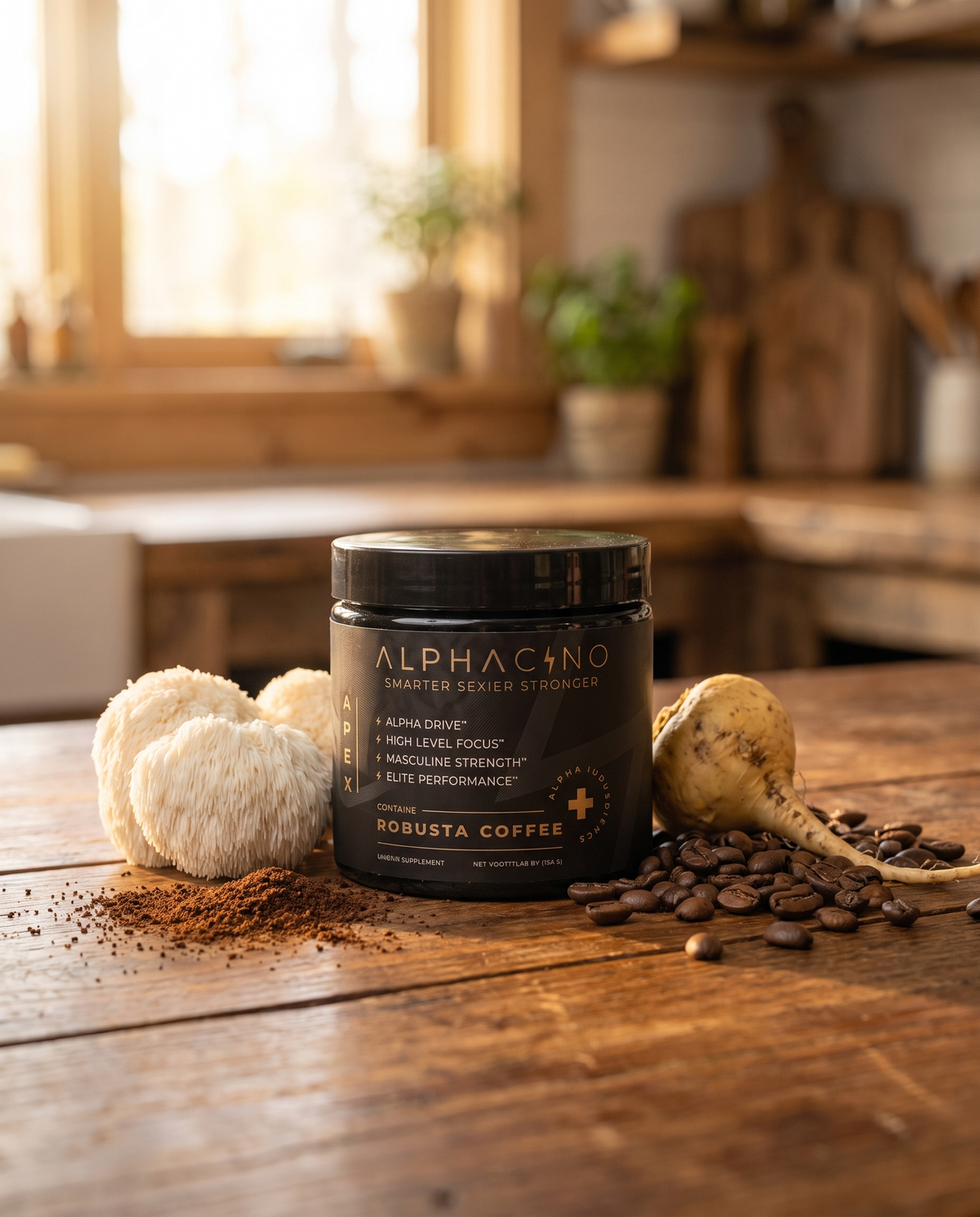
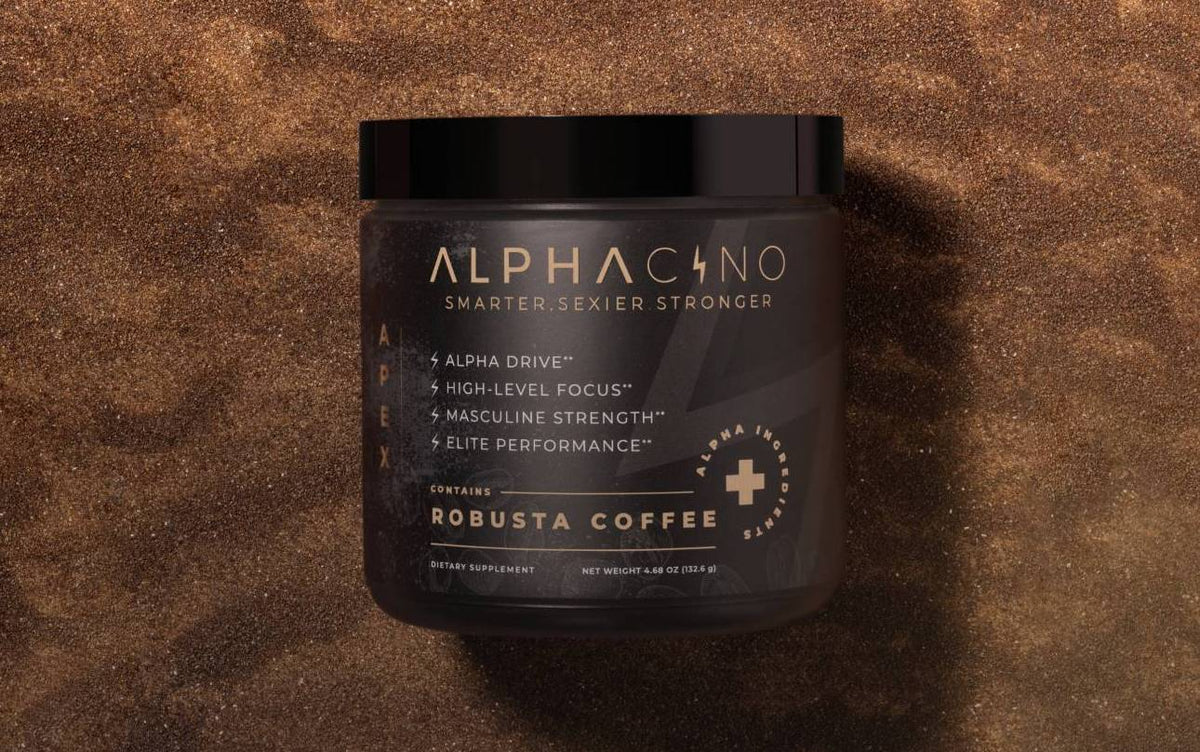
Short answer: mushroom coffee is ordinary coffee, usually instant, mixed with a powdered extract of one or more "functional" mushrooms such as lion's mane, chaga, reishi, cordyceps or turkey tail. It is not made from mushrooms instead of coffee, it does not taste like a mushroom soup, and it is not psychedelic. The caffeine comes from the coffee, so a cup holds anywhere from about 45 mg to 100 mg depending on the brand, against about 95 mg in an 8 oz brewed coffee1. The mushrooms add compounds that have been studied for focus, stamina and immunity, with evidence that ranges from a handful of human trials for lion's mane to laboratory work for chaga23. Mushroom coffee is one kind of functional coffee, the wider category of coffee with something added for a purpose. Alphacino is an example of both: robusta instant coffee at 100 mg of caffeine with 500 mg of lion's mane fruiting-body extract, plus KSM-66 ashwagandha, black maca and L-theanine, every amount printed on the jar4. Below is what goes into it, how it is made, which mushrooms are used and why, and how to read a label.
What is mushroom coffee made of?
Every mushroom coffee is built from the same three or four parts. What separates a good one from a weak one is how much of each the label tells you.
| Part | What it is | What to look for on the label |
|---|---|---|
| The coffee | Instant (freeze-dried or spray-dried) coffee in most brands; ground coffee or pods in a few. Arabica, robusta or a blend | A caffeine figure in milligrams, not "less than coffee" |
| The mushroom extract | A dried, concentrated powder of one or more mushroom species | Each species named with its own milligrams; fruiting body or mycelium; the extract ratio |
| Other actives (optional) | Adaptogen herbs such as ashwagandha, L-theanine, vitamins | An amount next to each, so it can be compared with the trials |
| Fillers and flavour (optional) | Coconut milk powder, MCT oil, collagen, fibre, sweeteners, flavourings | Sugar and creamer, which change what the drink is |
By weight, most of a scoop is coffee. A serving of Alphacino weighs 4.42 g, and its other-ingredients line reads coffee bean powder, natural flavour, silicon dioxide and green tea leaf extract, alongside the actives on the Supplement Facts panel4. Latte-style blends are heavier and creamier because they add coconut milk powder and MCT oil, as RYZE does; our RYZE review reads its label line by line.

How is mushroom coffee made?
- The mushroom is grown. Either the fruiting body, the part you would recognise as a mushroom, is harvested, or the mycelium, the root-like network underneath, is grown and harvested. The difference matters, and is explained below.
- It is dried and extracted. The dried material is steeped, typically in hot water, sometimes with an alcohol step as well ("dual extraction"), to pull out the compounds of interest, then the liquid is dried back to a powder.
- The extract is concentrated. That is where the ratio on some labels comes from. An "8:1" extract means 8 g of dried mushroom went into each gram of powder.
- It is blended with coffee. Most brands mix the extract into instant coffee, so the drink dissolves in hot water. A few blend it into ground coffee for brewing, or into pods.
Fruiting body or mycelium?
The two parts of the same fungus do not contain the same things. In lion's mane, the compounds behind the brain claims split by part: hericenones are found in the fruiting body and erinacines in the mycelium, and both raised nerve growth factor in laboratory studies56. At least two of the lion's mane trials in people used fruiting body78. So "fruiting body" is not automatically better, but it should be on the label either way, because a powder that says only "lion's mane" could be either. Watch for "myceliated grain", "mycelium on oats" or "mycelial biomass": those words mean the grain the mycelium grew on is part of the powder you are paying for.
What an extract ratio does to the numbers
Ratios make labels easy to misread. Cuppa, for example, prints "1,000 mg" of lion's mane, and its own footnote explains that the scoop holds 250 mg of 8:1 extracts in total, which the brand counts as "equivalent to 2,000 mg" of mushroom; our Cuppa review works through it. Neither number is wrong, but they are different measurements: one is what is in the scoop, the other is the dried mushroom it was made from. The trial doses you will see quoted, such as 1.8 g to 3.2 g of lion's mane a day, are weights of whatever preparation each trial used, and one single-dose trial used 3 g of a 10:1 extract2798. So check which kind of weight a number is before comparing. When a label prints an extract weight without a ratio, you cannot convert it either way.
Which mushrooms are in mushroom coffee, and why?
Six species turn up again and again. This is what each is sold for, and what the best human evidence behind it actually is.
| Mushroom | Sold for | Best human evidence | Our guide |
|---|---|---|---|
| Lion's mane (Hericium erinaceus) | Focus, memory, mood | Small placebo-controlled trials: better cognitive scores in adults over 50 after 12 to 16 weeks; a faster task in young adults after one dose; no overall effect from a single large extract dose. A 2025 systematic review found modest effects with sustained use and mild, mostly digestive side effects279810 | Lion's mane coffee |
| Cordyceps | Stamina, training | Two small trials found better exercise thresholds or tolerance over 3 to 12 weeks at about 1 to 4 g a day1112 | Cordyceps coffee |
| Reishi (Ganoderma) | Calm, sleep, immunity | A 16-week trial at 3 g a day in 84 people with type 2 diabetes found no effect on any outcome; there is a published case of fatal liver injury from a powdered product1314 | Reishi, chaga, turkey tail |
| Chaga (Inonotus obliquus) | Antioxidants, immunity | We found no controlled human trial; a 2025 review describes antioxidant, anti-inflammatory and immune activity of its compounds and looks ahead to clinical development3. A published case of kidney damage from its oxalate after months of heavy use15 | Reishi, chaga, turkey tail |
| Turkey tail (Trametes versicolor) | Immunity, gut | A phase 1 trial in nine women after breast cancer treatment: 3 to 9 g a day for six weeks was well tolerated, with trends in immune markers16 | Reishi, chaga, turkey tail |
| Shiitake | Immunity | Eating 5 or 10 g of dried shiitake a day for four weeks improved immune markers in 52 healthy adults17 | Is mushroom coffee good for you |
The pattern is the same across the table: the human evidence comes from doses measured in grams, taken daily for weeks. Beta-glucans, the fibre behind most immunity claims, have more than 80 clinical trials behind them, reviewed for their role in immune reactions and cancer treatment18, and a review of medicinal mushrooms calls for more clinical trials to confirm what the lab work suggests19. The coffees we have read carry from about 250 mg to 1,500 mg of mushroom extract a serving, and several print no amount at all, which is why the dose on the label decides whether any of this applies to your cup. The full benefit-by-benefit reading is in is mushroom coffee good for you, and what the evidence means for men specifically is in mushroom coffee benefits for men.
Is mushroom coffee real coffee?
Almost always, yes. The mushroom coffees that sell most are real coffee with an extract added, and you prepare them like any instant: Alphacino's directions are one scoop in 6 to 8 oz of hot water4. A few products sold alongside them are not coffee at all. MUD\WTR's original blend is cacao and chai spices with mushrooms, which is why its maker describes it as a seventh of a coffee's caffeine rather than a cup's worth; our caffeine-by-brand guide has the details. If you want a coffee, check that coffee is the first ingredient. How a real mushroom coffee compares with a plain cup, side by side, is in mushroom coffee vs regular coffee.

Does mushroom coffee have caffeine?
Yes, unless it is decaf or not made from coffee. The mushrooms contribute no caffeine, so the figure depends entirely on how much coffee the brand puts in. These are the numbers each brand printed on its own label or product page on the date in our caffeine guide.
| Product | Coffee base | Caffeine per serving |
|---|---|---|
| Everyday Dose Coffee+ Mild / Medium | Cold brew coffee extract | 45 mg / 90 mg |
| RYZE Mushroom Coffee | Organic instant arabica | 48 mg medium roast; 80 to 90 mg dark |
| BodyBrain Coffee | Freeze-dried Colombian instant | About 70 mg |
| Cuppa | Arabica instant | About 70 mg |
| Four Sigmatic Focus | Organic ground coffee | A regular brewed cup; not printed as a number |
| MUD\WTR :rise | Cacao, not coffee | About a seventh of a coffee, by the maker's description |
| Alphacino | Robusta instant | 100 mg, printed on the panel4 |
For scale, an 8 oz brewed coffee is about 95 mg1, and the European safety opinion found no safety concern for healthy adults up to 400 mg a day20. Caffeine's effects on alertness and attention are clear from about 40 mg up21, so a half-caf mushroom coffee is a gentler cup, not a different kind of drink. Several brands also add L-theanine, the amino acid in tea; with caffeine it improved attention and lowered tiredness and headache ratings in controlled trials2223. Our theanine and caffeine guide explains the pairing.
What does mushroom coffee taste like?
Mostly like the coffee it is made from. Extracts are used in small amounts and dissolve into the cup, so a black mushroom coffee tastes like a black instant coffee, sometimes slightly earthier; latte blends taste of their coconut milk and sweetener first. A robusta base gives a stronger, more bitter cup than arabica. The full answer, brand by brand, is in what does mushroom coffee taste like, and if you want to change the taste, how to make mushroom coffee taste good covers milk, sweetness and iced versions.
Is mushroom coffee psychedelic?
No. The compound in "magic" mushrooms is psilocybin, and it comes from a different group of fungi, above all the genus Psilocybe24. Lion's mane, chaga, reishi, cordyceps, turkey tail and shiitake are not among them, so nothing in a mushroom coffee is psychoactive beyond the caffeine. The question of drug tests, allergies and who should avoid particular mushrooms is covered in our mushroom coffee side effects guide.
What does mushroom coffee do?
On the day, it does what coffee does: the caffeine improves alertness, attention and reaction time21, and where theanine is added, the lift is steadier23. The coffee itself also carries long-term associations in large studies, including lower all-cause mortality at three to four cups a day25. The mushrooms and herbs are the slow part. Where they have shown anything in people, it took weeks of daily dosing at a stated amount: lion's mane for 12 to 16 weeks in the cognition trials, and ashwagandha, a common addition, for 60 days in the stress and cortisol trial2726. Two things can make a mushroom coffee worse than a plain one: sugar or sweetened creamer, which counteracted coffee's small weight benefit in three large cohorts27, and a dose too small to match any trial. The full reading is in is mushroom coffee good for you.
Mushroom coffee vs functional coffee: what is functional coffee?
Functional coffee is the umbrella term: any coffee with something added for a purpose beyond taste. Mushroom coffee is the best-known type, but the category is wider.
| Type of addition | Examples | What it is meant to do |
|---|---|---|
| Functional mushrooms | Lion's mane, cordyceps, chaga, reishi | Focus, stamina, immunity over weeks |
| Adaptogen herbs | Ashwagandha, rhodiola, maca | Stress, drive; ashwagandha lowered stress scores and cortisol in a 60-day trial26 |
| Amino acids | L-theanine | A calmer, more focused caffeine lift the same day22 |
| Fats and fibre | MCT oil, coconut milk, prebiotic fibre | Texture, fullness |
| Protein | Collagen, whey | Protein in the morning cup |
So every mushroom coffee is a functional coffee, but not every functional coffee contains mushrooms. Alphacino sits in both groups on purpose: one mushroom, lion's mane, at a printed 500 mg of fruiting-body extract, plus 600 mg of KSM-66 ashwagandha, 224 mg of black maca and 100 mg of L-theanine on a full cup of coffee4. How the herbal side of that works is in our adaptogens for men guide and can you take ashwagandha with coffee.
How to read a mushroom coffee label
- A caffeine number. "Less than half the caffeine of coffee" is a phrase; 48 mg or 100 mg is a number you can plan around.
- Each mushroom with its own milligrams. A "mushroom blend" total does not tell you how much of any one species you get.
- Fruiting body or mycelium, and the ratio. Without them, an extract weight cannot be compared with anything.
- Nothing you would need to research for safety. Chaga is high in oxalate and reishi has a published liver case1514; know whether they are in the scoop.
- The sugar and creamer line. Sweetened latte sachets are a different drink from a black coffee27.
- The price per cup at the dose you would take. A cheap jar at two scoops a day is not cheap.
Here is Alphacino read the same way, from the Supplement Facts panel on the jar4.
| Check | On the Alphacino label |
|---|---|
| Coffee and caffeine | Robusta instant coffee; caffeine 100 mg per 4.42 g scoop |
| Mushroom, part and amount | HericiumPrime lion's mane fruiting-body extract, 500 mg |
| Other actives | KSM-66 organic ashwagandha root extract 600 mg; black maca root extract 4:1, 224 mg; L-theanine 100 mg; S7 plant blend 50 mg; vitamin D 83.3 mcg |
| Safety-sensitive mushrooms | None: no chaga, reishi, cordyceps or turkey tail |
| Sugar and creamer | None in the ingredients; 10 calories, 3 g carbohydrate |
| Price | $49.97 for 30 servings, about $1.67 a cup, with a 60-day money-back guarantee |
The label also carries its own caution: if you are pregnant, under 12, or being treated by a physician, consult a healthcare professional before using it4. The full panel and the bundle prices are on the product page. If you want the same label test run across seven brands, see the best mushroom coffee for men ranking.
How to drink mushroom coffee
Treat it as the coffee it is. Stir one scoop into 6 to 8 oz of hot water, as the jar directs; the product page says it works hot or iced, so for iced, dissolve it in a little hot water and pour it over ice4. Have it in the morning, since the caffeine affects sleep the same way any coffee does; our best time to drink mushroom coffee guide has the cut-off. And give the mushroom and herb side the weeks the trials needed before judging it: the caffeine works on day one, the rest works on daily use, as how long mushroom coffee takes to work lays out.
Frequently asked questions
What is mushroom coffee?
It is ordinary coffee, usually instant, mixed with a powdered extract of functional mushrooms such as lion's mane, chaga, reishi, cordyceps or turkey tail. The coffee supplies the caffeine and the taste; the mushrooms add compounds studied for focus, stamina or immunity.
What is mushroom coffee made of?
Coffee, a dried and concentrated mushroom extract, and often extras such as L-theanine, adaptogen herbs, coconut milk powder or MCT oil. A good label names each mushroom, says whether it is fruiting body or mycelium, and prints an amount for every ingredient.
Is mushroom coffee real coffee?
Most of it is: real coffee with an extract added, made like any instant. A few products sold as mushroom coffee are not coffee at all; MUD\WTR's original blend, for example, is cacao and spices. Check that coffee is the first ingredient.
Does mushroom coffee have caffeine?
Yes, all of it from the coffee. Brands range from about 45 mg to 100 mg a serving, against about 95 mg in an 8 oz brewed coffee. The mushrooms themselves add no caffeine.
Does mushroom coffee taste like mushrooms?
Not much. The extract is used in small amounts and dissolves into the cup, so it tastes mainly of the coffee, sometimes slightly earthier. Latte blends taste mostly of their creamer and sweetener.
Can mushroom coffee make you hallucinate?
No. Psilocybin comes from other fungi, mainly the genus Psilocybe. The mushrooms used in coffee, such as lion's mane, chaga, reishi and cordyceps, are not psilocybin mushrooms, so the only active stimulant in the cup is caffeine.
What is functional coffee?
Coffee with an ingredient added for a purpose beyond taste: mushrooms, adaptogen herbs such as ashwagandha, L-theanine, MCT oil or collagen. Mushroom coffee is the best-known type of functional coffee.
How do you drink mushroom coffee?
Like instant coffee: one scoop in 6 to 8 oz of hot water, or dissolved and poured over ice. Drink it in the morning, and take it daily for several weeks before judging the mushroom side, since the trials ran for weeks.
Sources
- U.S. Department of Agriculture, Agricultural Research Service (2018). SR Legacy, via FoodData Central: brewed coffee (fdcId 171890). Serving value calculated from the per-100 g figure and the USDA 8 oz portion. fdc.nal.usda.gov
- Mori, K., et al. (2009). Improving effects of the mushroom Yamabushitake (Hericium erinaceus) on mild cognitive impairment: a double-blind placebo-controlled clinical trial. Phytotherapy Research, 23(3), 367 to 372. doi:10.1002/ptr.2634
- Wang, Y., et al. (2025). Natural Products and Health Care Functions of Inonotus obliquus. Current Issues in Molecular Biology, 47(4), 269. doi:10.3390/cimb47040269
- Alphacino. Supplement Facts panel, directions and label warning as printed on the jar, and the product page, read 9 October 2026. alphacino.com
- Lai, P. L., Naidu, M., Sabaratnam, V., Wong, K. H., David, R. P., Kuppusamy, U. R., Abdullah, N., & Malek, S. N. (2013). Neurotrophic properties of the lion's mane medicinal mushroom, Hericium erinaceus (higher Basidiomycetes) from Malaysia. International Journal of Medicinal Mushrooms, 15(6), 539 to 554. doi:10.1615/intjmedmushr.v15.i6.30
- Spangenberg, E. T., et al. (2025). Unveiling the role of erinacines in the neuroprotective effects of Hericium erinaceus. Frontiers in Pharmacology, 16, 1582081. doi:10.3389/fphar.2025.1582081
- Saitsu, Y., Nishide, A., Kikushima, K., Shimizu, K., & Ohnuki, K. (2019). Improvement of cognitive functions by oral intake of Hericium erinaceus. Biomedical Research, 40(4), 125 to 131. doi:10.2220/biomedres.40.125
- Surendran, G., et al. (2025). Acute effects of a standardised extract of Hericium erinaceus (lion's mane mushroom) on cognition and mood in healthy younger adults: a double-blind randomised placebo-controlled study. Frontiers in Nutrition, 12, 1405796. doi:10.3389/fnut.2025.1405796
- Docherty, S., et al. (2023). The acute and chronic effects of Lion's Mane mushroom supplementation on cognitive function, stress and mood in young adults: a double-blind, parallel groups, pilot study. Nutrients, 15(22), 4842. doi:10.3390/nu15224842
- Menon, A., et al. (2025). Benefits, side effects, and uses of Hericium erinaceus as a supplement: a systematic review. Frontiers in Nutrition, 12, 1641246. doi:10.3389/fnut.2025.1641246
- Chen, S., et al. (2010). Effect of Cs-4 (Cordyceps sinensis) on exercise performance in healthy older subjects: a double-blind, placebo-controlled trial. Journal of Alternative and Complementary Medicine, 16(5), 585 to 590. doi:10.1089/acm.2009.0226
- Hirsch, K. R., Smith-Ryan, A. E., Roelofs, E. J., Trexler, E. T., & Mock, M. G. (2017). Cordyceps militaris improves tolerance to high-intensity exercise after acute and chronic supplementation. Journal of Dietary Supplements, 14(1), 42 to 53. doi:10.1080/19390211.2016.1203386
- Klupp, N. L., Kiat, H., Bensoussan, A., Steiner, G. Z., & Chang, D. H. (2016). A double-blind, randomised, placebo-controlled trial of Ganoderma lucidum for the treatment of cardiovascular risk factors of metabolic syndrome. Scientific Reports, 6, 29540. doi:10.1038/srep29540
- Wanmuang, H., Leopairut, J., Kositchaiwat, C., Wananukul, W., & Bunyaratvej, S. (2007). Fatal fulminant hepatitis associated with Ganoderma lucidum (Lingzhi) mushroom powder. Journal of the Medical Association of Thailand, 90(1), 179 to 181. PMID 17621752
- Kikuchi, Y., Seta, K., Ogawa, Y., Takayama, T., Nagata, M., Taguchi, T., & Yahata, K. (2014). Chaga mushroom-induced oxalate nephropathy. Clinical Nephrology, 81(6), 440 to 444. doi:10.5414/CN107655
- Torkelson, C. J., et al. (2012). Phase 1 Clinical Trial of Trametes versicolor in Women with Breast Cancer. ISRN Oncology, 2012, 1 to 7. doi:10.5402/2012/251632
- Dai, X., et al. (2015). Consuming Lentinula edodes (shiitake) mushrooms daily improves human immunity: a randomized dietary intervention in healthy young adults. Journal of the American College of Nutrition, 34(6), 478 to 487. doi:10.1080/07315724.2014.950391
- Vetvicka, V., Vannucci, L., Sima, P., & Richter, J. (2019). Beta glucan: supplement or drug? From laboratory to clinical trials. Molecules, 24(7), 1251. doi:10.3390/molecules24071251
- Venturella, G., Ferraro, V., Cirlincione, F., & Gargano, M. L. (2021). Medicinal mushrooms: bioactive compounds, use, and clinical trials. International Journal of Molecular Sciences, 22(2), 634. doi:10.3390/ijms22020634
- EFSA Panel on Dietetic Products, Nutrition and Allergies (2015). Scientific opinion on the safety of caffeine. EFSA Journal, 13(5), 4102. doi:10.2903/j.efsa.2015.4102
- McLellan, T. M., Caldwell, J. A., & Lieberman, H. R. (2016). A review of caffeine's effects on cognitive, physical and occupational performance. Neuroscience & Biobehavioral Reviews, 71, 294 to 312. doi:10.1016/j.neubiorev.2016.09.001
- Haskell, C. F., et al. (2008). The effects of L-theanine, caffeine and their combination on cognition and mood. Biological Psychology, 77(2), 113 to 122. doi:10.1016/j.biopsycho.2007.09.008
- Owen, G. N., Parnell, H., De Bruin, E. A., & Rycroft, J. A. (2008). The combined effects of L-theanine and caffeine on cognitive performance and mood. Nutritional Neuroscience, 11(4), 193 to 198. doi:10.1179/147683008x301513
- Van Court, R., et al. (2022). Diversity, biology, and history of psilocybin-containing fungi: Suggestions for research and technological development. Fungal Biology, 126(4), 308 to 319. doi:10.1016/j.funbio.2022.01.003
- Poole, R., et al. (2017). Coffee consumption and health: umbrella review of meta-analyses of multiple health outcomes. BMJ, 359, j5024. doi:10.1136/bmj.j5024
- Chandrasekhar, K., Kapoor, J., & Anishetty, S. (2012). A prospective, randomized double-blind, placebo-controlled study of safety and efficacy of a high-concentration full-spectrum extract of ashwagandha root in reducing stress and anxiety in adults. Indian Journal of Psychological Medicine, 34(3), 255 to 262. doi:10.4103/0253-7176.106022
- Henn, M., Glenn, A. J., Willett, W. C., Martínez-González, M. A., Sun, Q., & Hu, F. B. (2023). Changes in coffee intake, added sugar and long-term weight gain: results from three large prospective US cohort studies. American Journal of Clinical Nutrition, 118(6), 1164 to 1171. doi:10.1016/j.ajcnut.2023.09.023
This article is general information, not medical advice. Alphacino is a food supplement, not a treatment for any condition. If you are pregnant, have a medical condition or take medication, talk to a doctor before changing your caffeine intake or adding a mushroom or herbal supplement.