Short answer: mushroom coffee is coffee with functional mushroom extracts added, and in the better blends an adaptogen and L-theanine as well. For men, the benefits with real trial evidence are steadier focus and alertness, less jitter and a softer crash, a lower stress load, and better training output. Those come from the caffeine, the theanine and the ashwagandha, at doses a cup can actually carry. The mushroom itself is the slow, small part: lion's mane has improved cognition in trials, but at 1.8 to 3 g a day, more than any coffee delivers. Below, seven benefits ranked by the strength of their evidence, each ingredient's trial dose beside what a cup holds, the benefits specific to men, and a plain list of what mushroom coffee will not do.
The benefits of mushroom coffee for men, ranked by evidence
- Steadier focus and alertness. Caffeine improves attention, vigilance and reaction time from about 40 mg upward1, and pairing it with L-theanine improved attention-switching accuracy and alertness within 20 to 70 minutes in controlled trials2,3. Evidence: strong. Felt: the same morning.
- Less jitter, softer crash. Theanine with caffeine cut headache and tiredness ratings against caffeine alone3, and most mushroom coffees carry 45 to 100 mg of caffeine, under a typical 150 mg mug. Evidence: strong. Felt: the same morning.
- Lower stress load. 600 mg of KSM-66 ashwagandha a day cut cortisol 27.9% and stress scores over 60 days4. Evidence: moderate, from human trials at a dose a scoop can hold. Felt: weeks.
- Better training output. Caffeine improves endurance, strength and power across 21 meta-analyses7, and KSM-66 improved VO2max in athletes over eight weeks6. Evidence: strong for caffeine, moderate for ashwagandha, mixed for cordyceps8.
- Coffee's own long-term benefits, kept. Across 28 cohorts, each daily cup of coffee was linked to a 9% lower risk of type 2 diabetes13, and an umbrella review of 201 meta-analyses found 3 to 4 cups a day associated with the largest reduction in all-cause mortality, 17% lower than none14. Evidence: observational, large, consistent. Only applies if there is real coffee in the cup.
- Cognition from lion's mane. Improved cognitive scores in older adults over 16 weeks9 and faster Stroop performance in young adults 60 minutes after a dose10. Evidence: early, and the trials used 1.8 to 3 g a day against the 500 to 600 mg of extract in a coffee. Felt: weeks, if at all at cup doses.
- Immune and gut support from mushrooms. Daily shiitake raised immune-cell activity and salivary IgA in four weeks12, at 5 to 10 g of whole mushroom. Evidence: real for mushrooms, untested for mushroom coffee. Felt: not something you notice.
The order matters more than the list. The benefits men actually feel are the top four, and none of them is a mushroom. That is not a criticism of the category; it is the reason a well-built mushroom coffee is worth drinking and a badly built one is expensive instant coffee. Whether yours is well built comes down to the label, which the last section covers.

What each ingredient does, with the trial dose beside the cup
| Ingredient | Benefit with evidence | Dose in the trials | Typical mushroom coffee |
|---|---|---|---|
| Caffeine | Alertness, vigilance, reaction time1; endurance, strength, power7 | 40 to 300 mg for attention; 3 to 6 mg per kg for sport | 35 to 100 mg per cup, brand dependent |
| L-theanine | With caffeine: sharper attention, less jitter2,3 | 97 to 250 mg with 40 to 150 mg caffeine | 0 to 200 mg; many blends carry none |
| KSM-66 ashwagandha | Cortisol and stress down4; VO2max up6; testosterone up 14.7% in overweight men 40 to 705 | 600 mg a day | 0 to 600 mg; usually absent |
| Lion's Mane | Cognition in older adults9; acute Stroop speed in young adults10 | 1.8 to 3 g a day of fruiting body | 250 to 600 mg of extract, or unstated |
| Black maca | Sexual desire up from week 8, testosterone unchanged11 | 1.5 to 3 g of root a day | 0 to 224 mg of extract |
| Cordyceps | Exercise capacity in older adults8; no benefit in trained cyclists | Grams a day | Blend amounts, usually unstated |
| Shiitake, reishi, chaga, turkey tail | Immune markers from whole shiitake12; no human coffee-dose data for the others | 5 to 10 g of whole mushroom | Blend amounts, usually unstated |
| Vitamin D | Testosterone rose over a year in overweight men15 | 3,332 IU a day | Rarely included |
Two columns decide everything. Where the trial dose and the cup dose match, the benefit is yours to expect; caffeine, theanine and a full 600 mg of ashwagandha all pass. Where the trial dose is grams and the cup is milligrams, the benefit is a hope, and every mushroom on the list is in that position, ours included. Our guides on Lion's Mane, KSM-66, black maca and reishi, chaga and turkey tail go through each trial.
The benefits that are specific to men
Stress and drive. The KSM-66 trials are the closest thing this category has to a men's result. In overweight men aged 40 to 70, eight weeks at 600 mg raised testosterone 14.7% more than placebo, with no change in how they rated their fatigue or vigour5. In chronically stressed adults, the same dose cut cortisol by more than a quarter4. Read that as stress relief with a modest hormonal side effect, not the other way round.
Testosterone. No coffee raises it meaningfully, mushroom or otherwise, and no mushroom lowers it in humans. The reishi laboratory finding that started the worry, the caffeine trials and the ashwagandha result are all laid out in does mushroom coffee lower testosterone.
Training. The caffeine is the ergogenic: a few percent on endurance and small-to-moderate gains in strength and power, timed 45 to 60 minutes before a session7. KSM-66 added VO2max over eight weeks in athletes6. Cordyceps improved an exercise-capacity measure in older adults but did nothing for trained cyclists8. The gym guide has the timing.
Libido and stamina. Maca raised sexual desire from week 8 of a 12-week trial without moving testosterone11, at 1.5 to 3 g a day of root. Most coffees carry a fraction of that; we carry 224 mg of a 4:1 extract and say so. The male vitality coffee guide covers the category, including the hidden-drug products to avoid.
Body composition. Caffeine raises resting metabolic rate 3 to 4% for about two and a half hours per 100 mg, and unsweetened coffee is associated with less weight gain over time. Sugar in the cup reverses it. The numbers are in does mushroom coffee help you lose weight.
Mushroom coffee vs regular coffee: what actually changes
Less than the label implies, and the change that matters is caffeine. A standard 8 oz brew is around 95 mg; mushroom coffees range from 35 mg (MUD\WTR) and 48 mg (RYZE medium) through 70 mg (BodyBrain) to 100 mg (Alphacino). At the low end you are drinking a third of a coffee, which is why "fewer jitters" and "better sleep" are the most commonly reported benefits: they are the benefits of drinking less coffee. Whether that is a benefit depends on whether you wanted the coffee. The long-term associations that make coffee worth drinking at all, lower type 2 diabetes risk at every cup up to six13 and 17% lower all-cause mortality at 3 to 4 cups14, belong to the coffee, so a blend that is mostly coconut milk and cacao does not inherit them. Our regular coffee comparison and caffeine-by-brand table cover the rest.
What mushroom coffee will not do
- Raise testosterone. The only ingredient with a human result is ashwagandha, and the effect is modest and came with no change in how the men felt5.
- Deliver a mushroom trial dose. Lion's mane, cordyceps and shiitake were tested at 1.8 to 10 g a day. A scoop holds under a gram of total extract.
- Replace sleep. Caffeine taken six hours before bed still cut sleep in a controlled trial. Short sleep costs the next morning more than any cup gives back; when to drink mushroom coffee covers the cut-off.
- Treat anything. It is a food. Persistent fatigue, low libido or low mood is a reason for a blood test, not a subscription.
- Work as an occasional cup. Every adaptogen and mushroom trial dosed daily for 8 to 16 weeks. The how-much-a-day guide explains why daily is not optional.
How long until you notice the benefits
Same morning for the caffeine and theanine: 20 to 70 minutes in the trials2. Weeks for the rest: the KSM-66 stress trial measured at 60 days4, the lion's mane trial at 16 weeks9, and the lion's mane benefit faded within a month of stopping. If a brand promises the second on day one, it is describing the first. The full timeline is in how long mushroom coffee takes to work.
Side effects, briefly
Above 400 mg of caffeine a day, expect jitters, a faster heart rate and broken sleep16. Coffee itself moves the bowels within minutes, mushroom or not, and latte-style blends with MCT oil and coconut milk cause loose stools in the first week; the gut-effects guide separates the causes. The ingredient-specific cautions belong to mushrooms that are not in every blend: reishi has case reports of liver injury and an antiplatelet effect, and chaga carries an oxalate load with a documented kidney case. Read your own label rather than the category; the side-effects guide does it ingredient by ingredient, and is mushroom coffee acidic answers the reflux question.
How to get the benefits: the label test
- Every active has a printed dose. "Proprietary blend" with no milligrams means the trial doses cannot be checked, which usually means they are not met.
- 80 to 120 mg of caffeine if you want the attention and training effects, not 35.
- L-theanine alongside it. The one pairing with clean same-day evidence2,3.
- 600 mg of KSM-66 if stress is the reason you are buying. Less is under every trial.
- Real coffee in the cup, so the long-term coffee benefits come with it.
- A guarantee that outlasts an adaptogen trial. Eight weeks minimum. A two-week return window is not a test.

Where Alphacino fits
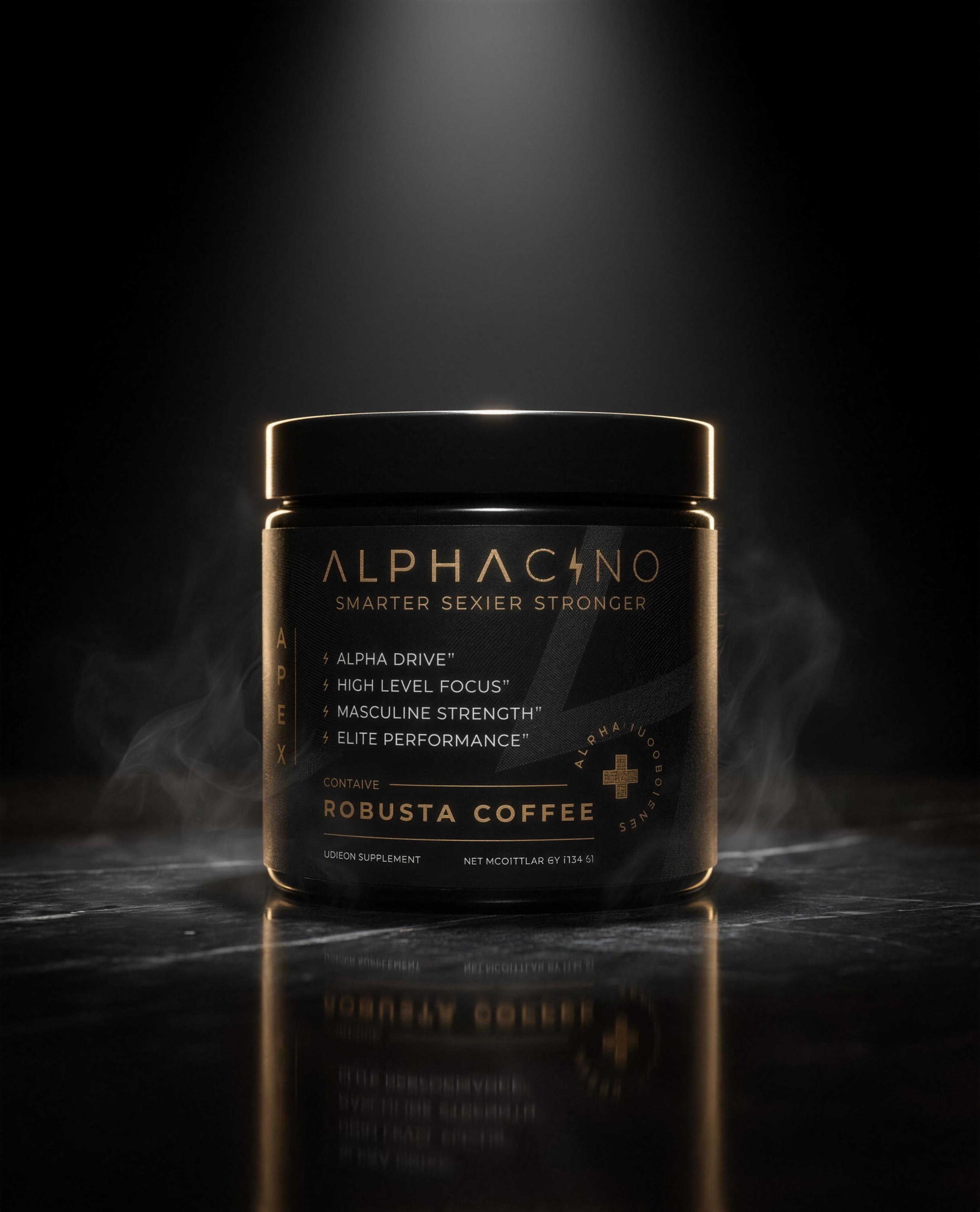
Alphacino was built around the top of the ranked list rather than the bottom. Per scoop: 100 mg of caffeine with 100 mg of L-theanine, inside the range the attention trials used; 600 mg of KSM-66 ashwagandha, the exact dose from the stress, VO2max and testosterone trials; 83.3 mcg of vitamin D, which is 3,332 IU, the dose from the year-long trial15; 224 mg of black maca 4:1 extract, below the libido-trial doses and stated as such; 500 mg of HericiumPrime lion's mane fruiting-body extract, a sixth of the cognition-trial dose and carried at a printed amount with no memory claim on it; and 50 mg of S7. It is a robusta coffee, so the coffee benefits come with it, and it contains no reishi, chaga, cordyceps or turkey tail, so none of their cautions apply. Every dose is on the tub. Thirty servings cost $49.97, $1.67 a cup, with a 60-day money-back guarantee, long enough to run the ashwagandha trial on yourself. The best mushroom coffee for men ranking puts it against five other labels on the same test, and the product page carries the full Supplement Facts panel.
Frequently asked questions
What are the benefits of mushroom coffee for men?
Ranked by evidence: steadier focus and alertness from caffeine with L-theanine, less jitter and a softer crash, a lower stress load from 600 mg of KSM-66 ashwagandha, and better training output from caffeine. Lion's Mane and the other mushrooms have early evidence at doses well above what a cup carries.
Does mushroom coffee actually work?
The caffeine and theanine work the same morning, in controlled trials. Ashwagandha works over weeks at 600 mg. The mushrooms themselves are present at a fraction of their trial doses, so treat them as a daily foundation rather than the reason to buy.
Is mushroom coffee good for men?
A well-built one is a better version of the coffee you already drink: same-day focus with less edge, plus a stress adaptogen at a real dose. A badly built one is low-caffeine instant coffee with a blend line. The label decides which you have.
What does mushroom coffee do for you?
Improves attention and reaction time within the hour, softens the caffeine curve if it carries theanine, lowers cortisol over weeks if it carries 600 mg of KSM-66, and keeps coffee's long-term associations with lower diabetes and mortality risk if it is actually coffee.
Does mushroom coffee boost testosterone?
No coffee does meaningfully. The one ingredient with a human result is KSM-66 ashwagandha, about 15% over eight weeks in overweight middle-aged men, with no change in how they felt. No mushroom lowers testosterone in humans either.
How long does it take to feel the benefits?
Caffeine and theanine: 20 to 70 minutes. Ashwagandha: the trials measured at 60 days. Lion's Mane: 16 weeks in the main trial, and the gain faded a month after stopping. Judge the botanicals in months, not mornings.
This article is general information, not medical advice. Alphacino is a food and is not intended to diagnose, treat, cure or prevent any condition. Talk to a doctor before combining ashwagandha with thyroid, sedative or immunosuppressant medication.
Sources
- McLellan, T. M., Caldwell, J. A., & Lieberman, H. R. (2016). A review of caffeine's effects on cognitive, physical and occupational performance. Neuroscience & Biobehavioral Reviews, 71, 294 to 312. doi:10.1016/j.neubiorev.2016.09.001
- Giesbrecht, T., et al. (2010). The combination of L-theanine and caffeine improves cognitive performance and increases subjective alertness. Nutritional Neuroscience, 13(6), 283 to 290. doi:10.1179/147683010X12611460764840
- Haskell, C. F., et al. (2008). The effects of L-theanine, caffeine and their combination on cognition and mood. Biological Psychology, 77(2), 113 to 122. doi:10.1016/j.biopsycho.2007.09.008
- Chandrasekhar, K., Kapoor, J., & Anishetty, S. (2012). A prospective, randomized double-blind, placebo-controlled study of safety and efficacy of a high-concentration full-spectrum extract of ashwagandha root in reducing stress and anxiety in adults. Indian Journal of Psychological Medicine, 34(3), 255 to 262. doi:10.4103/0253-7176.106022
- Lopresti, A. L., Drummond, P. D., & Smith, S. J. (2019). A randomized, double-blind, placebo-controlled, crossover study examining the hormonal and vitality effects of ashwagandha in aging, overweight males. American Journal of Men's Health, 13(2). doi:10.1177/1557988319835985
- Choudhary, B., Shetty, A., & Langade, D. G. (2015). Efficacy of ashwagandha (Withania somnifera) in improving cardiorespiratory endurance in healthy athletic adults. AYU, 36(1), 63 to 68. doi:10.4103/0974-8520.169002
- Grgic, J., et al. (2020). Wake up and smell the coffee: caffeine supplementation and exercise performance, an umbrella review of 21 published meta-analyses. British Journal of Sports Medicine, 54(11), 681 to 688. doi:10.1136/bjsports-2018-100278
- Chen, S., et al. (2010). Effect of Cs-4 (Cordyceps sinensis) on exercise performance in healthy older subjects: a double-blind, placebo-controlled trial. Journal of Alternative and Complementary Medicine, 16(5), 585 to 590. doi:10.1089/acm.2009.0226
- Mori, K., et al. (2009). Improving effects of the mushroom Yamabushitake (Hericium erinaceus) on mild cognitive impairment: a double-blind placebo-controlled clinical trial. Phytotherapy Research, 23(3), 367 to 372. doi:10.1002/ptr.2634
- Docherty, S., et al. (2023). The acute and chronic effects of Lion's Mane mushroom supplementation on cognitive function, stress and mood in young adults: a double-blind, parallel groups, pilot study. Nutrients, 15(22), 4842. doi:10.3390/nu15224842
- Gonzales, G. F., et al. (2002). Effect of Lepidium meyenii (maca) on sexual desire and its absent relationship with serum testosterone levels in adult healthy men. Andrologia, 34(6), 367 to 372. doi:10.1046/j.1439-0272.2002.00519.x
- Dai, X., et al. (2015). Consuming Lentinula edodes (shiitake) mushrooms daily improves human immunity: a randomized dietary intervention in healthy young adults. Journal of the American College of Nutrition, 34(6), 478 to 487. doi:10.1080/07315724.2014.950391
- Ding, M., et al. (2014). Caffeinated and decaffeinated coffee consumption and risk of type 2 diabetes: a systematic review and a dose-response meta-analysis. Diabetes Care, 37(2), 569 to 586. doi:10.2337/dc13-1203
- Poole, R., et al. (2017). Coffee consumption and health: umbrella review of meta-analyses of multiple health outcomes. BMJ, 359, j5024. doi:10.1136/bmj.j5024
- Pilz, S., et al. (2011). Effect of vitamin D supplementation on testosterone levels in men. Hormone and Metabolic Research, 43(3), 223 to 225. doi:10.1055/s-0030-1269854
- EFSA Panel on Dietetic Products, Nutrition and Allergies (2015). Scientific opinion on the safety of caffeine. EFSA Journal, 13(5), 4102. doi:10.2903/j.efsa.2015.4102