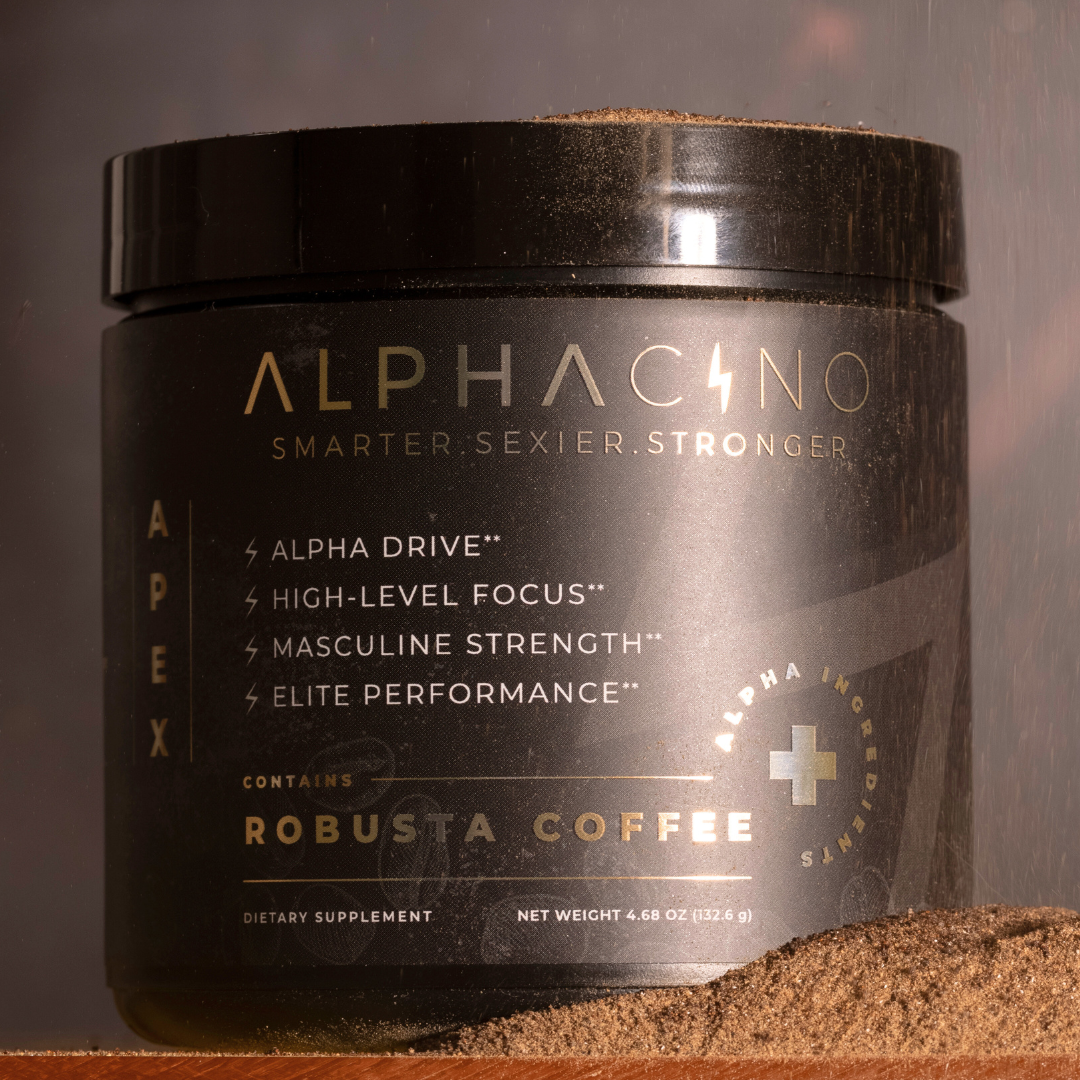
Short answer: not on its own, and not because of the mushrooms. No mushroom coffee has been tested for weight loss in a trial, and none of the mushrooms in these blends has a human weight-loss result: the reishi study everyone quotes was in mice2, and the one long human reishi trial, 3 g a day for 16 weeks, changed nothing it measured3. What a coffee can do for your weight is the caffeine. A 100 mg dose raises resting metabolic rate by 3 to 4% for about two and a half hours6, pooled trials show small reductions in weight and fat mass9, caffeine before exercise raises the fat burned during it12, and each daily cup of unsweetened coffee is linked to slightly less weight gain over the years, an effect one teaspoon of sugar cancels11. Alphacino is built to be the coffee that fits inside a fat-loss plan rather than one that promises to be the plan: 10 calories a scoop, no sugar in its ingredients, a full 100 mg of caffeine with 100 mg of L-theanine, and 600 mg of KSM-66 ashwagandha, the exact daily dose from the one human trial in this category where food cravings and body weight fell120. It makes no weight-loss claim, and this page explains why that is the honest position, what the numbers actually are, and how to use the cup so it helps.
What the mushrooms do for weight: the human evidence
Start with the part of the label the marketing leans on, because the answer decides whether "mushroom" belongs in the weight-loss sentence at all.
| Mushroom | Best evidence on weight | What it means for a coffee |
|---|---|---|
| Reishi | A water extract of the mycelium reduced body weight, inflammation and insulin resistance in mice on a high-fat diet, and the effect moved between mice by faecal transplant2. In the one long human trial, 84 adults with type 2 diabetes and metabolic syndrome took 3 g a day for 16 weeks; it had no effect on blood glucose or on any of the secondary measures3 | The only "weight" result is in mice. At a human dose 20 to 30 times what a coffee carries, nothing measurable happened |
| Lion's mane | 77 adults with overweight or obesity on a low-calorie diet took it for 8 weeks; depression, anxiety and sleep scores improved. Weight was not what the trial tested4 | A mood result in people who were dieting, not a fat-loss result |
| Cordyceps | 14 sedentary young adults did 8 weeks of endurance training with either a Rhodiola-and-Cordyceps supplement or placebo; body composition improved more in the supplement group, 7 people against 75 | A two-herb mix, 20 mg per kg a day, in 14 people who were also training. Not evidence for cordyceps in a coffee |
| Chaga | We could find no randomised human trial on body weight | No evidence either way |
| Turkey tail | None on weight | No evidence either way |
So if a mushroom coffee is sold for weight loss on the strength of its mushrooms, the claim is running ahead of the science. That includes the reishi and chaga blends, the "metabolism" blends and the ten-mushroom blends. Our reishi, chaga and turkey tail guide goes through what each one has actually been shown to do in people, which is a shorter list than the labels suggest. Alphacino contains one mushroom, 500 mg of lion's mane fruiting-body extract, and it is there for the cognition trials, not for your waist; we say so on the label and in our lion's mane coffee guide.
What the caffeine does, with numbers
This is the part of a mushroom coffee that has weight evidence, and it is the same evidence for any coffee with the same caffeine. The table gives each claim, the trial behind it and the size of the effect, because the size is the point.
| Claim | What the evidence found | Size of the effect |
|---|---|---|
| Burns more calories | A single 100 mg dose raised resting metabolic rate 3 to 4% for 150 minutes in lean and formerly obese volunteers; 100 mg every two hours across a 12-hour day raised daily energy expenditure 8 to 11%6. In healthy adults the rise in energy expenditure was dose-dependent across 100, 200 and 400 mg8 | About 150 kcal a day in the lean volunteers and 79 kcal in the formerly obese ones, with caffeine every two hours. Real, small, and it needs repeated doses |
| Burns fat rather than carbohydrate | 8 mg per kg of caffeine raised metabolic rate for three hours and roughly doubled free fatty acids in the blood, with more fat oxidised in the final hour; coffee at 4 mg per kg raised metabolic rate in both lean and obese people, but the extra fat oxidation appeared only in the lean group7 | Measurable in the lab at doses of 3 to 6 cups' worth. Weaker in people carrying more fat |
| Helps you lose weight | A meta-analysis of 13 randomised trials, 606 people, found caffeine intake reduced weight, BMI and fat mass, and each doubling of the dose was associated with 22%, 17% and 28% larger reductions9 | Statistically clear, small in kilograms, and the trials disagreed with each other a great deal (heterogeneity above 90%) |
| Burns more fat when you train | 15 active men took 3 mg per kg of caffeine or placebo before a graded cycling test, in the morning and again in the afternoon. Maximal fat oxidation rose 10.7% in the morning and 29% in the afternoon12 | A tenth to a third more fat burned during the session itself, at 3 mg per kg, which is about 240 mg for an 80 kg man |
| Keeps weight off over years | In 18,417 men and 39,740 women followed for 12 years, those who raised their caffeine intake gained 0.43 kg less than those who cut it10. In three cohorts followed in four-year blocks, each extra daily cup of unsweetened coffee, caffeinated or decaf, was linked to 0.12 kg less weight gain per four years; each teaspoon of added sugar was linked to 0.09 kg more; cream and whitener made no difference11 | A few hundred grams over a decade. Tiny per cup, and one spoon of sugar reverses it |
| Better workouts | An umbrella review of 21 meta-analyses found caffeine improved aerobic endurance, muscle strength, muscle endurance, power, jumping and speed13 | A few percent, larger for endurance than for lifting, which compounds only if it gets you training |
Put those together and the honest sentence is this: an unsweetened coffee with a proper caffeine dose is a small, real ally in a fat-loss plan, worth something in the region of a hundred calories a day and a slightly better session in the gym. It is not a fat burner. Whether it has mushrooms in it makes no measurable difference. What makes a difference is the caffeine dose, everything else in the cup, and when you drink it.
One number worth being straight about: Alphacino carries 100 mg of caffeine a scoop, the dose the metabolic-rate trial used and about the same as a brewed 8 oz cup122. The exercise fat-oxidation trial used 3 mg per kg, roughly two scoops for a man of 80 kg. One scoop before training gives you a smaller version of that effect, not nothing, and two is fine on the caffeine ceiling, but you should know which dose the number came from. Most mushroom coffees carry 45 to 70 mg, and some print a phrase instead of a number, which is a real problem for a weight claim, and our caffeine-by-brand table lists them.

Does mushroom coffee suppress appetite?
A little, sometimes, and not in a way you can plan a diet around. The review of the appetite studies found that caffeine taken half an hour to four hours before a meal may reduce what is eaten at that meal, that coffee taken three to four and a half hours before a meal had minimal effect, and that the evidence on hunger hormones, stomach emptying and hunger ratings was equivocal14. The best single test is a crossover trial in 50 adults who drank a beverage with 0, 1 or 3 mg per kg of caffeine and then ate a buffet breakfast 30 minutes later. At 1 mg per kg they ate about 10% less, 650 calories against 721. At 3 mg per kg they ate the same as placebo. Their hunger ratings did not change, and across the rest of the day, tracked hourly until bedtime, neither intake nor appetite differed15. An earlier crossover in 12 adults gave coffee or caffeine at breakfast and again two hours later, then measured lunch four and a half hours after breakfast: no difference in what was eaten16.
The practical reading is that a coffee close to a meal may trim that one meal slightly, the effect does not carry into the day, and nothing in the cup, mushroom or otherwise, has been shown to switch hunger off. The "curbs cravings" claim on a mushroom coffee is caffeine's, it is modest, and a sweetened version of the same coffee will more than give it back.
The three ways a "healthy coffee" makes you gain weight
Sugar in the sachet
The cohort study is unambiguous: a teaspoon of sugar in the coffee outweighed the coffee's own benefit, and cream did not11. The wider evidence on sweetened drinks says the same in stronger terms. Across randomised trials in adults, adding sugar-sweetened drinks to the diet raised body weight by 0.85 kg, and in cohorts each daily serving was linked to 0.12 to 0.22 kg of gain a year17. A flavoured latte-style mushroom sachet with cane sugar, coconut sugar or syrup solids in the ingredients is a dessert with a mushroom in it. Read the sugar line before the mushroom line.
Calories you drink
Liquid calories do not register the way food does. In a crossover study, people were given 450 calories a day either as soda or as jelly beans for four weeks each. In the jelly-bean weeks they ate correspondingly less at other times and their weight did not move; in the soda weeks they did not compensate at all, and weight and BMI rose18. That is the case against the creamy blends. Coconut milk powder, MCT oil and collagen each add calories to what should be a ten-calorie drink, and MCT's own weight evidence is for swapping it in place of ordinary fat, where it beat long-chain fat by about half a kilo across trials, not for adding it on top of breakfast19. Our Cuppa review and Everyday Dose review read those lines off the labels.
The crash snack and the short night
A big caffeine dose with nothing to soften it produces a slump two to three hours later, and the slump gets fed. That mechanism, and how to time cups so the afternoon does not collapse, is in why coffee makes you tired; L-theanine alongside the caffeine is the one addition with trial evidence for a smoother curve, and the ratio post has the numbers. The larger risk is sleep. A meta-analysis of sleep-restriction studies found that people short of sleep ate 385 more calories the next day, with no rise in what they burned21. That is three or four days of caffeine's metabolic effect wiped out by one late cup, which is why the timing advice below is not a footnote.

The one non-caffeine ingredient with a human weight result
It is not a mushroom. In a randomised, placebo-controlled trial, 52 adults under chronic stress took 300 mg of KSM-66 ashwagandha twice a day or placebo for eight weeks. Perceived stress and food cravings were the primary outcomes, and both improved significantly; serum cortisol, body weight and BMI were secondary outcomes and improved against placebo too20. Read it for what it is: one small trial in stressed adults, and the mechanism is fewer cravings rather than more fat burned. It is also the only result in the whole mushroom-coffee category that comes from a human trial at a dose a coffee can actually carry, which is why the 600 mg in Alphacino is worth a paragraph here and the reishi in other blends is not. The full trial record, including what the same extract did for strength and testosterone, is in our KSM-66 guide.
Best mushroom coffee for weight loss: the label test
Because the mushrooms carry no weight evidence, "best for weight loss" is a label question with four checks, and any brand can be run through it in a minute.
- The sugar line. Any added sugar, cane sugar, coconut sugar or syrup solids in the ingredients and the weight claim is void before you read further1117.
- The calories. A black instant is about 10 calories. A latte-style sachet with coconut milk, MCT or collagen is a small snack, and drunk calories are the ones the body does not notice18.
- The caffeine dose, printed. The metabolic-rate trial used 100 mg. Under about 50 mg there is not enough to produce the effects in the trials, and a brand that prints "less caffeine than coffee" instead of a number is telling you which side of that line it is on6.
- Which ingredient is doing the claiming. If the answer is reishi, chaga, cordyceps or a "metabolism blend" with no milligrams, ask for the human trial. There is not one.
Here is how the labels we have read this month come out on those four checks, each read from the brand's own listing on the date given in the linked review.
| Coffee | Caffeine printed | Calories and sugar | What carries the weight claim |
|---|---|---|---|
| Alphacino1 | 100 mg | 10 calories; no sugar in the ingredients | Makes no weight claim. Caffeine at the trial dose, 600 mg KSM-66 at the cravings-trial dose |
| Cuppa (review) | About 70 mg | 15 calories, sugar-free, with 1,000 mg of MCT and fibre | Mushrooms printed at "equivalent" weights; 250 mg KSM-66 |
| RYZE (review) | "Less than half" a coffee's; about 48 mg on the day we read it | No sugar; a latte-style blend with coconut milk and MCT oil | Six mushrooms with no per-mushroom amounts |
| Everyday Dose (review) | 45 mg Mild, 90 mg Medium | 4 g of collagen in the scoop; no MCT or coconut milk | 1,500 mg of lion's mane and chaga combined, no split |
| BodyBrain (review) | About 70 mg | Instant; 200 mg L-theanine | Tongkat ali and unbranded ashwagandha |
On that test Alphacino is the coffee we would put inside a fat-loss plan, and we are the ones making it, so here is the case in label lines rather than adjectives. It is a robusta instant, so a scoop is a real coffee's caffeine, 100 mg, paired with 100 mg of L-theanine for the smoother curve. It is 10 calories with 3 g of carbohydrate and no sugar, coconut milk, creamer or MCT in the ingredients1. Its 600 mg of KSM-66 is the exact daily dose from the cravings-and-weight trial20. It contains no reishi, chaga or cordyceps, so it borrows none of their mouse studies, and the one mushroom it does carry is printed with a number. It is $49.97 for 30 servings, about $1.67 a cup, with a 60-day money-back guarantee, which covers the eight weeks the ashwagandha trial ran. The full Supplement Facts panel is on the product page. If you want it ranked against the rest of the market on the same label test, the best mushroom coffee for men ranking does that.
How to use Alphacino in a fat-loss plan
None of this is complicated. It is a coffee, and the evidence says how to drink a coffee so that it helps.
- Drink it black. One scoop in 6 to 8 oz of hot water, as the jar says, or in cold water over ice. This is the whole game: cream is fine on the cohort data, sugar is not11.
- Put the first scoop 30 to 60 minutes before training. That is where caffeine's performance and fat-oxidation effects land, and where its small appetite effect on the next meal sits121315. The gym guide has the timing.
- Two scoops is the ceiling. That is 200 mg of caffeine, half the 400 mg daily limit for healthy adults and the single-dose limit in one go23; it is also 1,200 mg of ashwagandha, double the trial dose, so a second scoop is fine and a third is not sensible.
- Nothing after early afternoon. Caffeine's half-life is around five hours, and short sleep costs about 385 calories of extra eating the next day, more than any coffee saves21. How much caffeine is too much does the arithmetic by bedtime.
- If you fast, know what is in the cup. A black scoop is 10 calories and does not break a fast in any sense that matters for fat loss; a sweetened or creamed sachet does. Our fasting guide covers the adaptogen question.
- Budget it at 100 calories a day, not more. That is what the metabolic-rate data supports at repeated doses6. A 500-calorie daily deficit still has to come from food and training, and the protein at breakfast and lunch that keeps the afternoon from collapsing is in our natural energy guide.
What mushroom coffee will not do
It will not burn belly fat specifically; no food does, and the fat-oxidation trials measured whole-body fat burned during exercise, not where it came from12. It will not suppress appetite for the day1516. It will not "reset" or "boost" a metabolism in any lasting way; the 3 to 4% rise lasts about two and a half hours and is there again only when the next dose is6. It will not do more for you because it has more mushrooms in it, and a ten-mushroom blend with 40 mg of caffeine will do less for your weight than a plain black coffee. And it will not outrun a sweetened cup: the sugar line on the same sachet undoes the coffee's whole contribution11.
Who should not lean on coffee for fat loss
The caffeine is the ingredient with rules. Healthy adults should stay under 400 mg a day and 200 mg in one sitting; pregnancy caps the day at 200 mg23. Anyone whose sleep or anxiety worsens on caffeine loses more than they gain, because of the sleep arithmetic above. In Alphacino specifically, the ashwagandha is not for pregnancy or breastfeeding, and men on thyroid medicine, sedatives or immunosuppressants, or with liver disease, should ask a prescriber first; the full list, ingredient by ingredient, is in our side effects guide. Green coffee bean extract, which appears in Alphacino's 50 mg S7 antioxidant blend and on many "metabolism" labels, has its own weight literature, and it is worth knowing that the meta-analysis of 16 trials found a small BMI reduction and no significant change in body weight overall, with nothing at all from courses shorter than four weeks and the clearer effects in people already overweight24; at the amount in a coffee it is an antioxidant line, not a weight ingredient, and we do not claim otherwise.
Frequently asked questions
Does mushroom coffee help you lose weight?
Not by itself. No mushroom in these blends has a human weight-loss trial; the reishi study was in mice and the human reishi trial found nothing. The caffeine helps a little: about 100 extra calories burned a day at repeated 100 mg doses, a small reduction in weight and fat mass across pooled trials, and more fat burned during a workout taken after it. Sugar in the cup cancels the benefit.
Does mushroom coffee burn belly fat?
No food or drink burns fat from one place. Caffeine raises whole-body fat oxidation during exercise by 10 to 29% at 3 mg per kg, and resting metabolic rate by 3 to 4% for about two and a half hours per 100 mg. Where the fat comes off is decided by your genetics and the size of the deficit, not the coffee.
Does mushroom coffee suppress appetite?
Slightly and briefly. About 1 mg per kg of caffeine 30 minutes before a meal trimmed that meal by around 10% in a crossover trial, with no change in hunger ratings and no effect over the rest of the day. A higher dose did nothing, and coffee three or more hours before a meal made no difference. Nothing else in the cup has been shown to affect appetite.
Which mushroom coffee is best for weight loss?
Any unsweetened one with a printed caffeine figure of at least 80 to 100 mg and no latte base, and none that makes the claim on its mushrooms. On that test Alphacino is our pick: 100 mg of caffeine with L-theanine, 10 calories, no sugar or creamer in the ingredients, and 600 mg of KSM-66, the one non-caffeine ingredient with a human result on cravings and body weight.
Is RYZE mushroom coffee good for weight loss?
Its weight case is weaker than a black coffee's, on its own label: it prints "less than half" the caffeine of coffee rather than a number, which on the day we read it worked out at about 48 mg, and it is a latte-style blend with coconut milk and MCT. Its six mushrooms have no human weight trials. Our RYZE review reads every line of the label.
Can I drink mushroom coffee while fasting for weight loss?
Black, yes. A scoop of Alphacino is 10 calories, and caffeine does not raise insulin in a way that matters for fat loss. A sweetened or creamed sachet is a different drink. The fasting guide covers the adaptogens.
Can mushroom coffee make you gain weight?
The sweetened ones can. A teaspoon of sugar in coffee was linked to more weight gain than the coffee prevented, sugar-sweetened drinks added 0.85 kg in adult trials, and drunk calories are not compensated for the way eaten ones are. A black scoop cannot; it is 10 calories.
Sources
- Alphacino. Supplement Facts panel, ingredients list and directions, Alphacino Premium Mushroom Coffee, as printed on the jar and shown on the product page, read 28 September 2026. alphacino.com
- Chang, C. J., Lin, C. S., Lu, C. C., Martel, J., Ko, Y. F., Ojcius, D. M., ... & Lai, H. C. (2015). Ganoderma lucidum reduces obesity in mice by modulating the composition of the gut microbiota. Nature Communications, 6, 7489. doi:10.1038/ncomms8489
- Klupp, N. L., Kiat, H., Bensoussan, A., Steiner, G. Z., & Chang, D. H. (2016). A double-blind, randomised, placebo-controlled trial of Ganoderma lucidum for the treatment of cardiovascular risk factors of metabolic syndrome. Scientific Reports, 6, 29540. doi:10.1038/srep29540
- Vigna, L., Morelli, F., Agnelli, G. M., Napolitano, F., Ratto, D., Occhinegro, A., ... & Rossi, P. (2019). Hericium erinaceus improves mood and sleep disorders in patients affected by overweight or obesity: could circulating pro-BDNF and BDNF be potential biomarkers? Evidence-Based Complementary and Alternative Medicine, 2019, 7861297. doi:10.1155/2019/7861297
- Liao, Y. H., Chao, Y. C., Sim, B. Y. Q., Lin, H. M., Chen, M. T., & Chen, C. Y. (2019). Rhodiola/Cordyceps-based herbal supplement promotes endurance training-improved body composition but not oxidative stress and metabolic biomarkers: a preliminary randomized controlled study. Nutrients, 11(10), 2357. doi:10.3390/nu11102357
- Dulloo, A. G., Geissler, C. A., Horton, T., Collins, A., & Miller, D. S. (1989). Normal caffeine consumption: influence on thermogenesis and daily energy expenditure in lean and postobese human volunteers. American Journal of Clinical Nutrition, 49(1), 44 to 50. doi:10.1093/ajcn/49.1.44
- Acheson, K. J., Zahorska-Markiewicz, B., Pittet, P., Anantharaman, K., & Jéquier, E. (1980). Caffeine and coffee: their influence on metabolic rate and substrate utilization in normal weight and obese individuals. American Journal of Clinical Nutrition, 33(5), 989 to 997. doi:10.1093/ajcn/33.5.989
- Astrup, A., Toubro, S., Cannon, S., Hein, P., Breum, L., & Madsen, J. (1990). Caffeine: a double-blind, placebo-controlled study of its thermogenic, metabolic, and cardiovascular effects in healthy volunteers. American Journal of Clinical Nutrition, 51(5), 759 to 767. doi:10.1093/ajcn/51.5.759
- Tabrizi, R., Saneei, P., Lankarani, K. B., Akbari, M., Kolahdooz, F., Esmaillzadeh, A., ... & Asemi, Z. (2019). The effects of caffeine intake on weight loss: a systematic review and dose-response meta-analysis of randomized controlled trials. Critical Reviews in Food Science and Nutrition, 59(16), 2688 to 2696. doi:10.1080/10408398.2018.1507996
- Lopez-Garcia, E., van Dam, R. M., Rajpathak, S., Willett, W. C., Manson, J. E., & Hu, F. B. (2006). Changes in caffeine intake and long-term weight change in men and women. American Journal of Clinical Nutrition, 83(3), 674 to 680. doi:10.1093/ajcn.83.3.674
- Henn, M., Glenn, A. J., Willett, W. C., Martínez-González, M. A., Sun, Q., & Hu, F. B. (2023). Changes in coffee intake, added sugar and long-term weight gain: results from three large prospective US cohort studies. American Journal of Clinical Nutrition, 118(6), 1164 to 1171. doi:10.1016/j.ajcnut.2023.09.023
- Ramírez-Maldonado, M., Jurado-Fasoli, L., del Coso, J., Ruiz, J. R., & Amaro-Gahete, F. J. (2021). Caffeine increases maximal fat oxidation during a graded exercise test: is there a diurnal variation? Journal of the International Society of Sports Nutrition, 18(1), 5. doi:10.1186/s12970-020-00400-6
- Grgic, J., Grgic, I., Pickering, C., Schoenfeld, B. J., Bishop, D. J., & Pedisic, Z. (2020). Wake up and smell the coffee: caffeine supplementation and exercise performance, an umbrella review of 21 published meta-analyses. British Journal of Sports Medicine, 54(11), 681 to 688. doi:10.1136/bjsports-2018-100278
- Schubert, M. M., Irwin, C., Seay, R. F., Clarke, H. E., Allegro, D., & Desbrow, B. (2017). Caffeine, coffee, and appetite control: a review. International Journal of Food Sciences and Nutrition, 68(8), 901 to 912. doi:10.1080/09637486.2017.1320537
- Panek-Shirley, L. M., DeNysschen, C., O'Brien, E., & Temple, J. L. (2018). Caffeine transiently affects food intake at breakfast. Journal of the Academy of Nutrition and Dietetics, 118(10), 1832 to 1843. doi:10.1016/j.jand.2018.05.015
- Schubert, M. M., Grant, G., Horner, K., King, N., Leveritt, M., Sabapathy, S., & Desbrow, B. (2014). Coffee for morning hunger pangs: an examination of coffee and caffeine on appetite, gastric emptying, and energy intake. Appetite, 83, 317 to 326. doi:10.1016/j.appet.2014.09.006
- Malik, V. S., Pan, A., Willett, W. C., & Hu, F. B. (2013). Sugar-sweetened beverages and weight gain in children and adults: a systematic review and meta-analysis. American Journal of Clinical Nutrition, 98(4), 1084 to 1102. doi:10.3945/ajcn.113.058362
- DiMeglio, D. P., & Mattes, R. D. (2000). Liquid versus solid carbohydrate: effects on food intake and body weight. International Journal of Obesity, 24(6), 794 to 800. doi:10.1038/sj.ijo.0801229
- Mumme, K., & Stonehouse, W. (2015). Effects of medium-chain triglycerides on weight loss and body composition: a meta-analysis of randomized controlled trials. Journal of the Academy of Nutrition and Dietetics, 115(2), 249 to 263. doi:10.1016/j.jand.2014.10.022
- Choudhary, D., Bhattacharyya, S., & Joshi, K. (2017). Body weight management in adults under chronic stress through treatment with ashwagandha root extract: a double-blind, randomized, placebo-controlled trial. Journal of Evidence-Based Complementary and Alternative Medicine, 22(1), 96 to 106. doi:10.1177/2156587216641830
- Al Khatib, H. K., Harding, S. V., Darzi, J., & Pot, G. K. (2017). The effects of partial sleep deprivation on energy balance: a systematic review and meta-analysis. European Journal of Clinical Nutrition, 71(5), 614 to 624. doi:10.1038/ejcn.2016.201
- U.S. Department of Agriculture, Agricultural Research Service (2018). SR Legacy, via FoodData Central: brewed coffee (fdcId 171890). Serving value calculated from the per-100 g figure and the USDA 8 oz portion. fdc.nal.usda.gov
- EFSA Panel on Dietetic Products, Nutrition and Allergies (2015). Scientific opinion on the safety of caffeine. EFSA Journal, 13(5), 4102. doi:10.2903/j.efsa.2015.4102
- Gorji, Z., Varkaneh, H. K., Talaei, S., Nazary-Vannani, A., Clark, C. C. T., Fatahi, S., ... & Zhang, Y. (2019). The effect of green-coffee extract supplementation on obesity: a systematic review and dose-response meta-analysis of randomized controlled trials. Phytomedicine, 63, 153018. doi:10.1016/j.phymed.2019.153018
This article is general information, not medical advice. Alphacino is a food, not a weight-loss product. If you have a medical condition or take medication, talk to a doctor before changing your caffeine intake or adding ashwagandha.