Short answer: the famous 2:1 rule, L-theanine at twice your caffeine dose, is a forum rounding, not a trial result. The studies that made this stack's reputation used ratios from 1:1 to about 2.4:1, and what they agree on is the combination itself: better attention, less distraction and less tiredness than caffeine alone. The absolute doses matter more than the ratio: trials paired roughly 40 to 150 mg of caffeine with 97 to 250 mg of theanine. Here is what was actually tested.
What L-theanine is
L-theanine is an amino acid found almost exclusively in tea. On its own it is not a stimulant and not a sedative: in controlled testing it reduced physiological stress responses, including heart rate, under mental load without making subjects drowsy.1 That profile, calm without slowdown, is why it became caffeine's favourite partner: caffeine supplies the alertness, theanine trims the edge. It also runs on caffeine's clock, peaking in the blood at about 50 minutes, which is why when mushroom coffee kicks in treats the two as one event.
What the trials actually found
- 97 mg theanine + 40 mg caffeine: improved accuracy on attention-switching tasks and reduced susceptibility to distraction compared with caffeine alone.2 A follow-up with the same doses found improved cognitive performance, higher alertness and lower tiredness.3
- 250 mg theanine + 150 mg caffeine: faster reaction times, better accuracy on sustained-attention testing and less mental fatigue than caffeine alone.4
- 200 mg theanine + 200 mg caffeine: theanine blunted caffeine's blood-pressure rise, direct evidence that it softens the physical edge of a full-strength dose.5

So where did "2:1" come from?
| Study | Theanine | Caffeine | Ratio | Headline result |
|---|---|---|---|---|
| Owen 20082 | 97 mg | 40 mg | ~2.4:1 | Better attention, less distraction |
| Giesbrecht 20103 | 97 mg | 40 mg | ~2.4:1 | More alert, less tired |
| Haskell 20084 | 250 mg | 150 mg | ~1.7:1 | Faster, more accurate, less fatigue |
| Rogers 20085 | 200 mg | 200 mg | 1:1 | Blood-pressure rise blunted |
The nootropics community averaged that spread into a crisp "200 mg theanine per 100 mg caffeine" and the rounding stuck. It is a reasonable middle of the tested range, so it is not bad advice; it is just not a number any trial crowned. If your caffeine dose is moderate, anywhere from equal parts theanine to double will put you inside the evidence.
Does theanine cancel the caffeine?
No, and this is the most common worry. In the trials above, the combination scored higher on alertness and attention than caffeine alone, not lower.3,4 What theanine removed was the cost side: the distraction, the tiredness ratings, the blood-pressure bump.2,5 You keep the sharpness and lose some of the wire. That is exactly the spike-and-dip fix we point to in why coffee makes you tired and the jitters guide.
How to actually run the stack
- With your existing coffee: 100 to 200 mg of L-theanine alongside a normal cup. Capsules are cheap, tasteless and well tolerated.
- Tea alone will not get you there: a cup of green tea carries maybe 8 to 25 mg of theanine, well under the trial doses.
- Keep the caffeine moderate: the combination was tested at 40 to 200 mg of caffeine, and theanine is not a licence to blow past your ceiling; the limits are in how much caffeine is too much.
- Or buy it pre-paired: a coffee with theanine already in the formula removes the second purchase and the guesswork.

Where Alphacino fits
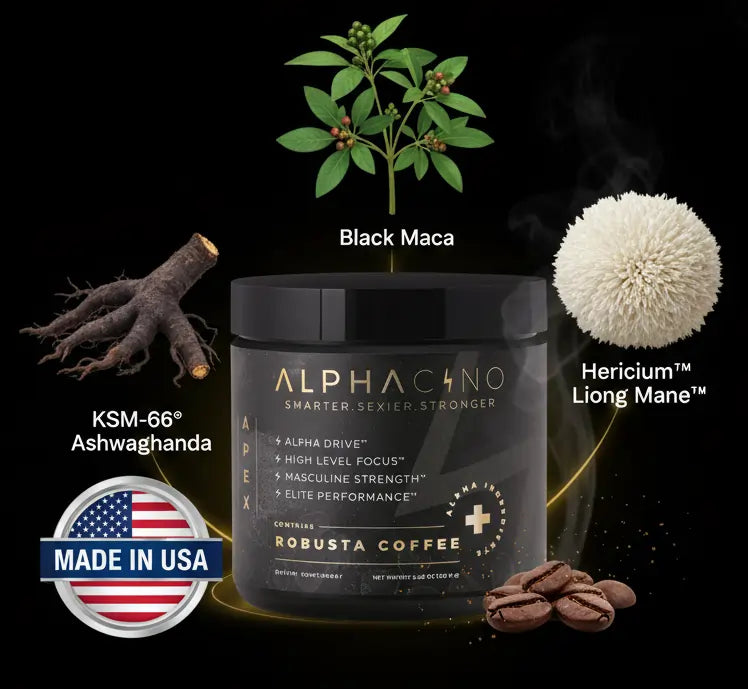
Alphacino ships the stack ready-made: a measured robusta caffeine dose with L-theanine in the same scoop, inside the evidence-backed range, plus Lion's Mane, KSM-66 ashwagandha and black maca for the parts of focus that caffeine does not touch. The full mechanics are in our L-theanine and caffeine guide, and the wider picks in best mushroom coffee for focus.
Frequently asked questions
What is the best L-theanine to caffeine ratio?
There is no single trial-proven ratio. Studies used 1:1 up to about 2.4:1 theanine to caffeine and all showed benefits. The popular 2:1 is a sensible middle of that range, not a magic number.
Does L-theanine cancel out caffeine?
No. In head-to-head trials the combination beat caffeine alone on alertness and attention. Theanine removed side effects, distraction, tiredness and the blood-pressure rise, not the benefit.
How much L-theanine should I take with coffee?
100 to 200 mg alongside a normal cup covers the tested range. Tea alone is too dilute: a cup of green tea has well under 30 mg.
Can you take L-theanine every day?
The trials dosed it daily without notable side effects and it is well tolerated. As with any supplement, check with your doctor if you take medication.
Why do coffee and L-theanine work together?
Caffeine blocks the tiredness signal and raises arousal; theanine independently damps the stress response without sedation. Stacked, you keep the alertness and lose some of the jitter.
This article is general information, not medical advice.
Sources
- Kimura, K., et al. (2007). L-Theanine reduces psychological and physiological stress responses. Biological Psychology, 74(1), 39–45. doi:10.1016/j.biopsycho.2006.06.006
- Owen, G. N., et al. (2008). The combined effects of L-theanine and caffeine on cognitive performance and mood. Nutritional Neuroscience, 11(4), 193–198. doi:10.1179/147683008X301513
- Giesbrecht, T., et al. (2010). The combination of L-theanine and caffeine improves cognitive performance and increases subjective alertness. Nutritional Neuroscience, 13(6), 283–290. doi:10.1179/147683010X12611460764840
- Haskell, C. F., et al. (2008). The effects of L-theanine, caffeine and their combination on cognition and mood. Biological Psychology, 77(2), 113–122. doi:10.1016/j.biopsycho.2007.09.008
- Rogers, P. J., et al. (2008). Time for tea: mood, blood pressure and cognitive performance effects of caffeine and theanine administered alone and together. Psychopharmacology, 195(4), 569–577. doi:10.1007/s00213-007-0938-1