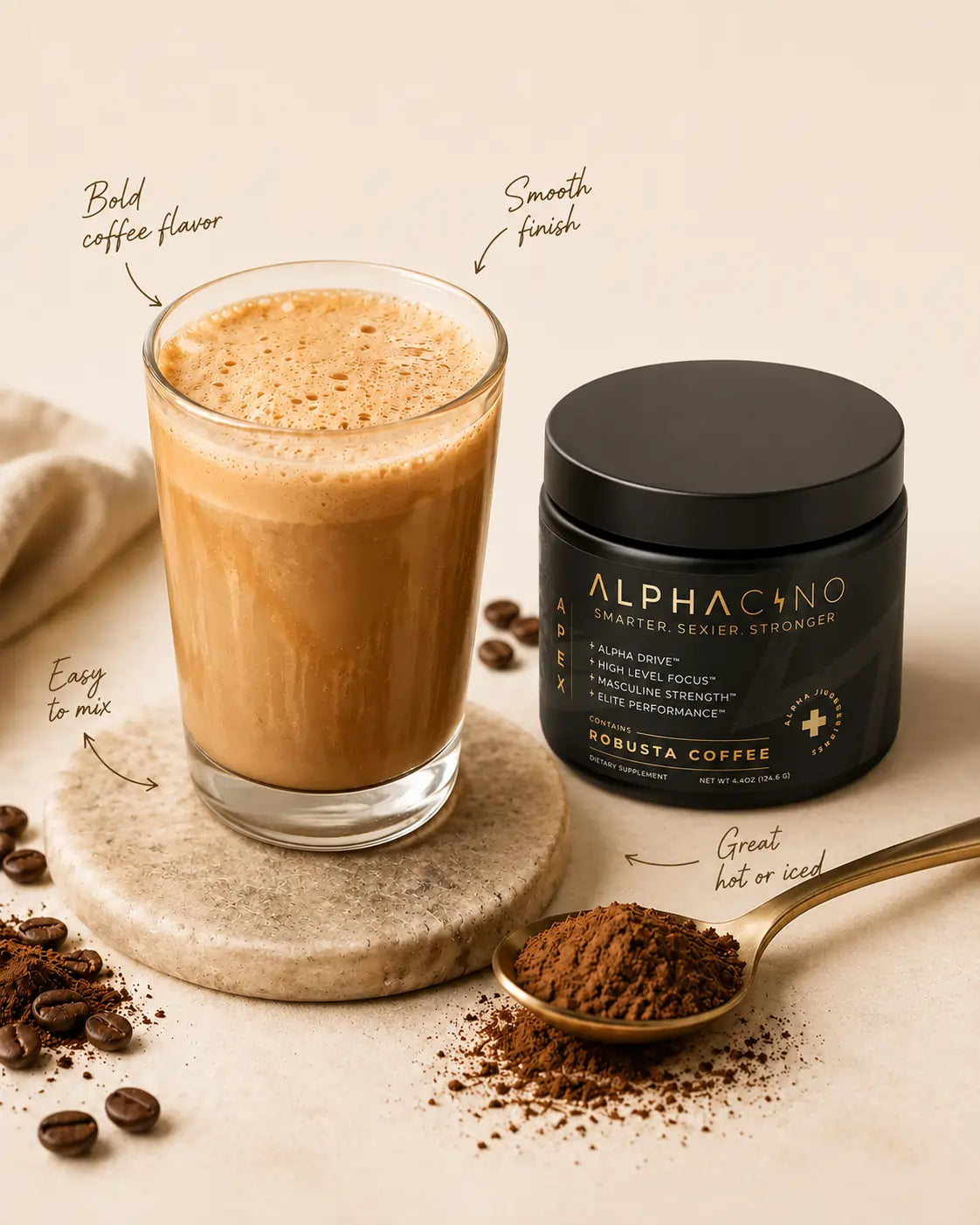
Short answer: robusta is the other coffee. It carries roughly twice the caffeine of arabica, more chlorogenic acid (the main antioxidant in coffee), and a stronger, more bitter cup, which is why cheap robusta gave the bean a bad name and why good robusta is quietly the better base for a functional coffee. Here is what the research says robusta actually offers, where arabica genuinely wins, and why we built Alphacino on it.
Robusta vs arabica: the two beans in one table
| Robusta (Coffea canephora) | Arabica (Coffea arabica) | |
|---|---|---|
| Caffeine | Roughly 1.7–4% of the bean, about double arabica1 | Roughly 0.8–1.4% |
| Chlorogenic acid (antioxidant) | Higher on average2 | Lower on average, though fine arabicas vary |
| Taste | Strong, earthy, more bitter, less sweet | Sweeter, more aromatic, more acidity |
| Crema | More and thicker (why espresso blends use it) | Less |
| Price and hardiness | Cheaper to grow, disease-resistant | Fussier crop, premium pricing |
| Reputation | Historically the budget bean; quality robusta is a recent story | The specialty-coffee default |

The three real benefits of robusta
1. Twice the caffeine per bean
Caffeine is the best-evidenced performance compound in the diet: a large research review concludes it reliably improves alertness, vigilance and reaction time at moderate doses.3 Robusta gets a normal cup to roughly 100 mg without over-extracting or double-scooping, which is exactly the range where benefits show up without the side effects of energy-drink doses. If you want to know where your current cup sits, our caffeine guide has the numbers. What that caffeine does for body weight, with the trial numbers, is in our weight-loss guide.
2. More chlorogenic acid
Chlorogenic acids (CGAs) are the main polyphenols in coffee, and robusta beans carry more of them on average.2 A meta-analysis of randomised trials found CGA intake produced modest reductions in blood pressure,4 and coffee overall is associated with neutral-to-positive health outcomes across the big umbrella reviews.5 None of that makes robusta a supplement on its own; it does make "the cheap bean" a strangely good delivery vehicle for the compounds people drink coffee for.
3. A base that stands up to functional ingredients
This one is practical rather than clinical. Mushroom extracts and adaptogens have flavours of their own. A bold robusta base carries 500 mg of Lion's Mane and 600 mg of ashwagandha without tasting like mushroom tea, where a delicate arabica gets buried. It is the same reason Italian espresso blends have always kept robusta in the mix.
The catch: why robusta got its bad name
Most robusta on the market is commodity-grade, harvested for yield and roasted dark to hide defects, and it tastes like it. The bitterness is partly intrinsic (more caffeine and CGAs, less sugar) and partly quality. Well-processed robusta is a different drink: strong, chocolatey, low-acid, and noticeably easier on sensitive stomachs than a bright arabica. If you have tried instant coffee and hated it, you have probably tasted bad robusta, not robusta. For taking the edge off a strong cup, a splash of milk and a pinch of salt both reduce bitterness, as our mushroom coffee recipes guide explains.
Honesty requires the other column too: arabica carries more trigonelline and more aromatic complexity, and if you drink coffee purely for flavour nuance, a good arabica pour-over is hard to beat. This is a "right tool for the job" question, not a war.

Why Alphacino is built on robusta
We wanted one scoop to do what men actually buy functional coffee for: a real cup's worth of caffeine (about 100 mg), smoothed with an equal 100 mg of L-theanine so the extra strength doesn't turn into jitters, plus Lion's Mane, KSM-66 ashwagandha and black maca at label doses. Robusta makes that possible in a cup that still tastes like strong, smooth coffee, hot or iced. The full breakdown is on the product page, and if you're comparing brands first, our best mushroom coffee for men ranking shows who uses what base.
Frequently asked questions
Is robusta coffee good for you?
It carries the same evidence-backed compounds as any coffee, caffeine and chlorogenic acids, in higher concentrations per bean. The umbrella reviews on coffee and health are broadly reassuring at three to four cups a day.
Does robusta have more caffeine than arabica?
Yes, roughly double: about 1.7 to 4% of the bean versus 0.8 to 1.4% for arabica.
Why is robusta cheaper?
The plant is hardier, higher-yielding and easier to grow at low altitude. Cheap to grow became synonymous with cheap-tasting because of how it was processed, not because of the species itself.
Is robusta easier on the stomach?
It is generally lower in acidity than arabica, and many people with sensitive stomachs find dark, low-acid cups more comfortable. If coffee reliably upsets your stomach, the caffeine dose and drinking it with food matter more than the bean.
Does Alphacino use robusta or arabica?
Robusta, as a premium instant, for the caffeine, the crema-style body, and because it carries the functional ingredients without tasting like mushrooms.
This article is general information, not medical advice.
Sources
- Heckman, M. A., Weil, J., & Gonzalez de Mejia, E. (2010). Caffeine (1,3,7-trimethylxanthine) in foods: a comprehensive review on consumption, functionality, safety, and regulatory matters. Journal of Food Science, 75(3), R77–R87. doi:10.1111/j.1750-3841.2010.01561.x
- Farah, A., & Donangelo, C. M. (2006). Phenolic compounds in coffee. Brazilian Journal of Plant Physiology, 18(1), 23–36. doi:10.1590/S1677-04202006000100003
- McLellan, T. M., Caldwell, J. A., & Lieberman, H. R. (2016). A review of caffeine's effects on cognitive, physical and occupational performance. Neuroscience & Biobehavioral Reviews, 71, 294–312. doi:10.1016/j.neubiorev.2016.09.001
- Onakpoya, I. J., Spencer, E. A., Thompson, M. J., & Heneghan, C. J. (2015). The effect of chlorogenic acid on blood pressure: a systematic review and meta-analysis of randomized clinical trials. Journal of Human Hypertension, 29(2), 77–81. doi:10.1038/jhh.2014.46
- Poole, R., et al. (2017). Coffee consumption and health: umbrella review of meta-analyses of multiple health outcomes. BMJ, 359, j5024. doi:10.1136/bmj.j5024