Short answer: both give you caffeine; almost everything else is different. A typical energy drink delivers 160 to 300 mg of caffeine in one hit, often with 25 to 50 g of sugar, and that combination is exactly what produces the 3 p.m. crash. A good mushroom coffee delivers a normal cup's worth of caffeine (about 100 mg), no sugar, and pairs it with L-theanine and adaptogens that smooth the curve. If you're trying to cut energy drinks without giving up energy, here is the honest comparison and a one-week switch plan.
Energy drinks vs mushroom coffee, side by side
| Typical energy drink | Mushroom coffee (coffee-based) | |
|---|---|---|
| Caffeine per serving | 80 mg (small can) to 200–300 mg (large cans and shots) | 45–100 mg, printed on the label of the good brands |
| Sugar | Often 25–50 g; "sugar-free" versions use sweeteners | None in the cup unless you add it |
| Other actives | Taurine, B vitamins, guarana (more caffeine) | Lion's Mane, adaptogens like ashwagandha, L-theanine |
| Crash profile | Big caffeine spike plus a sugar spike that wear off at different times | Moderate caffeine, no sugar dip; L-theanine flattens the edge |
| Heart and blood pressure | Large servings raised blood pressure and altered ECG readings versus the same caffeine alone in a controlled trial1 | Coffee at normal doses is associated with neutral-to-positive health outcomes in umbrella reviews2 |
| Cost per serving | Roughly $2–4 a can | Roughly $1–2 a cup |

Why energy drinks crash you
The crash has two engines. The first is sugar: a large meta-analysis found that sugar gives no real mood lift but measurably increases fatigue and reduces alertness within the following hour.3 A 50 g can is a dessert's worth of sugar arriving in minutes. The second is the caffeine dose itself: 200 to 300 mg at once produces a stronger spike, and what spikes harder falls harder as the caffeine wears off and the accumulated sleep pressure lands all at once.
Coffee at around 100 mg sits in the range where studies show improved alertness without the side effects that come with the big doses, and pairing it with L-theanine measurably improves attention while reducing the jittery, distractible edge.4 That pairing is the core of the "steady energy" claim, and it is one of the few with direct trial evidence. Where 100 mg sits against the daily ceiling and the single-dose line, with every common dose in cups, is in is 100, 200 or 400 mg of caffeine a lot. The other claims on a mushroom coffee label are held to the same standard in mushroom coffee benefits, checked against the trials.
What you lose and what you keep when you switch
- You keep the alertness. Caffeine is caffeine; 100 mg in coffee works the way 100 mg in a can does, minus the sugar swing.
- You lose the ritual of the cold can. Not trivial. Mushroom coffee works iced, which is the practical substitute; our taste guide covers it.
- You lose the taurine and B vitamins. Neither has convincing evidence for energy in people eating normally.
- You gain the slow ingredients. Lion's Mane and ashwagandha are daily-use compounds with small but real trials behind them for focus and stress; see our lion's mane coffee guide and KSM-66 guide.
The one-week switch plan
- Days 1–2: replace your first can of the day with a cup of mushroom coffee (hot or iced). Keep any later can for now; going cold turkey from 400 mg to 100 mg a day invites withdrawal headaches.
- Days 3–4: replace the second can with a second cup before 2 p.m., or a caffeine-free drink if you're sensitive. Total caffeine is now roughly halved.
- Days 5–7: one to two cups a day, nothing after 2 p.m. Expect a day or two of mild fog if you were on big doses; it passes.
- Keep the sleep. The point of the switch is not purity, it is that lower, earlier caffeine protects sleep, and sleep is where the energy actually comes from. Our timing guide has the details.
Where Alphacino fits
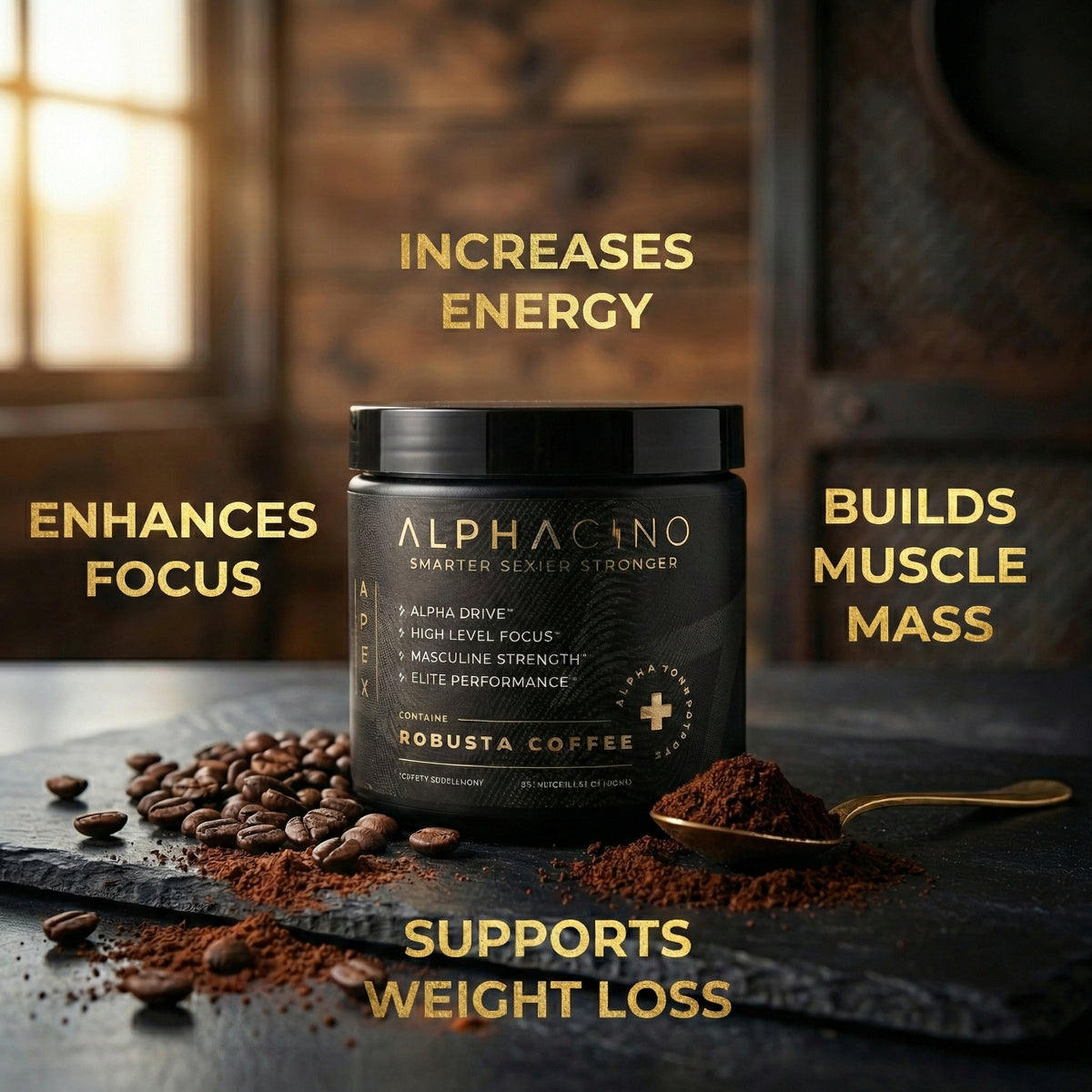
Alphacino was built for exactly this switch: real robusta coffee with about 100 mg of caffeine, 100 mg of L-theanine to smooth it, 500 mg Lion's Mane, 600 mg KSM-66 ashwagandha and black maca, no sugar, 10 calories, and every dose printed on the tin. It works hot or iced, and it comes with a 60-day money-back guarantee, which matters because the adaptogen half of the formula is judged over weeks, not days. If you want to compare options first, start with our best mushroom coffee for energy ranking.
Frequently asked questions
Is mushroom coffee better than energy drinks?
For steady energy and sleep, yes: normal-cup caffeine, no sugar, and L-theanine beat a 200 mg spike plus 40 g of sugar. For a maximum short-term jolt, a large energy drink is stronger; that jolt is also the crash.
Does mushroom coffee give you energy like an energy drink?
It gives you the same active ingredient, caffeine, at a moderate dose. Most people switching notice less of a peak and much less of a trough.
Can I quit energy drinks with mushroom coffee?
Yes; swap one can at a time over a week rather than stopping all caffeine at once, which causes withdrawal headaches.
How much caffeine is in mushroom coffee vs an energy drink?
Coffee-based mushroom blends run 45–100 mg per cup. Energy drinks run 80 mg for a small can to 200–300 mg for large cans and shots.
Are energy drinks bad for your heart?
In a controlled trial, large-volume energy drinks changed ECG readings and raised blood pressure compared with the same caffeine alone, which suggests the issue is not just the caffeine. People with heart conditions should be cautious with them.
This article is general information, not medical advice.
Sources
- Shah, S. A., et al. (2019). Impact of high volume energy drink consumption on electrocardiographic and blood pressure parameters: a randomized trial. Journal of the American Heart Association, 8(11), e011318. doi:10.1161/JAHA.118.011318
- Poole, R., et al. (2017). Coffee consumption and health: umbrella review of meta-analyses of multiple health outcomes. BMJ, 359, j5024. doi:10.1136/bmj.j5024
- Mantantzis, K., et al. (2019). Sugar rush or sugar crash? A meta-analysis of carbohydrate effects on mood. Neuroscience & Biobehavioral Reviews, 101, 45–67. doi:10.1016/j.neubiorev.2019.03.016
- Haskell, C. F., et al. (2008). The effects of L-theanine, caffeine and their combination on cognition and mood. Biological Psychology, 77(2), 113–122. doi:10.1016/j.biopsycho.2007.09.008