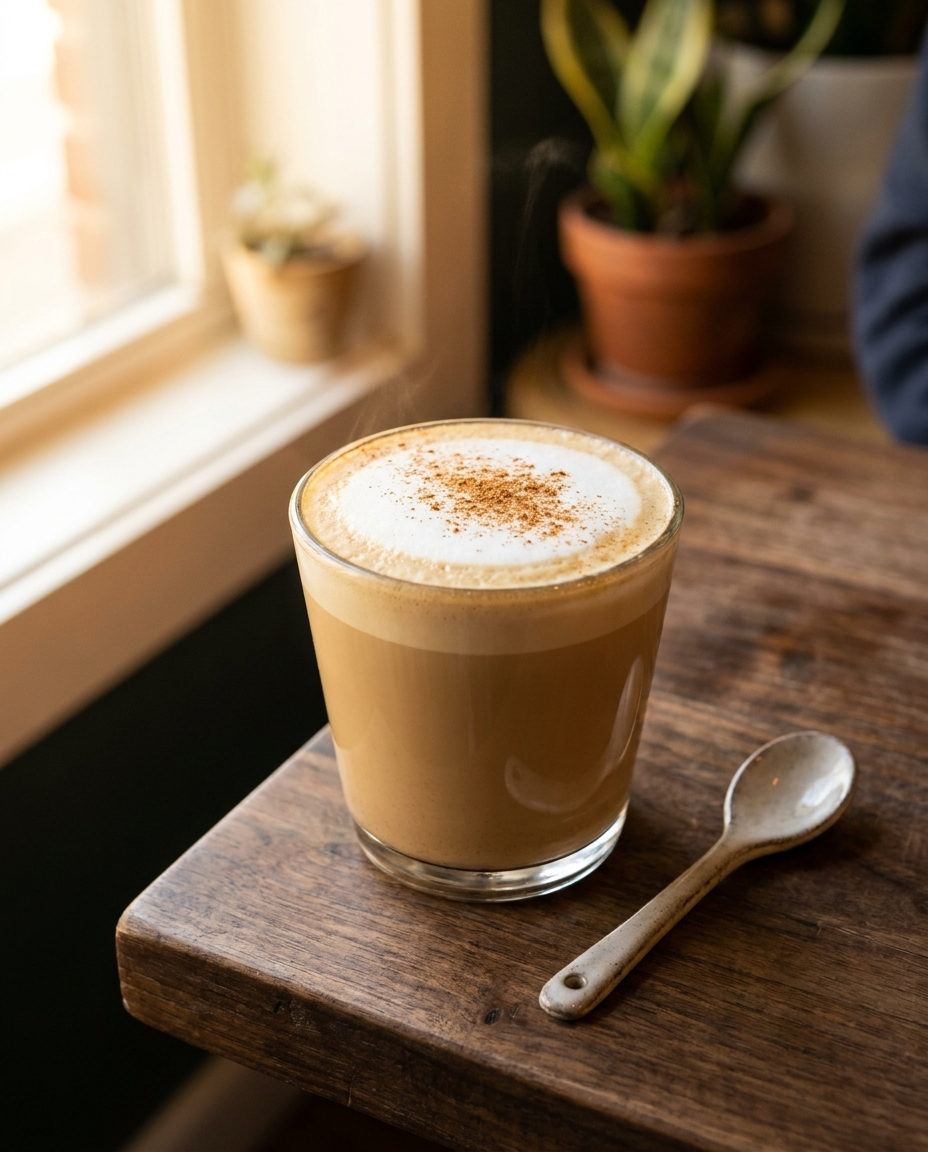
Short answer: yes. Unless the label says decaf or the drink is not coffee at all, mushroom coffee has caffeine, because it is coffee with mushroom extract stirred in, and every milligram comes from the coffee. How much depends entirely on the brand: 45 mg in an Everyday Dose Mild stick, about 70 mg in a BodyBrain or Cuppa sachet, 100 mg in a scoop of Alphacino, a regular brewed cup's worth in a Four Sigmatic ground coffee, and roughly a seventh of a coffee in a MUD\WTR, which is cacao rather than coffee12. For scale, an 8 oz cup of brewed coffee is about 95 mg1. The mushrooms add nothing: lion's mane, chaga, cordyceps and reishi do not make caffeine2. Below: the number for each brand as printed on its own page, why most blends land at half a coffee, what "decaf" and "caffeine-free" actually mean, whether a smaller dose matters, and how to pick the right one for you.
Does mushroom coffee have caffeine?
Yes, with two exceptions. Mushroom coffee is ordinary coffee, usually instant, blended with dried mushroom extract. The coffee brings the caffeine; the extract brings none. So the question "does mushroom coffee have caffeine" has the same answer as "does coffee have caffeine", and the only real question is how much coffee the brand put in the scoop. The first exception is a product labelled decaf, which is made from decaffeinated coffee and carries a few milligrams rather than none, as the decaf section below explains4. The second is a product that is not coffee at all: MUD\WTR's original blend is cacao and chai spices with mushrooms, and cacao carries a little caffeine of its own, which is why its maker describes it as a seventh of a coffee rather than zero12. Chicory and rooibos "mushroom coffees" are the true zeros.
The range across the brands people actually search for runs from about 14 mg to about 100 mg a serving, against 95 mg for an 8 oz brewed coffee and 63 mg for a single espresso shot1. Most sit at half a coffee or less, which is a design decision rather than an accident, and the brand table is the place to start.
How much caffeine is in mushroom coffee? By brand
Every figure below is what the brand prints on its own product page, read on the date given, with a brewed 8 oz coffee at 95 mg as the yardstick1,12. Where a brand prints a phrase instead of a number, the phrase is quoted and the number is left blank rather than guessed.
| Brand and product | What it is | Caffeine per serving, as printed | Against a 95 mg brewed cup |
|---|---|---|---|
| Everyday Dose Coffee+ Mild | Cold brew coffee extract with lion's mane, chaga, collagen and theanine | 45 mg (14 Sep 2026) | About half |
| Everyday Dose Coffee+ Medium | Same blend, stronger coffee | 90 mg (14 Sep 2026) | About a full cup |
| RYZE Mushroom Coffee | Organic instant arabica with six mushrooms, coconut milk powder and MCT | "Less than half the caffeine of regular coffee" (14 Sep 2026); 48 mg medium roast and 80 to 90 mg dark roast as read on RYZE's site on 10 Sep 2026 | Half for the medium roast; near a cup for the dark |
| BodyBrain Coffee | Freeze-dried Colombian instant with Tongkat Ali, ashwagandha, lion's mane and theanine | "Approximately 70 mg" (14 Sep 2026) | About three quarters |
| Cuppa | Arabica with lion's mane, cordyceps, KSM-66 and theanine | About 70 mg (label read 7 Sep 2026) | About three quarters |
| Four Sigmatic Focus Ground Coffee | Organic ground coffee with lion's mane; brewed like any coffee | Not printed as a number; it is a regular brewed cup. The range also has Half Caf, Focus Max High Caf, Think Hi-Caf and decaf lines (14 Sep 2026) | A full cup, or half, or more, by line |
| MUD\WTR Original | Cacao, chai spices and four mushrooms; not coffee | "1/7th the caffeine of coffee" (14 Sep 2026); about 14 mg on a 95 mg cup. Its :rest and turmeric blends are printed as zero caffeine | About a seventh |
| Alphacino | Robusta instant with lion's mane, KSM-66 ashwagandha, black maca, S7 and theanine | 100 mg (label) | A full cup |
Three things stand out. First, the brands split into two camps: the half-caf camp (Everyday Dose Mild, RYZE medium, MUD\WTR) and the full-cup camp (Alphacino, Everyday Dose Medium, RYZE dark, Four Sigmatic). Second, the number is often not printed at all; RYZE's product page gives a phrase, and Four Sigmatic sells its coffee as coffee and leaves the milligrams to your brewing. Third, the same brand can span the whole range: Everyday Dose doubles between Mild and Medium, RYZE nearly doubles between roasts, and Four Sigmatic runs from decaf to "Hi-Caf". If a search brought you here for one brand, the RYZE question in particular has its own page, the RYZE review, and BodyBrain's label is read line by line in the BodyBrain review.

Do the mushrooms add any caffeine?
No. Caffeine is a plant alkaloid made by a short list of plants: coffee, tea, cacao, yerba mate, guarana and kola. The biochemistry review that maps how it is built lists the caffeine-producing genera as Camellia (tea), Coffea (coffee), Theobroma (cacao) and Ilex (mate)2. Fungi are not on the list. Lion's mane, chaga, cordyceps, reishi, turkey tail and shiitake contain no caffeine, which is why a "mushroom blend" sold without coffee, like Four Sigmatic's Focus or Calm blends, is printed as caffeine-free12. It also means the mushroom extract cannot cancel caffeine out. If a 48 mg cup feels gentler than a 95 mg cup, that is because it is 48 mg, not because lion's mane did something to the caffeine.
The one ingredient that does bring caffeine of its own is cacao, which is why MUD\WTR is not zero, and why a mocha-flavoured mushroom coffee carries a few milligrams more than the plain version. What lion's mane does bring, on its own clock of weeks rather than minutes, is in lion's mane benefits for men.
Why most mushroom coffee is low-caffeine
A scoop or a stick pack has a fixed weight, and most of it is instant coffee. To fit a gram or two of mushroom extract, a creamer, some collagen or a fibre blend into the same stick, the brand takes coffee out. Less coffee is less caffeine, and the half-caf result is then marketed as the point: "less than half the caffeine of regular coffee" is RYZE's line, and "80% less caffeine than a cup of coffee" is Everyday Dose's for its matcha12. For the people who feel wired on a normal cup, that is a genuine feature. For everyone else it is a smaller dose of coffee at a higher price per milligram.
Instant coffee itself is on the lighter side. USDA's figure for a prepared cup of instant coffee is 62 mg per 8 oz, against 95 mg for brewed, because a teaspoon of instant powder is less coffee than a scoop of grounds1. The bean choice moves the number too. In a comparison of two arabica and two robusta coffees at three roast levels, the robusta sample had the highest caffeine content of all, and caffeine fell as roasting intensified3. That is why Alphacino, built on robusta, reaches a full 100 mg from a single instant scoop while carrying 1.4 g of other ingredients, and why a dark roast is not the strong one; the detail is in the robusta post.
Mushroom coffee caffeine vs regular coffee, tea and energy drinks
The comparison most people want is with the drink they would otherwise have. USDA's analytical figures, converted to the servings people buy, put the mushroom coffees in context1.
| Drink | Serving | Caffeine |
|---|---|---|
| Brewed coffee | 8 oz | 95 mg |
| Brewed coffee | 16 oz | 189 mg |
| Espresso | Single shot | 63 mg |
| Instant coffee, prepared | 8 oz | 62 mg |
| Full-caffeine mushroom coffee (Alphacino, Everyday Dose Medium) | 1 serving | 90 to 100 mg |
| Three-quarter mushroom coffee (BodyBrain, Cuppa) | 1 serving | About 70 mg |
| Half-caf mushroom coffee (RYZE medium, Everyday Dose Mild) | 1 serving | 45 to 48 mg |
| Black tea | 8 oz | 47 mg |
| Green tea | 8 oz | 29 mg |
| Cola | 12 oz can | 33 mg |
| MUD\WTR Original | 1 serving | About 14 mg, by its "1/7th of coffee" description |
| Energy drink | 16 oz can | 137 to 156 mg |
Read down the table and the half-caf mushroom coffees land on black tea, the three-quarter ones between tea and espresso, and the full-caffeine ones on a brewed cup. A large coffee-shop pour at 16 oz is nearly two of any of them, which matters for the sleep arithmetic later. Where each of these doses sits against the daily and single-dose safety lines, with an "is it a lot?" row for every number from 15 to 400 mg, is the job of how much caffeine is too much; this page stays on the mushroom coffees.
Is there caffeine-free mushroom coffee? Decaf is not zero
There are three different things sold under that phrase, and they are not the same. The first is decaf mushroom coffee: real coffee with most of the caffeine removed, then blended with mushrooms. Four Sigmatic sells its Focus blend as decaf pods and a decaf Calm ground coffee12. Decaf is not caffeine-free. When ten decaffeinated coffees from different outlets were measured, they contained 0 to 13.9 mg of caffeine per 16 oz serving, and six decaf espresso shots from one outlet ranged from 3.0 to 15.8 mg a shot4. Small, but not nothing, and for someone told to avoid caffeine entirely, it counts.
The second is a mushroom drink that was never coffee. RYZE's Mushroom Chicory is printed as zero caffeine, MUD\WTR's :rest rooibos blend and its turmeric blend are printed as zero, and Four Sigmatic's mushroom blends and elixirs are sold as caffeine-free powders to add to whatever you drink12. These are the true zeros. The third is the low-caffeine cup that gets called caffeine-free in conversation: MUD\WTR's original cacao blend at a seventh of a coffee, or a 45 mg Mild stick. Those are low, not free.
Which one you want depends on why. If the goal is sleep, the meta-analysis below says even a 107 mg cup needs 8.8 hours before bed, so a 14 mg cacao drink in the evening is a reasonable trade and a 45 mg coffee at 6 pm is not8. If the goal is to cut caffeine altogether, only the chicory, rooibos and turmeric lines and the coffee-free mushroom powders do it, and the morning lift goes with it: what you feel on day one from a mushroom coffee is the caffeine, and the mushrooms and adaptogens work on a clock of weeks. If you are cutting down rather than out, be aware that withdrawal is real even from modest habits. In the review that validated the symptoms, headache, fatigue and difficulty concentrating began 12 to 24 hours after stopping, peaked at 20 to 51 hours and lasted 2 to 9 days, and the severity rose with the daily dose11. Stepping from a 95 mg cup to a 45 mg stick for a week before going to zero is the gentler route.

Does mushroom coffee have less caffeine than regular coffee, and does it matter?
Usually yes, and whether it matters depends on what the cup is for. Three trial figures put the dose in perspective. For alertness and attention, the caffeine and theanine pairing that most mushroom coffees use was tested at 150 mg of caffeine with 250 mg of theanine, and the combination produced faster reaction time, better accuracy on a sustained-attention task and lower "tired" and "headache" ratings than either alone10. A 100 mg cup with 100 mg of theanine is in the neighbourhood of that; a 45 mg cup is a third of the caffeine the trial used. For training, the sports-nutrition position stand puts the effective dose at 3 to 6 mg per kilogram of body weight, with a possible floor around 2 mg per kg7. For an 80 kg man that floor is 160 mg, so even a full-caffeine mushroom coffee is a light pre-workout and a half-caf one is a warm drink; the honest version of that is in mushroom coffee for the gym. For sleep, every milligram counts against you: caffeine cut total sleep time by 45 minutes and deep sleep by 11 minutes across 24 studies, and a 107 mg cup should be at least 8.8 hours before bed8.
So a lower dose matters in both directions. It buys you an earlier last-cup time and a smaller afternoon dip, and it costs you most of the alertness and all of the training effect. The mistake to avoid is the one the half-caf cup invites: drinking two or three of them to get the lift back, at which point you have paid for three sticks to reach the caffeine of one coffee, and you have pushed the last dose later into the day. If the jitters are the reason you want less, the theanine pairing is the lever to look at before the milligram count; how the ratio works is in the L-theanine to caffeine ratio, and the jitters themselves in mushroom coffee and jitters.
How much caffeine is right for you?
For a healthy adult, up to 400 mg a day and up to 200 mg in one sitting is the line drawn by both the European food safety authority and a systematic review of the adverse-effect literature5,6. In mushroom coffees, that is four full-caffeine cups or eight half-caf sticks a day, and two full cups or four sticks at once. The pregnancy line is lower, 200 mg a day5, which is two half-caf sticks and a small margin, or one Alphacino.
The line that catches most people first is bedtime, not the daily total. The half-life of caffeine averages four to six hours but runs from 1.5 to 10 hours between individuals7, and in the home study a 400 mg dose taken six hours before bed still cut sleep9. The cut-off scales with the dose, which is where the brand number earns its keep. For an 11 pm bedtime, a 100 mg cup is a 2 pm cut-off by the meta-analysis figure; a 45 mg stick has no trial-derived cut-off, but the six-hour floor from the home study makes 5 pm the latest sensible hour, and earlier if you are a slow metaboliser8,9. The full timing rules, by goal, are in when to drink mushroom coffee, and how many cups a day each brand allows is run through in how much mushroom coffee a day.
Two practical rules. Read the milligrams on the pack, not the word "mushroom" on the front, because the two tell you nothing about each other. And count the cup you are replacing: if you are switching from a 16 oz coffee-shop pour at 189 mg to a 45 mg stick, you have cut your dose by three quarters, and the first week will feel like it, which is withdrawal rather than the mushrooms11.

How much caffeine is in Alphacino?
100 mg a scoop, from robusta instant coffee, matched with 100 mg of L-theanine. We chose the full cup on purpose. The functional ingredients in the scoop, 600 mg of KSM-66 ashwagandha, 500 mg of lion's mane extract, 224 mg of black maca extract and the S7 blend, work over weeks, and we did not want to sell a coffee that asks you to give up the coffee to get them. Robusta is how a single instant scoop reaches 100 mg with room for 1.4 g of other ingredients3. The theanine is why 100 mg feels steadier than the same dose from a plain cup, in the pairing's trial, faster reaction time and fewer "tired" ratings than caffeine alone10.
What that means in practice: one scoop is one coffee, two scoops is 200 mg and the single-dose line, four scoops is the daily line, and the last scoop for an 11 pm bedtime is around 2 pm5,8. It is not the right cup for someone cutting caffeine; Everyday Dose Mild, RYZE's medium roast or a cacao drink are the honest answers there, and we say so in the best mushroom coffee for men, where all seven brands are ranked on their printed doses. Black, it is 5 to 10 calories, which is why it holds a fast; the detail is in does mushroom coffee break a fast. The label itself is on the product page.
Frequently asked questions
Does mushroom coffee have caffeine?
Yes, unless it is labelled decaf or is not coffee at all. The caffeine comes from the coffee in the blend; the mushrooms add none. Brands print anywhere from 45 mg (Everyday Dose Mild) to 100 mg (Alphacino) a serving, against 95 mg in an 8 oz brewed coffee.
How much caffeine is in mushroom coffee?
By brand, as printed on 14 September 2026: Everyday Dose 45 mg Mild and 90 mg Medium; BodyBrain about 70 mg; Cuppa about 70 mg; RYZE "less than half the caffeine of regular coffee", 48 mg medium roast as read on 10 September; Four Sigmatic ground coffee a regular brewed cup, with half-caf, high-caf and decaf lines; Alphacino 100 mg. MUD\WTR's cacao blend is about a seventh of a coffee.
Does RYZE mushroom coffee have caffeine?
Yes. RYZE's product page says "less than half the caffeine of regular coffee", and its site put the medium roast at 48 mg and the dark roast at 80 to 90 mg when we read it on 10 September 2026. RYZE's Mushroom Chicory is printed as zero caffeine.
Is there a caffeine-free mushroom coffee?
Not a coffee, strictly. Decaf mushroom coffee still carries a few milligrams, measured at 0 to 13.9 mg per 16 oz in decaf coffees. The true zeros are the coffee-free mushroom drinks: chicory, rooibos and turmeric blends, and mushroom powders sold without coffee.
Does lion's mane have caffeine?
No. Caffeine is made by coffee, tea, cacao, mate, guarana and kola plants, not by fungi. Lion's mane, chaga, cordyceps and reishi contain none, and a mushroom blend sold without coffee is caffeine-free.
How much caffeine is in Alphacino?
100 mg a scoop from robusta instant coffee, paired with 100 mg of L-theanine. One scoop is one brewed coffee; two scoops reach the 200 mg single-dose line.
Can I drink two cups of mushroom coffee a day?
For a healthy adult, yes at any of these doses: two full-caffeine cups are about 200 mg, half the 400 mg daily line. The limit that bites first is bedtime: a 100 mg cup needs about 8.8 hours before sleep, so keep the second cup before 2 pm for an 11 pm bedtime.
Sources
- U.S. Department of Agriculture, Agricultural Research Service (2018). SR Legacy, via FoodData Central: brewed coffee (fdcId 171890), espresso (171891), instant coffee prepared (174130), black tea (173227), green tea (171917), cola (174852), Red Bull (173210), Rockstar (171937) and Full Throttle (174172) energy drinks. Serving values calculated from the per-100 g figures and USDA portion weights. fdc.nal.usda.gov
- Ashihara, H., Sano, H., & Crozier, A. (2008). Caffeine and related purine alkaloids: biosynthesis, catabolism, function and genetic engineering. Phytochemistry, 69(4), 841 to 856. doi:10.1016/j.phytochem.2007.10.029
- Hečimović, I., Belščak-Cvitanović, A., Horžić, D., & Komes, D. (2011). Comparative study of polyphenols and caffeine in different coffee varieties affected by the degree of roasting. Food Chemistry, 129(3), 991 to 1000. doi:10.1016/j.foodchem.2011.05.059
- McCusker, R. R., Fuehrlein, B., Goldberger, B. A., Gold, M. S., & Cone, E. J. (2006). Caffeine content of decaffeinated coffee. Journal of Analytical Toxicology, 30(8), 611 to 613. doi:10.1093/jat/30.8.611
- EFSA Panel on Dietetic Products, Nutrition and Allergies (2015). Scientific opinion on the safety of caffeine. EFSA Journal, 13(5), 4102. doi:10.2903/j.efsa.2015.4102
- Wikoff, D., et al. (2017). Systematic review of the potential adverse effects of caffeine consumption in healthy adults, pregnant women, adolescents, and children. Food and Chemical Toxicology, 109, 585 to 648. doi:10.1016/j.fct.2017.04.002
- Guest, N. S., et al. (2021). International Society of Sports Nutrition position stand: caffeine and exercise performance. Journal of the International Society of Sports Nutrition, 18, 1. doi:10.1186/s12970-020-00383-4
- Gardiner, C., et al. (2023). The effect of caffeine on subsequent sleep: a systematic review and meta-analysis. Sleep Medicine Reviews, 69, 101764. doi:10.1016/j.smrv.2023.101764
- Drake, C., Roehrs, T., Shambroom, J., & Roth, T. (2013). Caffeine effects on sleep taken 0, 3, or 6 hours before going to bed. Journal of Clinical Sleep Medicine, 9(11), 1195 to 1200. doi:10.5664/jcsm.3170
- Haskell, C. F., Kennedy, D. O., Milne, A. L., Wesnes, K. A., & Scholey, A. B. (2008). The effects of L-theanine, caffeine and their combination on cognition and mood. Biological Psychology, 77(2), 113 to 122. doi:10.1016/j.biopsycho.2007.09.008
- Juliano, L. M., & Griffiths, R. R. (2004). A critical review of caffeine withdrawal: empirical validation of symptoms and signs, incidence, severity, and associated features. Psychopharmacology, 176(1), 1 to 29. doi:10.1007/s00213-004-2000-x
- Brand product pages, read on the dates stated: Everyday Dose (14 Sep 2026), RYZE (14 Sep and 10 Sep 2026), BodyBrain (14 Sep 2026), Four Sigmatic (14 Sep 2026), MUD\WTR (14 Sep 2026), and the Cuppa label (7 Sep 2026). Figures can change; check the pack before you buy.