Short answer: Everyday Dose Coffee+ is a real, fully listed product: a frothed instant drink built on cold brew coffee extract with 45 mg of caffeine in the Mild version and 90 mg in the Medium roast, 1,500 mg of fruiting-body lion's mane and chaga combined, 4 g of grass-fed collagen and 150 mg of L-theanine, at $45 for 30 servings, which is $1.50 a cup1. Read against the trials, the theanine is the best-supported line on the label: 100 mg of theanine with 50 mg of caffeine improved attention in a trial that looks very like this cup6. The mushrooms are a combined figure with no split, so nobody can say how much lion's mane is in it; the lion's mane trial used 3 g a day3, and chaga has no human trial at any dose. The collagen sits at the dose that improved skin elasticity in women8, not the dose that built muscle in men9. If you are choosing between RYZE and Everyday Dose, the head-to-head is below, label to label, and so is the comparison with Alphacino, which is a different kind of cup. Everything here is read from each brand's own product listing on 17 September 2026, and the page says where Everyday Dose wins as plainly as where it does not.
Comparing Everyday Dose? Alphacino at a glance
| Everyday Dose | Alphacino | |
|---|---|---|
| The cup | Small frothed latte | Black coffee, any size |
| Caffeine | 45 mg (Mild) or 90 mg (Medium) | 100 mg |
| Lion's mane | In 1,500 mg with chaga, split not printed | 500 mg, on its own line |
| Ashwagandha | None | 600 mg KSM‑66 |
| Collagen | 4 g | None |
| Price a cup | $1.50 | $1.67, or $1.50 in the 3 pack |
Pick Everyday Dose if you are cutting caffeine and want a creamy latte with collagen. Pick Alphacino if you want a real coffee that still feels like coffee, carrying the men's ingredients at the doses their trials used.
60‑day money-back guarantee. We make Alphacino; every figure here is from each brand's own label.
What is Everyday Dose mushroom coffee?
Everyday Dose sells Coffee+ as a scoop-and-froth powder: one scoop whisked into 4 to 6 oz of water makes a small, creamy, latte-style cup rather than a mug of black coffee1. The coffee in it is a cold brew coffee extract, which the brand describes as low-acidity, and it comes in two strengths: the original Mild blend at 45 mg of caffeine a serving and a Medium roast at 90 mg. The brand's own summary of the formula is "functional mushrooms, collagen protein, and nootropics", and its pitch is aimed at people who want to drink less coffee rather than more: "the fastest growing alternative to regular coffee and stimulants" and "it's coffee, but better"1.
The range has grown around that core. On the day we read the store it listed a 30-serving bag at $45, a 60-serving pack at $90 and a 90-serving quarterly pack at $135, a 15-serving trial bag at $23, single-serve To-Go sticks at $15 for ten, a Protein Coffee+ with 10 g of whey per packet, a mushroom matcha sold on "80% less caffeine than a cup of coffee", and a separate collagen peptides powder1. At $45 for 30 the coffee is $1.50 a cup, the same per-cup price as RYZE's list price and 17 cents under Alphacino. One thing we could not read: Everyday Dose's refund terms. Its policy pages block automated reading, so check the guarantee on the site before you order rather than taking a number from any review, including this one.
Everyday Dose ingredients: the label, line by line
The listing gives four active lines per serving and a phrase for each1. The table adds what the label does not say, because that decides what each line can do.
| Line | Per serving | What the listing says | What the label does not say |
|---|---|---|---|
| Lion's mane and chaga | 1,500 mg combined | "Fruiting body"; an older listing adds "double extracted and 100% fruiting body" | The split between the two mushrooms; the extract ratio |
| Collagen | 4 g | "Grass-fed collagen (amino acids)" | The source animal on the coffee listing (the brand's separate collagen product is bovine) |
| L-theanine | 150 mg | "From Japan (reduce anxiety)" | Nothing missing; a clear dose |
| Cold brew coffee extract | 45 mg caffeine (Mild); 90 mg (Medium roast) | "A hint of low-acidity cold brew coffee extract" | The weight of coffee; whether the Medium roast changes anything but the caffeine |
Credit where it is due. Everyday Dose prints milligrams, names fruiting body rather than mycelium, and gives a caffeine figure, which puts it ahead of most of the category on disclosure; several rivals print a phrase where the caffeine number should be, as our caffeine-by-brand guide shows. The gap is the mushroom line. "1,500 mg of lion's mane and chaga" could be 1,400 mg of chaga and 100 mg of lion's mane, or the reverse, and the two mushrooms have completely different evidence behind them, so the one number that would let you judge the cup is the one that is not printed.

Does Everyday Dose work? Each dose against the trials
The listing promises "Zen-like focus that lasts way longer than a normal coffee", "all-day energy", "unleash your creativity", "better sleep" and "gut health / better digestion"1. The fair way to test that is one ingredient at a time, at the printed amount, against the best human trial for it.
| Ingredient | Everyday Dose | What the trial used, and found | Read |
|---|---|---|---|
| L-theanine with caffeine | 150 mg with 45 mg caffeine | 100 mg theanine with 50 mg caffeine in 27 volunteers: faster and more accurate attention-switching at 60 minutes and less distraction at 60 and 90 minutes than caffeine alone6. 250 mg with 150 mg: faster reaction time, better attention accuracy, fewer "tired" and "headache" ratings7 | The best line on the label. The Mild cup is almost exactly the low-dose trial |
| L-theanine alone, daily | 150 mg a day | 200 mg a day for 4 weeks in 30 healthy adults: trait anxiety, depression and sleep-quality scores improved, with shorter sleep latency than placebo10 | Three quarters of the dose; the "reduce anxiety" and "better sleep" claims have a trial behind them in direction |
| Lion's mane | Part of 1,500 mg, split unstated | 3 g a day of dried fruiting body for 16 weeks in 30 adults aged 50 to 80 with mild cognitive impairment: cognitive scores above placebo from week 8, falling back within 4 weeks of stopping3 | Even if the whole 1,500 mg were lion's mane, it is half the trial's weight; a double extract narrows the gap by an unstated ratio |
| Chaga | Part of 1,500 mg, split unstated | No human trial we could find at any dose. The human literature is two case reports of kidney injury from chaga powder at 10 to 15 g a day for three months4 and over years5 | No benefit evidence; a safety note below |
| Collagen | 4 g | 2.5 or 5 g a day of collagen peptides for 8 weeks in 69 women aged 35 to 55: skin elasticity significantly better than placebo8. 15 g a day with 12 weeks of resistance training in 53 men aged about 72 with sarcopenia: more fat-free mass and strength than placebo9 | In the skin trial's range; about a quarter of the muscle trial's dose |
| Caffeine | 45 mg (Mild), 90 mg (Medium) | 200 mg is the single-dose line and 400 mg the daily line for healthy adults11 | A quarter of the single-dose line in the Mild cup; under half in the Medium |
So the honest answer to "does Everyday Dose work" is that the theanine and caffeine pairing works, and the low-dose trial says it works at almost exactly this ratio6. The collagen does what 4 g of collagen does, which in the trials is skin, not muscle8,9. The mushrooms are present at an amount nobody can judge, because the split is not printed. Of the five promises on the listing, "focus" has a trial behind it, "better sleep" has one in direction at a higher theanine dose10, and "all-day energy", "creativity" and "gut health" have no trial for any of these ingredients at these doses that we could find. "Lasts way longer than a normal coffee" is a claim about duration, and no trial we found measured it. What the lion's mane trial actually showed, and what a coffee dose of it can and cannot do, is in lion's mane benefits for men.
How much caffeine is in Everyday Dose, and how does it compare with coffee?
45 mg a serving in the Mild blend and 90 mg in the Medium roast, by the brand's own figures1. An 8 oz cup of brewed coffee is about 95 mg and a single espresso 63 mg2, so the Mild cup is just under half a coffee, about the caffeine of a black tea, and the Medium roast is a full cup. The older "80% less caffeine than a cup of coffee" line on the brand's pages assumes a large cup; against the standard 95 mg it is 53% less. Against RYZE's 48 mg medium roast, the Mild blend is level, and the Medium roast is close to RYZE's 80 to 90 mg dark roast12.
Two things follow. The Mild cup is the right dose for someone cutting caffeine or sensitive to it: it is inside the range the low-caffeine theanine trial used, and it sits far under the 200 mg single-dose line6,11. It is the wrong dose for someone who drinks coffee for the lift, because 45 mg is about a third of what the strong theanine trial used and a quarter of the single-dose line, and the temptation is to drink three, at which point the price per cup has tripled. On timing, the sleep meta-analysis gives an 8.8-hour cut-off before bed for a 107 mg cup, so the Medium roast is a 2 pm drink for an 11 pm bedtime; the Mild cup has no trial-derived cut-off and six hours is the sensible floor13. Where every dose from 15 to 400 mg sits, with the arithmetic, is in how much caffeine is too much.
Everyday Dose side effects
Everyday Dose is a mild product and most people will notice nothing but the cup. Four things are worth knowing, and one of them is specific to this formula.
Chaga and the kidneys. Chaga is unusually high in oxalate. In a 2020 report, a 49-year-old man developed end-stage kidney disease after years of taking chaga powder for a skin condition; the powder he had been taking was measured at 14.2 g of oxalate per 100 g5. In a 2022 report, a 69-year-old man developed acute oxalate nephropathy after three months of 10 to 15 g of chaga powder a day with vitamin C, and recovered with treatment4. Those doses are ten to twenty times anything a coffee scoop could hold, and extraction changes the oxalate figure, so this is not an alarm about a 45 mg latte. It is a reason to want the lion's mane and chaga split printed, and a reason for anyone with a history of kidney stones or kidney disease to ask a doctor before making a chaga drink a daily habit. The general chaga evidence is set out in reishi, chaga and turkey tail benefits.
Collagen. Four grams of collagen is a food dose. Neither collagen trial reported side effects8,9. The brand's separate collagen product is bovine; the coffee listing does not name the animal, so if you avoid beef products, ask.
Theanine. No adverse effects were reported in the four-week daily trial10. In the single-dose trial, theanine on its own raised "headache" ratings slightly, and the combination with caffeine lowered them7.
Caffeine. At 45 or 90 mg the usual caffeine cautions apply in miniature: sleep if it is late, and the 200 mg pregnancy line, which the Mild cup sits well under11. Everyday Dose has no MCT oil or coconut milk, so the loose-stool complaint that follows some mushroom coffees does not apply here; that one belongs to RYZE, as does mushroom coffee make you poop explains. What it does have is 4 g of protein and a coffee extract, which means it is not a black coffee for fasting purposes; the calorie arithmetic by ingredient is in does mushroom coffee break a fast. The category-wide list, mushroom by mushroom, is in mushroom coffee side effects.

RYZE vs Everyday Dose: label to label
This is the comparison most people are actually making, because the two brands sell the same promise, a gentler coffee with mushrooms in it, at the same $1.50 a cup. Both labels were read on 17 September 2026; RYZE's caffeine figures come from its own FAQ as read on 10 September12.
| Line | RYZE Mushroom Coffee | Everyday Dose Coffee+ |
|---|---|---|
| Coffee | Organic instant arabica | Cold brew coffee extract |
| Caffeine | 48 mg medium roast; 80 to 90 mg dark roast | 45 mg Mild; 90 mg Medium roast |
| Mushrooms | Six as one blend: cordyceps, reishi, turkey tail, king trumpet, shiitake, lion's mane; no per-mushroom amounts | Two as one figure: lion's mane and chaga, 1,500 mg fruiting body; no split |
| Everything else | Coconut milk, MCT oil, organic fibre blend | Grass-fed collagen 4 g, L-theanine 150 mg |
| Theanine | None | 150 mg |
| Cup | 1 to 2 tablespoons in 4 to 6 oz; creamy from the coconut and MCT | 1 scoop frothed in 4 to 6 oz; creamy from the collagen |
| Price for 30 | $45 list; $27 one-time and $36 subscription refill on the day | $45; $90 for 60; $135 for 90 |
| Guarantee | 30-day money back on the page; the refund policy limits the "Love-It" guarantee to a first subscription order, not one-time purchases | Not readable from the site on the day |
| Organic | Yes | Not claimed |
| Fasting | Breaks a fast (coconut milk, MCT) | Breaks a fast (collagen) |
Where Everyday Dose wins. The theanine, which RYZE does not carry, and which is the one line in either cup with a trial at the printed dose6. A printed mushroom weight, 1,500 mg, where RYZE prints none. Fruiting body stated. No MCT oil, so none of the first-week stomach complaints that follow RYZE.
Where RYZE wins. Price on the day, at $27 one-time. Organic certification. Six mushrooms for people who want the variety, though the trials behind them ran on grams: 4 g a day of a cordyceps blend for three weeks before endurance improved14, 5 to 10 g of shiitake a day for four weeks before immune markers moved15, and 1.44 g of reishi a day for four weeks in healthy adults produced no significant change in any biomarker measured16. RYZE's dark roast gives a stronger cup than Everyday Dose's Mild. The full RYZE label, its legitimacy question and its caffeine are in the RYZE review.
The weight-loss version of the question. A lot of searches phrase this as "Everyday Dose vs RYZE for weight loss". Neither product has a weight trial, neither contains an ingredient with one at coffee doses, and both are around 45 to 90 mg of caffeine, which is the only line in either that has any metabolic effect at all. If that is the reason you are choosing, read does mushroom coffee help you lose weight first; the honest answer is that swapping a sugared coffee-shop drink for either of these saves calories, and nothing in the scoop does the rest.
Verdict, RYZE or Everyday Dose: Everyday Dose if you want the theanine pairing and a printed mushroom weight; RYZE if you want organic and the lowest price. Both are half-caf lattes with mushrooms at unjudgeable amounts, and both are honest about being gentle.
Everyday Dose vs Alphacino, label to label
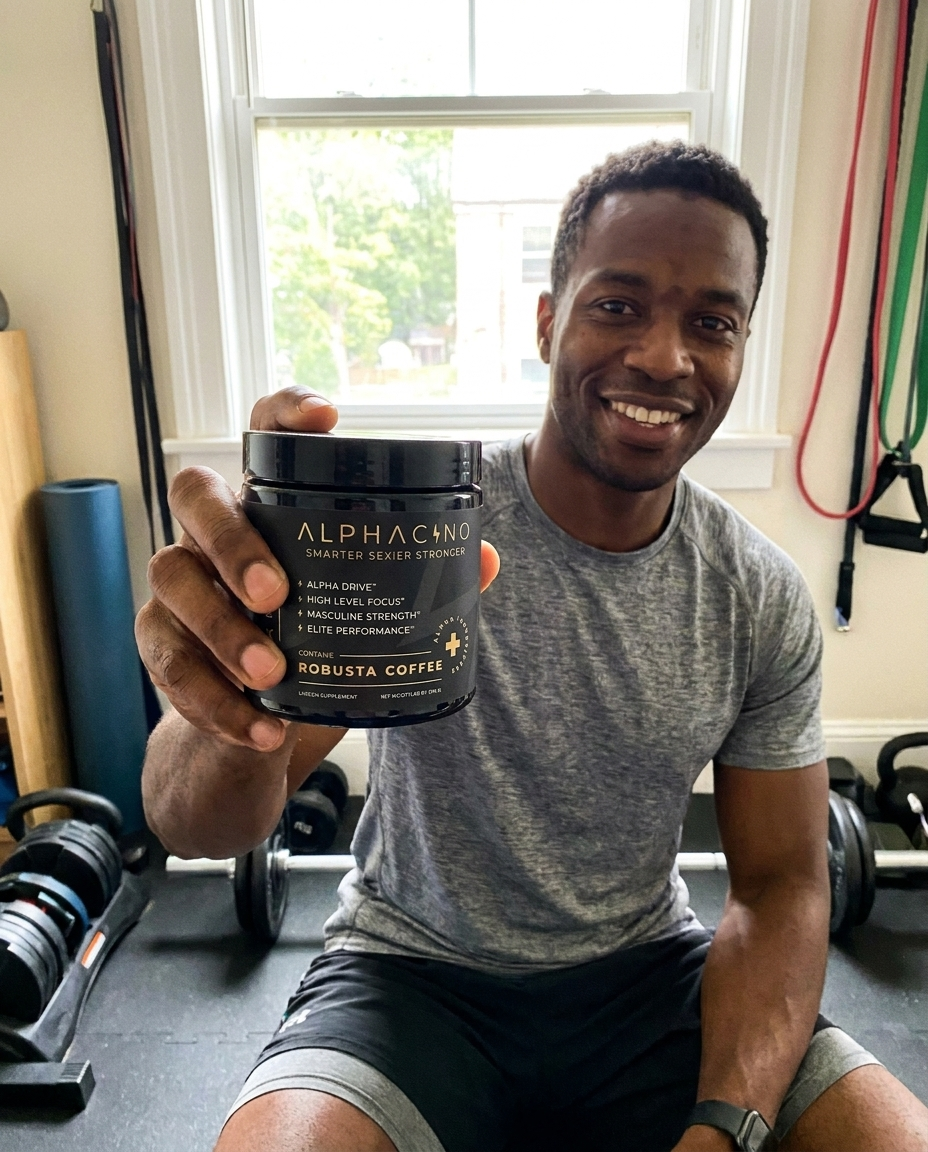
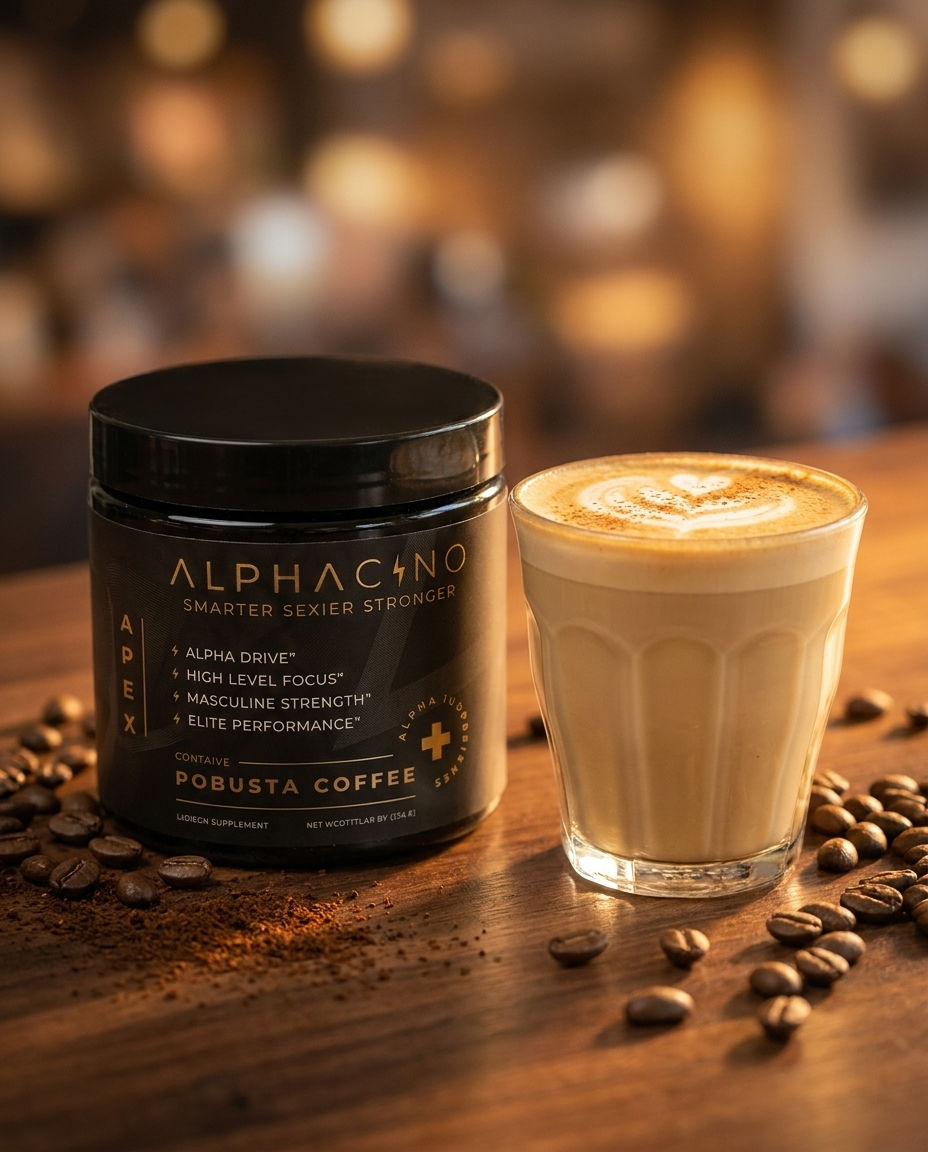
This is a comparison between two different kinds of cup, and it is worth saying so before the table. Everyday Dose is a low-caffeine collagen latte for people stepping away from coffee. Alphacino is a full-strength black robusta coffee carrying a men's stress and focus stack at trial doses. Alphacino's label is read from the tub: 100 mg of caffeine, 600 mg of KSM-66 ashwagandha, 500 mg of lion's mane fruiting-body extract, 224 mg of black maca 4:1 extract, 100 mg of L-theanine, 50 mg of the S7 plant blend, vitamin D and green tea leaf extract, $49.97 for 30 servings, $1.67 a cup, 60-day guarantee.
| Line | Everyday Dose Coffee+ | Alphacino |
|---|---|---|
| Coffee and caffeine | Cold brew extract; 45 mg Mild, 90 mg Medium | Robusta instant; 100 mg |
| Lion's mane | Part of 1,500 mg with chaga, split not printed | 500 mg fruiting-body extract, on its own line |
| Chaga | Part of 1,500 mg | None |
| Ashwagandha | None | 600 mg KSM-66, the stress trial's dose and extract17 |
| Black maca | None | 224 mg of a 4:1 extract, about 900 mg root equivalent18 |
| Collagen | 4 g | None |
| L-theanine | 150 mg with 45 mg caffeine | 100 mg with 100 mg caffeine |
| Everything else | Nothing else printed | S7 blend 50 mg, vitamin D, green tea leaf extract |
| Cup | Small frothed latte, 4 to 6 oz | Black coffee, any size |
| Fasting | Breaks a fast | Holds a fast black, 5 to 10 calories |
| Price and guarantee | $1.50 a cup; guarantee not readable on the day | $1.67 a cup; 60 days |
Where Everyday Dose wins. A gentler cup for anyone who has decided to drink less caffeine; the Mild blend is a tea-strength dose with the theanine trial's ratio6. Fifty percent more theanine. Collagen, which we do not carry, at the skin-trial dose8. A creamy latte format for people who do not want black coffee. Seventeen cents a cup cheaper.
Where Alphacino wins. A full coffee dose, so the cup does the job a coffee is for, with theanine to shape it. Lion's mane on its own line at a stated 500 mg of extract, rather than an unsplit share of a combined figure. The two adaptogens with men's trials at the doses those trials used: KSM-66 at 600 mg for stress and cortisol17, and maca near the low trial dose for desire18. No chaga. A guarantee you can read. A black cup that holds a fast. How that reads against the whole market, seven brands ranked on their printed doses, is in the best mushroom coffee for men; the shape of the theanine-to-caffeine ratio in each is in the L-theanine to caffeine ratio.
Who should pick which
Everyday Dose if you are cutting caffeine, you like a small creamy latte, you want collagen in your morning anyway, and the theanine pairing is the thing you are buying. Start with the Mild and judge the focus at 60 minutes, which is when the trial measured it6. Ask the brand for the lion's mane and chaga split and for the refund terms before a 90-serving order.
RYZE if organic matters, price matters more, and you want six mushrooms in the cup even though none is dosed to a trial. Start with half a scoop for the MCT. The detail is in the RYZE review.
Alphacino if you want a real coffee that still feels like coffee, the full studied dose of KSM-66 for stress, lion's mane at a stated extract dose, and a black cup you can drink fasted. Judge the ashwagandha at eight weeks17, not eight days. Timing for either cup is the same arithmetic, and it is in when to drink mushroom coffee. The one comparison closer to Everyday Dose's own shape than Alphacino is BodyBrain, another instant with theanine and a printed caffeine figure, reviewed the same way in the BodyBrain coffee review.

Where Alphacino fits
We do not sell a half-caf latte and we do not pretend to. Alphacino is a black robusta coffee at 100 mg of caffeine with 100 mg of theanine, the full 600 mg trial dose of KSM-66 ashwagandha, 500 mg of lion's mane extract, black maca and the S7 blend, every line printed on its own with its amount. Its case against Everyday Dose is not that it is gentler; it is not. Its case is that if you want your morning coffee to stay a coffee and to carry the men's ingredients at the doses their trials used, this is the cup built for that, and the guarantee is 60 days because the ashwagandha trial ran eight weeks17. The tub is on the product page, and the KSM-66 evidence is in the KSM-66 guide.
Frequently asked questions
Is Everyday Dose mushroom coffee good for you?
It is a mild, fully listed product with one well-supported line, the theanine and caffeine pairing, and a collagen dose in the range that improved skin elasticity in trials. The mushrooms are a combined 1,500 mg with no split, so their contribution cannot be judged, and chaga has no human benefit trial. For a healthy adult it is a reasonable low-caffeine cup; it is not a treatment for anything.
What are the ingredients in Everyday Dose coffee?
Per serving, from the brand's listing on 17 September 2026: 1,500 mg of fruiting-body lion's mane and chaga combined, 4 g of grass-fed collagen, 150 mg of L-theanine, and cold brew coffee extract with 45 mg of caffeine in the Mild blend or 90 mg in the Medium roast.
How much caffeine is in Everyday Dose?
45 mg a serving in the Mild blend and 90 mg in the Medium roast. An 8 oz brewed coffee is about 95 mg, so the Mild cup is just under half a coffee and the Medium is a full cup.
What are the side effects of Everyday Dose?
For most people, none beyond the caffeine. Chaga is high in oxalate and has caused kidney injury in case reports at 10 to 15 g a day, far above a coffee dose, so people with kidney stones or kidney disease should ask a doctor. The collagen is a food dose; the theanine trials reported no adverse effects. There is no MCT oil, so the loose-stool complaint that follows RYZE does not apply.
RYZE or Everyday Dose?
Everyday Dose if you want the theanine pairing, a printed mushroom weight and no MCT; RYZE if you want organic and the lowest price. Both are half-caf mushroom lattes at 45 to 48 mg in their standard versions, with stronger roasts at 80 to 90 mg, and neither prints per-mushroom amounts.
Does Everyday Dose break a fast?
Yes. Four grams of collagen is protein, and the coffee extract and mushrooms add to it, so it is not a black coffee for fasting purposes. A black cup with no collagen or creamer is the only mushroom coffee that holds a fast.
Is Everyday Dose worth it?
At $1.50 a cup it is priced with RYZE and 17 cents under Alphacino. It is worth it if a gentle 45 mg latte with theanine and collagen is the morning you want. It is poor value if you drink coffee for the lift, because you will drink two or three to reach one coffee's caffeine.
Sources
- Everyday Dose. Coffee+ product listings (30-Serving Coffee+, 60 Servings Coffee+, 90 Servings Coffee+ Medium Roast, Coffee+ Sample Kit, To-Go sticks, Protein Coffee+, Mushroom Matcha, Collagen Peptides), everydaydose.com, as read from the store's public product feed on 17 September 2026; the Medium roast caffeine figure from the Coffee+ Sample Kit listing as read on 14 September 2026. everydaydose.com
- U.S. Department of Agriculture, Agricultural Research Service (2018). SR Legacy, via FoodData Central: brewed coffee (fdcId 171890) and espresso (171891). Serving values calculated from the per-100 g figures and USDA portion weights. fdc.nal.usda.gov
- Mori, K., Inatomi, S., Ouchi, K., Azumi, Y., & Tuchida, T. (2009). Improving effects of the mushroom Yamabushitake (Hericium erinaceus) on mild cognitive impairment: a double-blind placebo-controlled clinical trial. Phytotherapy Research, 23(3), 367 to 372. doi:10.1002/ptr.2634
- Kwon, O., Kim, Y., Paek, J. H., Park, W. Y., et al. (2022). Chaga mushroom-induced oxalate nephropathy that clinically manifested as nephrotic syndrome: a case report. Medicine, 101(10), e28997. doi:10.1097/MD.0000000000028997
- Lee, S., Lee, H. Y., Park, Y., Ko, E. J., et al. (2020). Development of end stage renal disease after long-term ingestion of chaga mushroom: case report and review of literature. Journal of Korean Medical Science, 35(19), e122. doi:10.3346/jkms.2020.35.e122
- Owen, G. N., Parnell, H., De Bruin, E. A., & Rycroft, J. A. (2008). The combined effects of L-theanine and caffeine on cognitive performance and mood. Nutritional Neuroscience, 11(4), 193 to 198. doi:10.1179/147683008X301513
- Haskell, C. F., Kennedy, D. O., Milne, A. L., Wesnes, K. A., & Scholey, A. B. (2008). The effects of L-theanine, caffeine and their combination on cognition and mood. Biological Psychology, 77(2), 113 to 122. doi:10.1016/j.biopsycho.2007.09.008
- Proksch, E., Segger, D., Degwert, J., Schunck, M., Zague, V., & Oesser, S. (2014). Oral supplementation of specific collagen peptides has beneficial effects on human skin physiology: a double-blind, placebo-controlled study. Skin Pharmacology and Physiology, 27(1), 47 to 55. doi:10.1159/000351376
- Zdzieblik, D., Oesser, S., Baumstark, M. W., Gollhofer, A., & König, D. (2015). Collagen peptide supplementation in combination with resistance training improves body composition and increases muscle strength in elderly sarcopenic men: a randomised controlled trial. British Journal of Nutrition, 114(8), 1237 to 1245. doi:10.1017/S0007114515002810
- Hidese, S., Ogawa, S., Ota, M., Ishida, I., et al. (2019). Effects of L-theanine administration on stress-related symptoms and cognitive functions in healthy adults: a randomized controlled trial. Nutrients, 11(10), 2362. doi:10.3390/nu11102362
- EFSA Panel on Dietetic Products, Nutrition and Allergies (2015). Scientific opinion on the safety of caffeine. EFSA Journal, 13(5), 4102. doi:10.2903/j.efsa.2015.4102
- RYZE Superfoods. Mushroom Coffee and Dark Roast product pages and refund policy, ryzesuperfoods.com, as read on 17 September 2026; caffeine per roast from RYZE's FAQ as read on 10 September 2026. ryzesuperfoods.com
- Gardiner, C., et al. (2023). The effect of caffeine on subsequent sleep: a systematic review and meta-analysis. Sleep Medicine Reviews, 69, 101764. doi:10.1016/j.smrv.2023.101764
- Hirsch, K. R., Smith-Ryan, A. E., Roelofs, E. J., Trexler, E. T., & Mock, M. G. (2017). Cordyceps militaris improves tolerance to high-intensity exercise after acute and chronic supplementation. Journal of Dietary Supplements, 14(1), 42 to 53. doi:10.1080/19390211.2016.1203386
- Dai, X., Stanilka, J. M., Rowe, C. A., Esteves, E. A., et al. (2015). Consuming Lentinula edodes (shiitake) mushrooms daily improves human immunity: a randomized dietary intervention in healthy young adults. Journal of the American College of Nutrition, 34(6), 478 to 487. doi:10.1080/07315724.2014.950391
- Wachtel-Galor, S., Tomlinson, B., & Benzie, I. F. F. (2004). Ganoderma lucidum ("Lingzhi"), a Chinese medicinal mushroom: biomarker responses in a controlled human supplementation study. British Journal of Nutrition, 91(2), 263 to 269. doi:10.1079/BJN20041039
- Chandrasekhar, K., Kapoor, J., & Anishetty, S. (2012). A prospective, randomized double-blind, placebo-controlled study of safety and efficacy of a high-concentration full-spectrum extract of ashwagandha root in reducing stress and anxiety in adults. Indian Journal of Psychological Medicine, 34(3), 255 to 262. doi:10.4103/0253-7176.106022
- Gonzales, G. F., et al. (2002). Effect of Lepidium meyenii (maca) on sexual desire and its absent relationship with serum testosterone levels in adult healthy men. Andrologia, 34(6), 367 to 372. doi:10.1046/j.1439-0272.2002.00519.x