Short answer: yes, mushroom coffee can help you focus, but mostly for a reason the marketing skips. The sharper first hour comes from caffeine, which reliably improves alertness, vigilance, attention and reaction time at doses from about 40 mg up to about 300 mg1, and it is steadier when the caffeine is paired with L-theanine: 40 to 150 mg of caffeine with 97 to 250 mg of theanine improved attention accuracy in three controlled trials and cut tiredness ratings in two of them234. Lion's mane, the mushroom sold for focus, improved cognition in trials, but at 1.8 to 3 g a day for 4 to 16 weeks56, more than any coffee holds in a cup. For ADHD, the honest reading is thinner still: caffeine alone did no better than placebo in children in a 2023 meta-analysis7, and the theanine-and-caffeine pairing has one five-boy proof-of-concept study behind it8. So the best mushroom coffee for focus is the one that gets the caffeine-and-theanine pairing right and prints its lion's mane dose. What the trials found, what "focus coffee", "nootropic coffee" and "brain fog" mean in practice, then seven labels ranked on exactly that.
What "focus" from a coffee actually is
In the research, focus is measured as attention, vigilance and reaction time, and caffeine is the best-studied substance on earth for all three. A 2016 review of the caffeine literature put the useful range at about 40 mg to about 300 mg: across that range alertness, vigilance, attention and reaction time improve reliably, while memory and higher-order judgement improve much less consistently1. Two things follow. A "focus coffee" with 35 mg of caffeine is at the bottom of that range and will feel like nothing to a regular coffee drinker. And a coffee that promises better memory or decision-making is promising what caffeine does not deliver.
The same review notes that caffeine is consumed by more than 80% of American adults1. That matters for the word "nootropic", which simply means a substance taken to improve a mental function. By that definition caffeine is the most used nootropic there is, and every "nootropic mushroom coffee" is, first of all, a caffeinated coffee. The question is what else is in the cup, at what dose.
The three ingredients that do the work
| Ingredient | What the trials found | Dose in the trials | When you feel it |
|---|---|---|---|
| Caffeine | Better alertness, vigilance, attention and reaction time; weaker effects on memory and judgement1 | About 40 to 300 mg | Within the hour |
| L-theanine with caffeine | Better accuracy on a task-switching test, higher alertness and less tiredness, measured at 20 and 70 minutes, with 97 mg theanine and 40 mg caffeine2; faster reaction times, better attention accuracy, and lower tiredness and headache ratings with 250 mg and 150 mg3; faster and more accurate attention switching and less distraction with 100 mg and 50 mg4 | 97 to 250 mg theanine with 40 to 150 mg caffeine | 20 to 90 minutes |
| Lion's mane | Higher cognitive scores than placebo from week 8 in adults aged 50 to 80 with mild cognitive impairment, falling back within 4 weeks of stopping6; better scores on one of three cognitive tests after 12 weeks of a fruiting-body supplement9; faster performance on one task after a single dose and a trend to lower stress after 28 days in young adults5; no overall change 90 minutes after one 3 g dose in a 2025 crossover10 | 1.8 to 3.2 g a day of mushroom, or 3 g of a 10:1 extract | Weeks, at those doses |
| Ashwagandha | Better memory, executive function, sustained attention and processing speed than placebo after 8 weeks in 50 adults with mild cognitive impairment11 | 300 mg twice a day of root extract | Eight weeks |
Notice the two clocks. Caffeine and theanine work on the day you drink them. Lion's mane and ashwagandha were measured after weeks of daily use, in people who were already struggling with cognition, at doses a coffee has to be honest about. A cup can only carry the slow ingredients at a fraction of a gram, so the question for every brand is whether it prints that fraction.
Why some mushroom coffees hurt focus
- Too little caffeine. The low-caffeine lattes sit at 35 to 50 mg a cup. If you normally drink coffee, that is a withdrawal dose, not a focus dose, and the fog that follows gets blamed on the mushrooms.
- Too much caffeine, with nothing beside it. Caffeine raises anxiety in healthy people, modestly at low doses and sharply above 400 mg a day12. A jittery mind is not a focused one. That is the case for theanine in the cup, which lowered tiredness and headache ratings alongside caffeine in a crossover trial3; our guide to mushroom coffee and jitters covers the fix.
- Milk, sugar and MCT oil in a "focus" cup. A sweet latte in the morning is a blood sugar swing with a mushroom name on it. The latte-style blends are fine drinks; they are not where the focus comes from.
- Blends with no doses. If a label lists six mushrooms and one total, or no amount at all, the mushroom part of the promise cannot be checked. Lion's mane needs grams a day in the trials, and a tablespoon of instant coffee cannot hold that; what it can hold is a printed extract weight, which is the only figure that lets you compare a cup with the research.
- The afternoon cup. A cup of coffee is best finished at least 8.8 hours before bed to avoid losing sleep, by a meta-analysis of 24 studies13. Lost sleep costs more focus the next day than any ingredient gives back.
The 7 best mushroom coffees for focus, ranked on the label
Figures are from each brand's own listing or label1415. Where a brand does not publish a per-serving dose, the table says so, because that absence is itself information. We make Alphacino, and we rank it first on the rule below, so read the rule before the order.
| # | Coffee | Caffeine | L-theanine | Lion's mane per cup | Price a cup | Focus read |
|---|---|---|---|---|---|---|
| 1 | Alphacino | 100 mg | 100 mg | 500 mg fruiting-body extract | $1.67 (30 for $49.97) | Caffeine and theanine inside the tested range, a printed lion's mane extract, and 600 mg KSM-66 ashwagandha, the cognition trial's daily dose. A full-strength coffee |
| 2 | BodyBrain | About 70 mg | 200 mg | 600 mg | $1.50 (30 for $44.99) | The highest printed lion's mane figure and the most theanine per milligram of caffeine; a milder cup, sold for testosterone rather than focus |
| 3 | Everyday Dose Coffee+ | 45 mg Mild, 90 mg Medium | 150 mg | 1,500 mg of lion's mane and chaga together, split not printed | $1.50 (30 for $45) | The most theanine and the biggest mushroom number, but it is one weight for two species. Choose Medium for a focus dose of caffeine; a collagen latte, not a black coffee |
| 4 | Cuppa | About 70 mg | 100 mg | Printed as "1,000 mg", held as part of 250 mg of 8:1 extracts, about 125 mg of extract | $0.97 (30 for $29) | The right pairing at the lowest price, with 250 mg of KSM-66; the lion's mane is an equivalence, not a dose |
| 5 | Four Sigmatic Focus | About 150 mg brewed; 50 mg instant | None | Not printed | About $1.15 to $1.54 (ground); $1.50 (instant) | Real organic coffee you brew, with lion's mane in the bag at an unstated amount. The strongest caffeine dose on the list and no theanine beside it |
| 6 | RYZE | 48 mg | None | Six mushrooms, amounts not printed | $1.50 (30 for $45) | A general wellness latte at low caffeine. Pleasant; not built for focus |
| 7 | MUD\WTR :rise | A fraction of a coffee, not printed | None | Four mushrooms, amounts not printed | $1.67 (30 for $50) | A cacao and spice coffee replacement, for quitting caffeine rather than for focus |
How the order was decided. First, is the same-day pairing right: 50 to 150 mg of caffeine with theanine beside it, the range the attention trials used234. Second, is the lion's mane dose printed as an amount of extract. Third, price. BodyBrain, Everyday Dose and Cuppa all carry the pairing, which puts them ahead of the three that do not. BodyBrain edges the other two because its 600 mg of lion's mane is a plain printed dose; Everyday Dose has the bigger numbers but one combined weight for two mushrooms, and Cuppa's figure is an equivalence by its own footnote. Four Sigmatic Focus makes the best plain coffee of the seven and the weakest focus case, because a bag of ground coffee with an unstated amount of mushroom is still a bag of ground coffee. RYZE and MUD\WTR are honest products for a different job. The full comparison beyond focus, including price per cup and what else is in each scoop, is the best mushroom coffee ranking.
Mushroom coffee for ADHD: what the evidence says
"Mushroom coffee for ADHD" is searched often enough to deserve a straight answer, so here it is: no mushroom coffee has been tested in people with ADHD, and the ingredients that have been tested do not support the idea that a cup treats it.
- Caffeine alone. A 2023 systematic review found seven randomized trials of caffeine against placebo in 104 children aged 5 to 15 with ADHD. Four found no improvement in any symptom; pooled, overall ADHD symptoms were no different from placebo7.
- Caffeine with L-theanine. In a proof-of-concept crossover with brain imaging, five boys aged 8 to 15 with ADHD took theanine, caffeine, both or placebo. The combination improved an overall cognition score and sensitivity on a sustained-attention task, with a trend to better inhibitory control, and reduced activity in the brain network linked to mind-wandering; caffeine on its own made inhibitory control worse8. Five children is a reason to run a bigger study, not a treatment.
- Lion's mane. We found no human trial of lion's mane in ADHD, in children or adults.
- The 2025 review. A systematic review of supplements for ADHD concluded that caffeine showed no significant benefit, that its combination with theanine may enhance attention, and that the limited effect of supplements cannot replace stimulant medication16.
What that means in practice. If you have ADHD and like coffee, a cup that pairs its caffeine with theanine is the version the small evidence points toward, and it is the same cup the attention trials in adults without ADHD used. It is not a substitute for treatment, and if you take a stimulant medication, the caffeine adds to it: that is a conversation for your prescriber, not a label. Nothing in this guide is medical advice.
Mushroom coffee for brain fog
"Brain fog" is not a diagnosis; it is the word people use for a slow, unfocused morning or a mid-morning slump. The common causes are mundane: sleep debt, a cup of caffeine that has already peaked and is sliding, a high-carbohydrate breakfast, or an afternoon cup from the day before. A mushroom coffee helps with the caffeine part and, if it carries theanine, with the jittery edge; the alertness and tiredness ratings in the theanine trials are the closest the research comes to measuring "fog" lifting32. It does nothing for the sleep part. Our guide to why your focus fades by mid-morning works through the causes one by one, and why coffee makes you tired covers the caffeine slide.
For long work sessions without a crash
A workable routine, built from the timings in the trials rather than from a brand's copy:
- One cup with theanine within half an hour of sitting down. The theanine trials measured their benefits at 20 to 90 minutes24, so drink it as you start, not an hour before.
- Second cup before 1 pm, or not at all. The daily ceiling for healthy adults is 400 mg17, and the last cup wants to be 8.8 hours before bed13. How much caffeine is too much does the arithmetic by brand.
- Water and a protein breakfast. The mid-morning fade that gets blamed on the coffee is usually dehydration plus a sugar breakfast.
- Take the mushroom every day and judge it at eight weeks. That is when the lion's mane and ashwagandha trials measured611, and the lion's mane benefit faded within a month of stopping6.
The full routine, including how to structure 90-minute blocks around the caffeine curve, is in mushroom coffee for deep work.

Where Alphacino fits
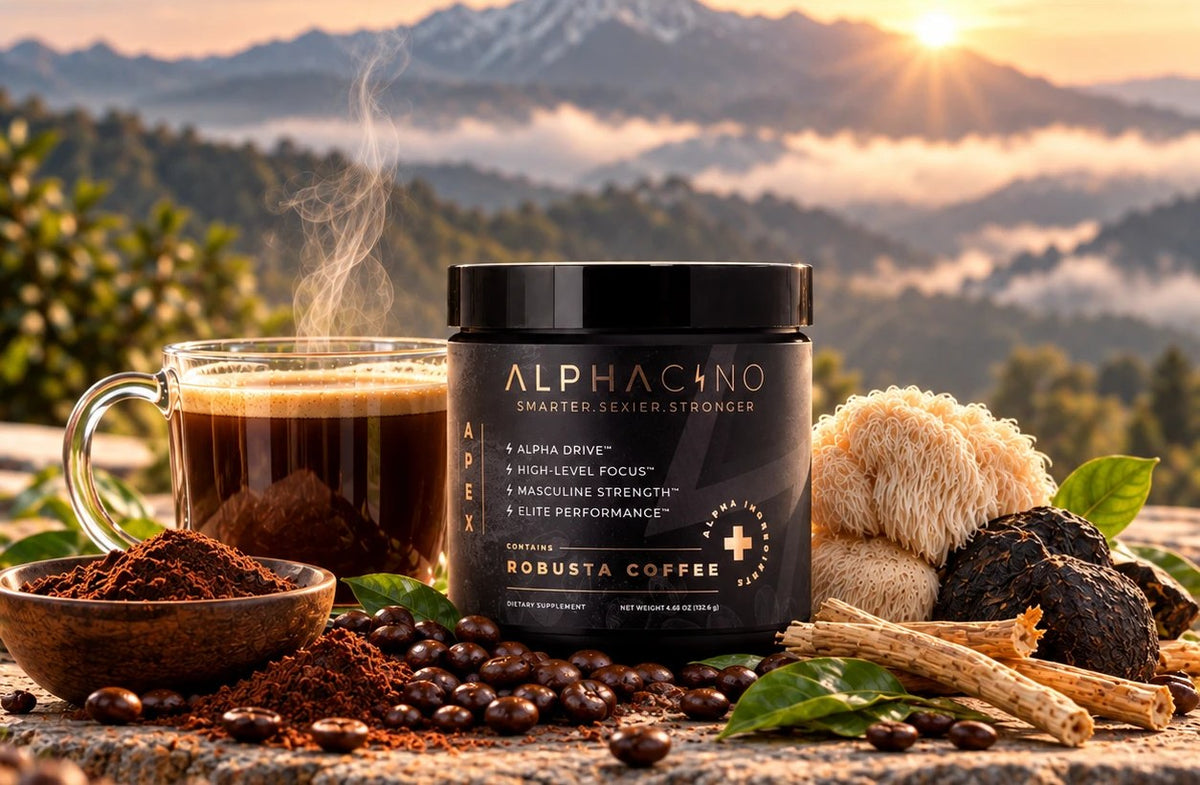
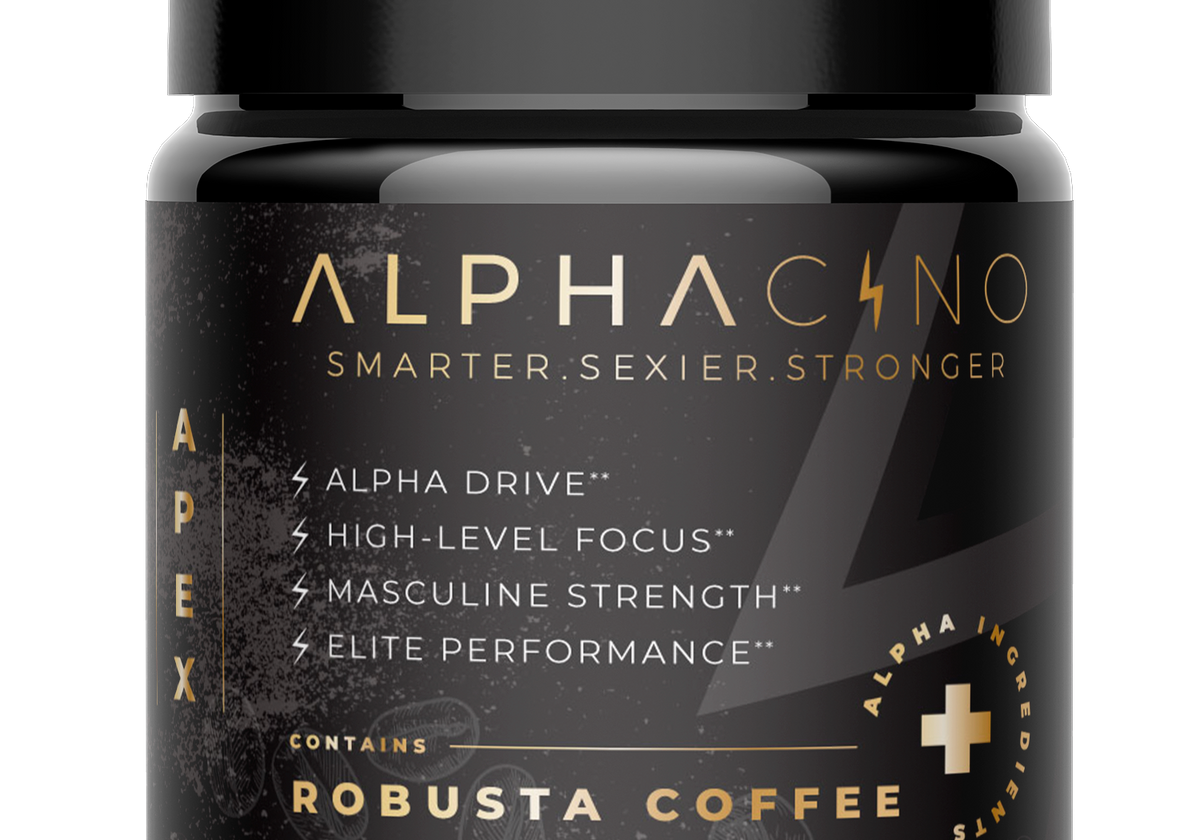
Alphacino ranks first here on the two things the trials support, and we will be plain about the third. Its 100 mg of robusta caffeine with 100 mg of L-theanine sits inside the range the attention trials used, so the same-day effect is the tested one, not a guess. Its 600 mg of KSM-66 ashwagandha is the daily dose from the eight-week memory and attention trial11. Its 500 mg of HericiumPrime lion's mane fruiting-body extract is a printed amount, which is more than most of the list offers, and it is still a fraction of the 1.8 to 3 g the trials used; no coffee on this list reaches that dose, and we make no memory claim on it15. Thirty servings cost $49.97, $1.67 a cup, or $1.50 a cup in the 3 pack, with a 60-day money-back guarantee, which is long enough to run the eight-week test yourself. The lion's mane evidence on its own is in lion's mane for men, and the caffeine-to-theanine arithmetic in the L-theanine and caffeine ratio.
Alphacino at a glance
Real robusta coffee with 100 mg of caffeine and 100 mg of L‑theanine, 600 mg of KSM‑66 ashwagandha, 500 mg of lion's mane and 224 mg of black maca, every dose printed on the tub.
30 cups a tub: $1.67 a cup, or $1.50 a cup in the 3 pack. 60‑day money-back guarantee.
Frequently asked questions
Does mushroom coffee help you focus?
Yes, mainly through its caffeine, which improves alertness, attention and reaction time at about 40 to 300 mg, and more steadily when paired with L-theanine. Lion's mane improved cognition in trials only at 1.8 to 3 g a day over weeks, which is more than a cup of coffee carries.
What is the best mushroom coffee for focus?
On the labels, Alphacino: 100 mg of caffeine with 100 mg of L-theanine, 500 mg of lion's mane extract and 600 mg of KSM-66 ashwagandha, every dose printed. BodyBrain and Everyday Dose Medium also pair theanine with caffeine. We make Alphacino.
Is mushroom coffee good for ADHD?
There is no trial of mushroom coffee in ADHD. Caffeine alone did no better than placebo in children with ADHD across seven trials, and L-theanine with caffeine improved attention measures in one five-boy study. It is not a treatment, and if you take a stimulant medication, ask your prescriber before adding caffeine.
Which mushroom is best for focus?
Lion's mane has the most human evidence, with better cognitive scores in older adults after 8 to 16 weeks and faster task performance in young adults. The trials used 1.8 to 3 g a day, so a coffee should print its lion's mane extract amount; many do not.
How much lion's mane do you need for focus?
The trials used 1.8 g to 3.2 g of mushroom a day, or 3 g of a 10:1 extract, for 4 to 16 weeks. No mushroom coffee holds that in a scoop. A printed extract dose, such as 500 or 600 mg, is the most a cup can honestly offer.
Is mushroom coffee a nootropic?
By the plain meaning of the word, yes: it contains caffeine, the most widely used substance for alertness and attention there is, and the better blends add L-theanine, which the trials show sharpens attention alongside it. The mushroom part works on a different timescale, over weeks, and only at a real dose.
Does mushroom coffee help with brain fog?
It helps with the caffeine part of a foggy morning and, with theanine in the cup, with the jittery edge; the theanine trials measured lower tiredness and higher alertness within 90 minutes. It does nothing for lost sleep, which is the usual cause.
Which mushroom coffee has the most caffeine?
Four Sigmatic Focus ground coffee at about 150 mg per brewed 12 oz cup, then Alphacino at 100 mg and Everyday Dose Medium at 90 mg. The low end is Everyday Dose Mild at 45 mg, RYZE at 48 mg and MUD\WTR at a fraction of a coffee.
Sources
- McLellan, T. M., Caldwell, J. A., & Lieberman, H. R. (2016). A review of caffeine's effects on cognitive, physical and occupational performance. Neuroscience & Biobehavioral Reviews, 71, 294 to 312. doi:10.1016/j.neubiorev.2016.09.001
- Giesbrecht, T., Rycroft, J. A., Rowson, M. J., & De Bruin, E. A. (2010). The combination of L-theanine and caffeine improves cognitive performance and increases subjective alertness. Nutritional Neuroscience, 13(6), 283 to 290. doi:10.1179/147683010X12611460764840
- Haskell, C. F., Kennedy, D. O., Milne, A. L., Wesnes, K. A., & Scholey, A. B. (2008). The effects of L-theanine, caffeine and their combination on cognition and mood. Biological Psychology, 77(2), 113 to 122. doi:10.1016/j.biopsycho.2007.09.008
- Owen, G. N., Parnell, H., De Bruin, E. A., & Rycroft, J. A. (2008). The combined effects of L-theanine and caffeine on cognitive performance and mood. Nutritional Neuroscience, 11(4), 193 to 198. doi:10.1179/147683008X301513
- Docherty, S., Doughty, F. L., & Smith, E. F. (2023). The acute and chronic effects of Lion's Mane mushroom supplementation on cognitive function, stress and mood in young adults: a double-blind, parallel groups, pilot study. Nutrients, 15(22), 4842. doi:10.3390/nu15224842
- Mori, K., Inatomi, S., Ouchi, K., Azumi, Y., & Tuchida, T. (2009). Improving effects of the mushroom Yamabushitake (Hericium erinaceus) on mild cognitive impairment: a double-blind placebo-controlled clinical trial. Phytotherapy Research, 23(3), 367 to 372. doi:10.1002/ptr.2634
- Perrotte, G., Moreira, M. M. G., de Vargas Junior, A., Teixeira Filho, A., & Castaldelli-Maia, J. M. (2023). Effects of caffeine on main symptoms in children with ADHD: a systematic review and meta-analysis of randomized trials. Brain Sciences, 13(9), 1304. doi:10.3390/brainsci13091304
- Kahathuduwa, C. N., Wakefield, S., West, B. D., Blume, J., Dassanayake, T. L., Weerasinghe, V. S., & Mastergeorge, A. (2020). Effects of L-theanine-caffeine combination on sustained attention and inhibitory control among children with ADHD: a proof-of-concept neuroimaging RCT. Scientific Reports, 10, 13072. doi:10.1038/s41598-020-70037-7
- Saitsu, Y., Nishide, A., Kikushima, K., Shimizu, K., & Ohnuki, K. (2019). Improvement of cognitive functions by oral intake of Hericium erinaceus. Biomedical Research, 40(4), 125 to 131. doi:10.2220/biomedres.40.125
- Surendran, G., Saye, J., Binti Mohd Jalil, S., Spreadborough, J., Duong, K., Shatwan, I. M., Lilley, D., Heinrich, M., Dodd, G. F., & Surendran, S. (2025). Acute effects of a standardised extract of Hericium erinaceus (lion's mane mushroom) on cognition and mood in healthy younger adults: a double-blind randomised placebo-controlled study. Frontiers in Nutrition, 12, 1405796. doi:10.3389/fnut.2025.1405796
- Choudhary, D., Bhattacharyya, S., & Bose, S. (2017). Efficacy and safety of ashwagandha (Withania somnifera (L.) Dunal) root extract in improving memory and cognitive functions. Journal of Dietary Supplements, 14(6), 599 to 612. doi:10.1080/19390211.2017.1284970
- Liu, C., Wang, L., Zhang, C., Hu, Z., Tang, J., Xue, J., & Lu, W. (2024). Caffeine intake and anxiety: a meta-analysis. Frontiers in Psychology, 15, 1270246. doi:10.3389/fpsyg.2024.1270246
- Gardiner, C., Weakley, J., Burke, L. M., Roach, G. D., Sargent, C., Maniar, N., Townshend, A., & Halson, S. L. (2023). The effect of caffeine on subsequent sleep: a systematic review and meta-analysis. Sleep Medicine Reviews, 69, 101764. doi:10.1016/j.smrv.2023.101764
- Brand product listings and labels, as read for our reviews: BodyBrain, Cuppa, RYZE and MUD\WTR on 14 October 2026 (see the best mushroom coffee guide); Everyday Dose on 16 September 2026 (its store refuses automated reads); Four Sigmatic on 18 October 2026 (see the Four Sigmatic review). Prices are one-time prices for the standard pack on those dates. Our label test, brand by brand
- Alphacino. Supplement Facts panel as printed on the tub and the product page, read 19 October 2026. alphacino.com
- Al Shahab, S., Al Balushi, R., Qambar, A., Abdulla, R., Qader, M., Abdulla, S., & Jahrami, H. (2025). Efficiency of different supplements in alleviating symptoms of ADHD with or without the use of stimulants: a systematic review. Nutrients, 17(9), 1482. doi:10.3390/nu17091482
- EFSA Panel on Dietetic Products, Nutrition and Allergies (2015). Scientific opinion on the safety of caffeine. EFSA Journal, 13(5), 4102. doi:10.2903/j.efsa.2015.4102