Short answer: the coffee part works in 30 to 60 minutes and the mushroom part works in weeks, and the two should never be judged on the same morning. Caffeine reaches peak blood levels 30 to 120 minutes after the cup1, L-theanine peaks at about 50 minutes2, and the pairing's effect on attention was measured at 60 and 90 minutes3. That is what you feel on day one. The functional ingredients were tested on a different clock: the KSM-66 ashwagandha trial measured its result at day 606, maca's effect on desire appeared from week 89, and the lion's mane trial found its first significant difference at week 8 of 168. Below: how long it takes to kick in, how long it lasts, how long it stays in your system, the week-by-week timeline with the trial behind each date, and the honest reasons you might feel nothing at all.
How long does mushroom coffee take to kick in?
Thirty to sixty minutes for most people, because that is how fast caffeine moves. It is absorbed almost completely from the gut, with peak blood concentration arriving anywhere from 30 to 120 minutes after you drink it depending on the person and what else is in the stomach1. If your blend carries L-theanine, it arrives on the same schedule: in the kinetics study, a 100 mg dose peaked in plasma 0.8 hours after ingestion, whether it came from a capsule or from tea2. The two together were tested against each other and against placebo in a crossover trial, and the combination produced faster simple reaction time, better accuracy on a sustained-attention task, and lower "tired" and "headache" ratings, with the measurements taken at 60 and 90 minutes after the dose3.
So the first-cup experience is a caffeine and theanine experience. What changes it from brand to brand is the caffeine number, which runs from about 48 mg in a RYZE medium roast to 100 mg in Alphacino, with the coconut and cacao blends near zero. A 48 mg cup kicks in on the same clock as a 100 mg cup; it just kicks less. The by-brand figures are in our caffeine-by-brand guide, and what the theanine does to the shape of that hour is in the L-theanine to caffeine ratio.

How long does it take to feel the benefits of mushroom coffee?
This is the question the label ingredients answer, and each one has a trial with a date in it. The table gives the date the effect was measured, the dose the trial used, and what a cup of Alphacino carries, because the gap between those two numbers is the honest part of the timeline.
| Ingredient | When the trial measured an effect | Trial dose | In an Alphacino cup |
|---|---|---|---|
| Caffeine | 30 to 120 minutes, peak blood level1 | Any | 100 mg |
| L-theanine | Peak at 0.8 hours2; attention and mood effects at 60 and 90 minutes with caffeine3 | 100 mg alone; 250 mg with 150 mg caffeine | 100 mg with 100 mg caffeine |
| KSM-66 ashwagandha | Day 60: stress scores and serum cortisol lower than placebo6. A second 60-day trial of a different extract found lower anxiety scores and lower morning cortisol7 | 300 mg twice a day; 240 mg once a day | 600 mg, the full KSM-66 dose in one scoop |
| Black maca | Week 8 of 12: sexual desire improved, with no change in testosterone9 | 1,500 or 3,000 mg of gelatinised maca a day | 224 mg of a 4:1 extract, about 900 mg root equivalent |
| Lion's mane | Week 8 of 16: cognitive scores significantly above placebo, improving to week 16, falling back within 4 weeks of stopping8 | 3 g of dried fruiting body a day | 500 mg of a fruiting-body extract |
| S7 plant blend | No human trial with a timeline that we could find | 50 mg in the manufacturer's study | 50 mg |
Three things follow from the table. First, nothing on the functional side was measured before day 60 except maca and lion's mane at week 8, so anyone who tells you they felt the ashwagandha on day three is describing caffeine or expectation. Second, the trials ran on daily doses, so the calendar counts and the clock does not: a cup missed is a day lost, a cup at the wrong hour is nothing. Third, the doses matter. Alphacino carries the full ashwagandha trial dose, a fraction of the maca dose, and a sixth of the lion's mane dose, which is true of every coffee blend on the market, and it is why we say give the lion's mane 16 weeks rather than 8. Each ingredient's evidence is set out in the KSM-66 guide, the black maca guide and the lion's mane guide.
How long does mushroom coffee last?
Three to five hours of felt effect, and a longer tail you do not feel. Caffeine's average half-life is four to six hours, with a range of 1.5 to 10 hours between individuals1, so a 7 am cup is at full strength between 8 and 9 am, about half gone by early afternoon, and a quarter left by dinner. The lift fades before the caffeine does, which is why the afternoon dip lands while there is still caffeine in you. Theanine is shorter: it peaks under an hour after the cup and is largely cleared within the day2.
The tail matters for sleep. A meta-analysis of 24 studies found caffeine cut total sleep time by 45 minutes and deep sleep by 11 minutes, and worked out that a cup carrying 107 mg should be drunk at least 8.8 hours before bed to avoid losing total sleep time10. For a 100 mg mushroom coffee that is a 2 pm cut-off for an 11 pm bedtime; for a 48 mg blend there is no trial-derived figure, and six hours is the floor. The full timing rules are in the best time to drink mushroom coffee, and why the drop can feel like tiredness rather than the end of a lift is in why coffee makes you tired.
How long does mushroom coffee stay in your system?
About a day for the caffeine, hours for the theanine, and the mushroom extracts have no pharmacokinetic data to answer with. The arithmetic for caffeine is five half-lives to clear roughly 97% of a dose. At the average four to six hour half-life that is 20 to 30 hours; at the slow end of the range it can be two days, and at the fast end under eight hours1. Smoking speeds it up, pregnancy and some medications slow it down, and the difference between people is bigger than the difference between brands. Theanine and its breakdown products were measured in urine within 24 hours of a 100 mg dose2.
For the mushrooms and adaptogens, the honest answer is that nobody has measured it in a coffee, and it is the wrong question anyway: they were tested as daily doses over weeks, so what is in your blood on any single day was never the mechanism. None of the ingredients in a mushroom coffee shows up on a drug test.
Week by week: what to expect and when
Here is the timeline with the trial behind each date, for someone drinking one 100 mg cup a day at the same time each morning.
| When | What happens | Source |
|---|---|---|
| Day 1, first hour | Caffeine peaks; theanine peaks; the pairing's effects on reaction time, attention accuracy and "tired" ratings are measurable | Peak at 30 to 120 min1; theanine at 0.8 h2; effects at 60 and 90 min3 |
| Days 1 to 3 | If you switched from 200 to 300 mg of daily coffee, withdrawal: headache, fatigue, low mood, poor concentration, starting 12 to 24 hours after the last big dose and peaking at 20 to 51 hours | Withdrawal review: onset 12 to 24 h, peak 20 to 51 h, duration 2 to 9 days, headache in 50% of abstinence studies5 |
| Days 3 to 9 | Withdrawal ends. The 100 mg cup now feels like what it is. This is the first fair reading of the caffeine side | Duration 2 to 9 days5 |
| Days 15 to 20 | Tolerance to caffeine's performance effect sets in for daily users at 3 mg per kg. At 100 mg a day (1.25 mg per kg for an 80 kg man) the dose is lower and the tolerance slower, but the day-one sharpness is not the steady state | 20-day trial: effect largest on day 1, held about 15 days, then lessened4 |
| Week 8 | First measured effects for maca (desire) and lion's mane (cognition in older adults with mild impairment), at trial doses several times a cup | Maca from week 89; lion's mane at week 88 |
| Day 60 | The ashwagandha measurement: stress scores and cortisol lower than placebo at the dose Alphacino carries | 60-day KSM-66 trial6; second 60-day trial7 |
| Week 16 | Lion's mane at full trial length. Scores kept rising with duration and fell within four weeks of stopping, which is the argument for not stopping | 16-week trial with 4-week follow-up8 |
The practical reading is that a mushroom coffee has three verdict dates, not one: day 9 for the caffeine, day 60 for the ashwagandha, and week 16 for the lion's mane. The 60-day money-back window on Alphacino was set to match the second of those, and it is also the reason we tell people to decide in a month what they think of the cup and in two months what they think of the tub.

Why you might feel nothing, and what each reason looks like
Five reasons cover almost every "it does nothing" report, and only one of them is the product.
- You cut your caffeine by half or more. A 100 mg cup replacing a 250 mg mug is a 60% reduction, and a 48 mg blend replacing it is an 80% reduction. Withdrawal symptoms appear at abstinence from doses as low as 100 mg a day5, so the first week reads as "worse", which is the old dose leaving, not the new cup failing. Wait for day 9 before judging.
- You are judging the mushrooms on the caffeine clock. Nothing on the functional side was measured before week 8. A week is not a test.
- The dose is under the trial dose. This is real for maca and lion's mane in every coffee blend, including ours, and it means the week-8 and week-16 dates in the trials are optimistic for a cup. It is not real for KSM-66 at 600 mg.
- Sleep is the ceiling. The theanine and caffeine effects in the trial were measured in rested volunteers. No cup outruns five hours of sleep, and a cup after 2 pm costs sleep on its own10.
- You expected a stimulant. The theanine pairing lowered "tired" ratings but also takes the edge off caffeine's jolt3. Some people read the absence of jitters as the absence of an effect. Our jitters guide explains the difference.
Then there is the sixth possibility, which honest brands say out loud: it may not do anything for you. The ashwagandha trial was run in people with chronic stress, the lion's mane trial in older adults with mild cognitive impairment, and the maca trial in men reporting on desire. If you are 30, sleeping eight hours, and not stressed, there is less room to move and less to feel. Anything that persists beyond the timeline, or feels like a side effect rather than an absence, belongs in the side-effects guide.

Does the brand change how long it takes?
For the caffeine, only in size, not in timing: every brand's caffeine arrives on the same 30 to 120 minute curve1. For the mushrooms, the brand changes everything, because the dose is what sets the timeline and most brands do not print one. A blend that lists "mushroom blend, 500 mg" across six species is delivering under 100 mg of each, against trial doses of 3 g for lion's mane. There is no timeline for that; there is no trial of it. RYZE, the brand this question is most often asked about, uses a six-mushroom blend with the per-species doses undisclosed, so the only honest answer for "how long does RYZE take to work" is the caffeine answer: 30 to 60 minutes for a 48 mg cup, and no date for the rest. The label is read in full in our RYZE review.
The one thing to check on any tub before you start the clock is whether the functional ingredient you are buying it for has a printed milligram figure and whether that figure is within sight of the trial dose. If it is not, you are not on the trial's timeline, you are on no timeline.
How to tell whether it is working
Memory across weeks is unreliable, and the effects in the trials were measured with instruments, not impressions. Three habits give you something closer to a measurement.
- Score three things nightly for 30 days. Energy at 3 pm, focus in the hardest work block, and how wound up the day left you, each out of ten. Thirty rows beat a feeling. The ashwagandha trials used stress scales scored the same way6,7.
- Watch what you stopped doing. The third coffee, the 4 pm sugar, the hour awake replaying the day. Absences are the clearest signal and the easiest to miss.
- Change one thing at a time. If you start the coffee the same week you fix your sleep or start training, you will never know which one worked. The trials changed one variable; do the same.
And keep the cup at the same time every day, because the functional ingredients only did anything in the trials because they were taken daily. How many cups a day is a caffeine question with its own arithmetic, in how much mushroom coffee you can drink a day.
Where Alphacino fits
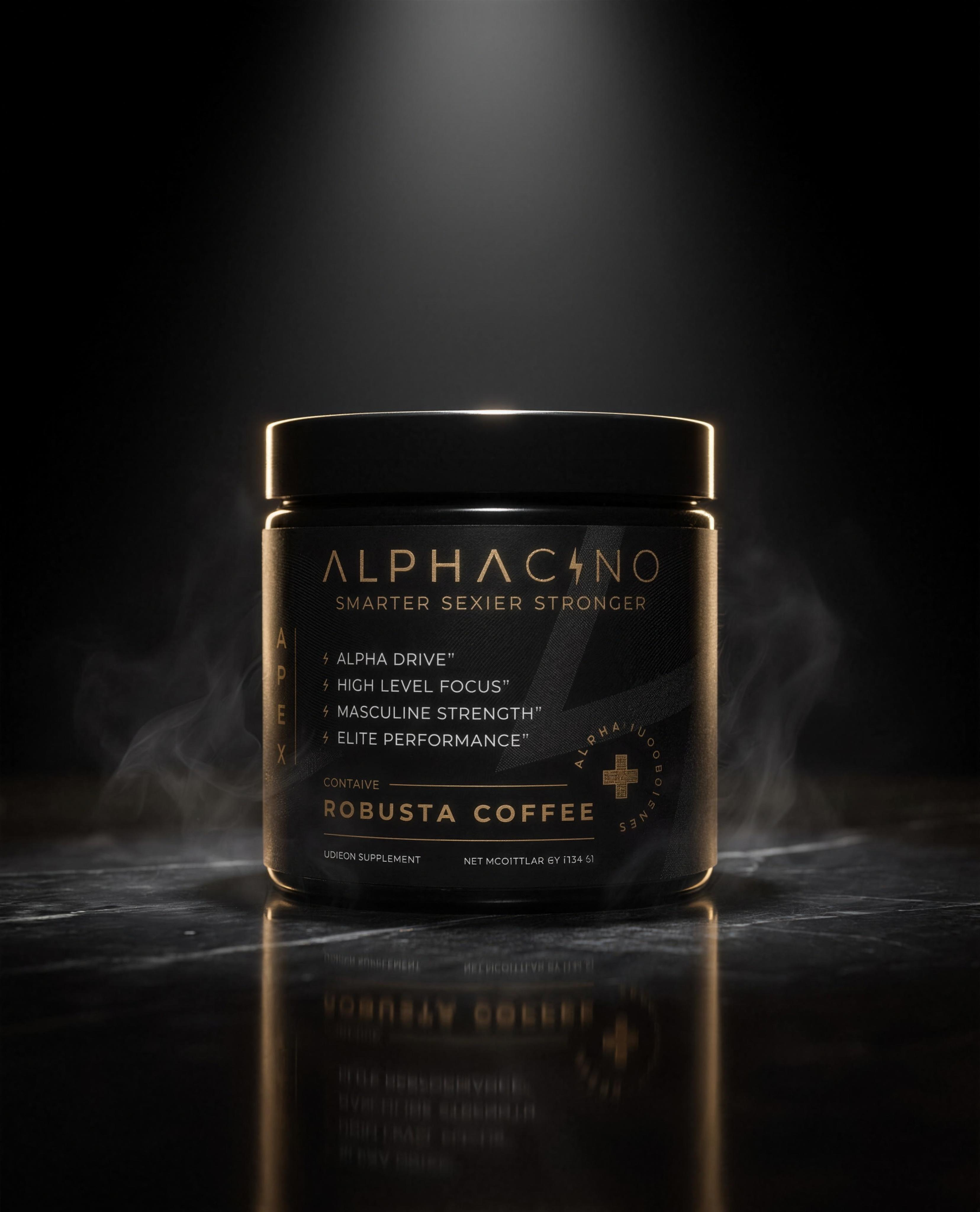
One scoop carries 100 mg of caffeine and 100 mg of L-theanine, so the first hour is the tested pairing at close to the tested ratio: expect it in 30 to 60 minutes, at full strength for two or three hours, and gone from the felt part of the day by early afternoon. The 600 mg of KSM-66 is the dose from the 60-day trial, taken once rather than split, which puts the ashwagandha verdict at day 60, the same length as the money-back guarantee. The 500 mg of HericiumPrime lion's mane extract and 224 mg of black maca extract are under their trial doses, as in every coffee, so we put their verdict at week 16 and say so. The doses, the directions and the label are on the product page.
Frequently asked questions
How long does mushroom coffee take to kick in?
Thirty to sixty minutes. Caffeine peaks in the blood 30 to 120 minutes after the cup, L-theanine peaks at about 50 minutes, and the pairing's effects on attention were measured at 60 and 90 minutes. The mushrooms and adaptogens are not part of the first hour at all.
How long do the effects of mushroom coffee last?
Three to five hours of felt lift from the caffeine, with a half-life of four to six hours, so half is still in you by early afternoon. A 100 mg cup should be at least 8.8 hours before bed to protect total sleep time.
How long does mushroom coffee stay in your system?
About a day for the caffeine: five half-lives is 20 to 30 hours for the average person, up to two days for slow metabolisers. Theanine is cleared within the day. The mushroom extracts have no measured clearance time and were never meant to work on a single-day basis.
Will I feel mushroom coffee on the first day?
You will feel the caffeine and theanine within the hour, and if you came from a strong coffee habit you may feel the withdrawal from the old dose for two to nine days. Day nine is the first fair reading of the caffeine side.
How long until lion's mane and ashwagandha work?
The KSM-66 ashwagandha trial measured its result at day 60. The lion's mane trial found its first significant difference at week 8 of 16, and the benefit faded within four weeks of stopping. Both were daily doses, and lion's mane in any coffee is well under the trial's 3 g.
Is it normal to feel nothing after a week?
Yes. A week covers the withdrawal from your old caffeine dose and nothing else; no functional ingredient was measured before week 8. If nothing has moved by day 60 on a daily cup, it may simply not be doing anything for you, and honest brands say so.
This article is general information, not medical advice. If you take medication, are pregnant, or have a heart, thyroid or anxiety condition, ask your doctor before adding caffeine or adaptogens to your routine.
Sources
- Guest, N. S., et al. (2021). International society of sports nutrition position stand: caffeine and exercise performance. Journal of the International Society of Sports Nutrition, 18(1), 1. doi:10.1186/s12970-020-00383-4
- Scheid, L., Ellinger, S., Alteheld, B., Herholz, H., Ellinger, J., Henn, T., Helfrich, H.-P., & Stehle, P. (2012). Kinetics of L-theanine uptake and metabolism in healthy participants are comparable after ingestion of L-theanine via capsules and green tea. The Journal of Nutrition, 142(12), 2091 to 2096. doi:10.3945/jn.112.166371
- Haskell, C. F., Kennedy, D. O., Milne, A. L., Wesnes, K. A., & Scholey, A. B. (2008). The effects of L-theanine, caffeine and their combination on cognition and mood. Biological Psychology, 77(2), 113 to 122. doi:10.1016/j.biopsycho.2007.09.008
- Lara, B., Ruiz-Moreno, C., Salinero, J. J., & Del Coso, J. (2019). Time course of tolerance to the performance benefits of caffeine. PLOS ONE, 14(1), e0210275. doi:10.1371/journal.pone.0210275
- Juliano, L. M., & Griffiths, R. R. (2004). A critical review of caffeine withdrawal: empirical validation of symptoms and signs, incidence, severity, and associated features. Psychopharmacology, 176(1), 1 to 29. doi:10.1007/s00213-004-2000-x
- Chandrasekhar, K., Kapoor, J., & Anishetty, S. (2012). A prospective, randomized double-blind, placebo-controlled study of safety and efficacy of a high-concentration full-spectrum extract of ashwagandha root in reducing stress and anxiety in adults. Indian Journal of Psychological Medicine, 34(3), 255 to 262. doi:10.4103/0253-7176.106022
- Lopresti, A. L., Smith, S. J., Malvi, H., & Kodgule, R. (2019). An investigation into the stress-relieving and pharmacological actions of an ashwagandha (Withania somnifera) extract: a randomized, double-blind, placebo-controlled study. Medicine, 98(37), e17186. doi:10.1097/MD.0000000000017186
- Mori, K., Inatomi, S., Ouchi, K., Azumi, Y., & Tuchida, T. (2009). Improving effects of the mushroom Yamabushitake (Hericium erinaceus) on mild cognitive impairment: a double-blind placebo-controlled clinical trial. Phytotherapy Research, 23(3), 367 to 372. doi:10.1002/ptr.2634
- Gonzales, G. F., Cordova, A., Vega, K., Chung, A., Villena, A., Gonez, C., & Castillo, S. (2002). Effect of Lepidium meyenii (maca) on sexual desire and its absent relationship with serum testosterone levels in adult healthy men. Andrologia, 34(6), 367 to 372. doi:10.1046/j.1439-0272.2002.00519.x
- Gardiner, C., Weakley, J., Burke, L. M., Roach, G. D., Sargent, C., Maniar, N., Townshend, A., & Halson, S. L. (2023). The effect of caffeine on subsequent sleep: a systematic review and meta-analysis. Sleep Medicine Reviews, 69, 101764. doi:10.1016/j.smrv.2023.101764