Short answer: they are not competing for the same job. Ashwagandha is the stress-first herb with the deeper trial record: at 600 mg a day, KSM-66 extract cut cortisol by roughly a quarter in a placebo-controlled trial, and its modest testosterone effects appear to ride on that stress reduction. Tongkat ali is the libido-and-testosterone-first herb: its best results come from stressed men and older men with clinically low testosterone, on a thinner evidence base. Pick by the problem you actually have. Here are the trials side by side.
Two herbs, two different jobs
Both get sold with the same "male vitality" label, which is how men end up buying the wrong one. Ashwagandha (Withania somnifera) is an adaptogen: the measurable effect is on your stress axis. Tongkat ali (Eurycoma longifolia) is a Southeast Asian root whose studied effects centre on testosterone status and libido, mostly in men who start low. One is for the wired-and-tired problem; the other is for the low-drive problem.
What ashwagandha's trials show
- Stress and cortisol: in a 60-day randomized, placebo-controlled trial, 600 mg a day of KSM-66 reduced serum cortisol by about 28% and cut stress-scale scores significantly versus placebo.1 A separate trial found similar anxiety and stress reductions.2
- Hormones: in an 8-week crossover trial in overweight men aged 40 to 70, ashwagandha extract raised testosterone by about 15% and DHEA-S by about 18% versus placebo.3 Useful, but modest: this is a nudge back toward your baseline, most plausibly by lowering the cortisol that suppresses it, not a replacement-level change.
What tongkat ali's trials show
- Stressed adults: four weeks of 200 mg a day improved mood scores, lowered salivary cortisol by about 16% and raised salivary testosterone by about 37% versus placebo, in moderately stressed subjects.4
- Older men with low testosterone: in an open-label study of 76 men with late-onset hypogonadism, a month of 200 mg a day brought roughly 90% of them back into the normal testosterone range.5 Promising, but note the design: no placebo arm.
- The caveats: the trials are small, some are industry-funded, and market quality varies a lot; reviews of the herb flag standardization and adulteration as real problems when buying it.6 If your testosterone is genuinely low, that is a medical finding worth a proper workup, not just a supplement; here is how to test it without botching the result.

Head to head
| Ashwagandha (KSM-66) | Tongkat ali | |
|---|---|---|
| Primary studied effect | Stress and cortisol reduction, better sleep | Testosterone status and libido |
| Evidence depth | Multiple placebo-controlled RCTs | Fewer, smaller trials; one key study unblinded |
| Testosterone effect | Modest (~15%), likely via lower stress3 | Larger in stressed or low-T men4,5 |
| Studied dose | 600 mg a day | 200 mg a day |
| Timeline | 4 to 8 weeks | 4 weeks |
| Watch out for | Drowsiness in some; check meds | Product quality and adulteration6 |
Which one should you take?
- Stressed, wired, sleeping badly, focus shot: ashwagandha, and it is not close. That is the problem its trials actually tested. Our KSM-66 guide has the full breakdown.
- Low drive, low energy, over 45, suspected low T: tongkat ali has the better-matched evidence, but get the blood test first so you know what you are treating, and buy a standardized extract from a brand that publishes testing.
- Just want more from your mornings: neither is a stimulant. The everyday stack question is covered in does mushroom coffee increase testosterone and our black maca guide, maca being the third herb in this conversation.
Can you take both?
Men commonly stack them, and nothing in the trial literature says the combination is unsafe. But no trial has tested them together, so the honest play is one at a time: run ashwagandha for eight weeks, judge it, then decide whether tongkat adds anything. Two variables at once means you will never know which one worked. If the other thing in your stack is coffee, that pairing has its own answer: can you take ashwagandha with coffee.

Where Alphacino fits
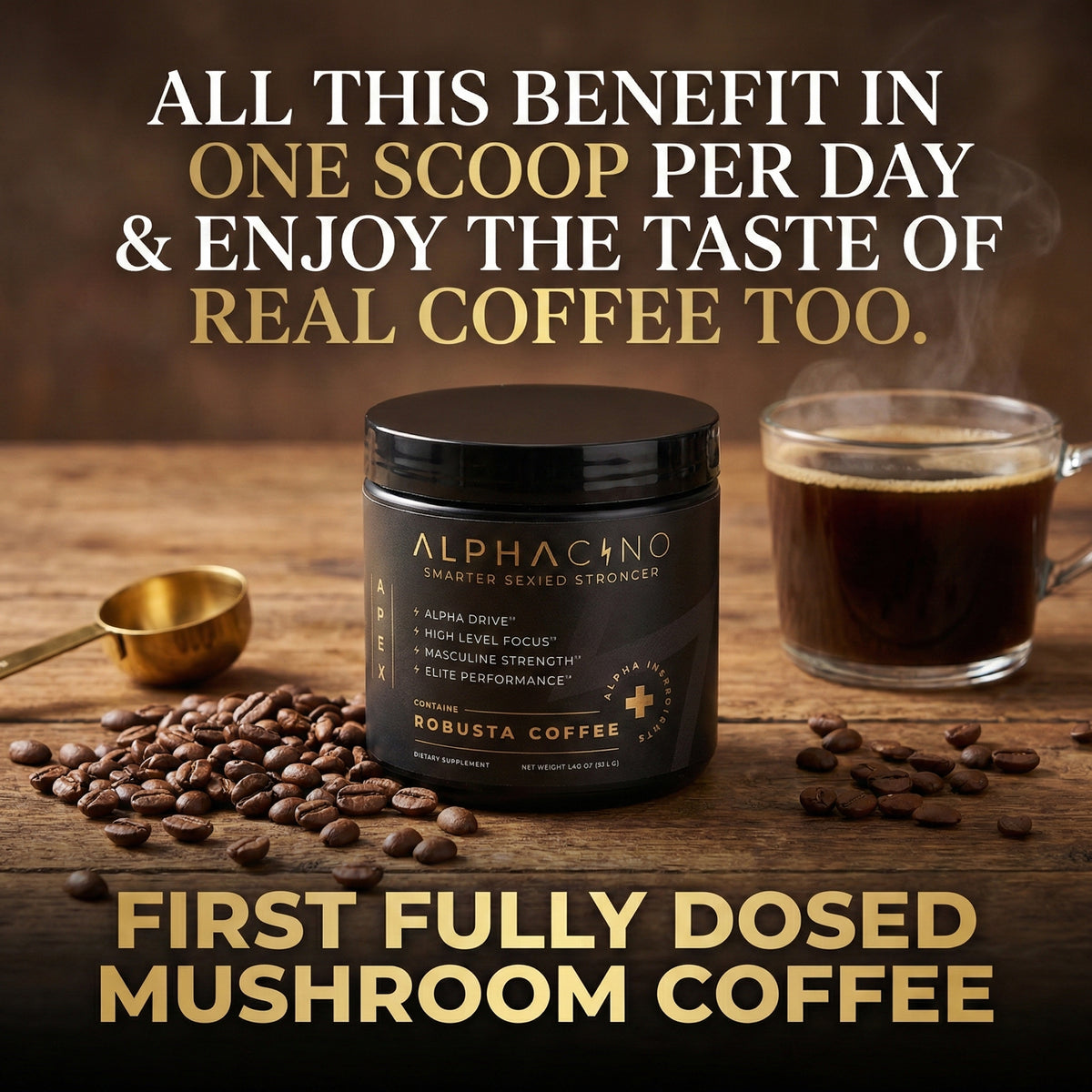
We picked a side. Alphacino includes KSM-66 ashwagandha at the full studied 600 mg dose, because stress is the problem most working men actually have, and its evidence is the strongest in this comparison. We do not sell tongkat ali and do not sneak it in underdosed; if your situation calls for it, buy it properly and separately. The rest of the formula is in the best mushroom coffee for men ranking.
Frequently asked questions
Is tongkat ali better than ashwagandha for testosterone?
In men who start low or stressed, tongkat ali's testosterone numbers are bigger. Ashwagandha's effect is more modest and appears to work through stress reduction. Neither replaces a medical workup for genuinely low testosterone.
Which is better for stress: tongkat ali or ashwagandha?
Ashwagandha. Cortisol and stress reduction is its primary, repeatedly trialled effect at 600 mg a day. Tongkat ali showed a smaller cortisol effect in one four-week study.
Can I take tongkat ali and ashwagandha together?
They are commonly stacked and no interaction is documented, but no trial has tested the combination. Run one at a time for eight weeks each so you can tell what is working.
How long does each take to work?
Both are slow herbs: the ashwagandha trials ran 8 weeks, the tongkat trials 4 weeks. Neither does anything the same day.
What doses were actually studied?
Ashwagandha: 600 mg a day of a root extract such as KSM-66. Tongkat ali: 200 mg a day of a standardized water-soluble extract. Blends that contain a sprinkle of either are not running the studied dose.
This article is general information, not medical advice. Talk to your doctor before starting any supplement, especially alongside medication.
Sources
- Chandrasekhar, K., et al. (2012). A prospective, randomized double-blind, placebo-controlled study of safety and efficacy of a high-concentration full-spectrum extract of ashwagandha root in reducing stress and anxiety in adults. Indian Journal of Psychological Medicine, 34(3), 255–262. doi:10.4103/0253-7176.106022
- Salve, J., et al. (2019). Adaptogenic and anxiolytic effects of ashwagandha root extract in healthy adults: a double-blind, randomized, placebo-controlled clinical study. Cureus, 11(12), e6466. doi:10.7759/cureus.6466
- Lopresti, A. L., et al. (2019). A randomized, double-blind, placebo-controlled, crossover study examining the hormonal and vitality effects of ashwagandha in aging, overweight males. American Journal of Men's Health, 13(2). doi:10.1177/1557988319835985
- Talbott, S. M., et al. (2013). Effect of Tongkat Ali on stress hormones and psychological mood state in moderately stressed subjects. Journal of the International Society of Sports Nutrition, 10, 28. doi:10.1186/1550-2783-10-28
- Tambi, M. I. B. M., et al. (2012). Standardised water-soluble extract of Eurycoma longifolia, Tongkat ali, as testosterone booster for managing men with late-onset hypogonadism? Andrologia, 44(s1), 226–230. doi:10.1111/j.1439-0272.2011.01168.x
- Rehman, S. U., Choe, K., & Yoo, H. H. (2016). Review on a traditional herbal medicine, Eurycoma longifolia Jack (Tongkat Ali): its traditional uses, chemistry, evidence-based pharmacology and toxicology. Molecules, 21(3), 331. doi:10.3390/molecules21030331