Short answer: Laird Superfood's PERFORM mushroom coffee is a real coffee first. It is a USDA organic Peruvian arabica, sold ground, whole bean, decaf, in K-Cups and as an instant, with "approximately 500 mg" of a four-mushroom extract blend stirred into each 10 g serving and about 100 mg of caffeine when you brew it the way the bag says1. The blend is chaga, lion's mane, maitake and cordyceps, from fruiting bodies, with no figure for any one of them1. At $20 for a 12 oz bag that is about 59 cents a cup, which makes it one of the cheapest mushroom coffees you can buy, and the coffee itself is good. The mushrooms are a different story: half a gram shared four ways is a fraction of what any human trial used, so buy it as a coffee with a sprinkle, not as a supplement. Laird's newer instants print more. Its Mushroom Instant Coffee holds 2,000 mg of lion's mane with 45 mg of caffeine2, which is a real dose of one mushroom and the most honest label in the range. We make Alphacino, so below you get Laird's whole coffee line read from its own product pages on 3 November 2026, each ingredient against the trials, the caffeine per product, the price per cup, and the comparison with RYZE, Four Sigmatic and our own tub, where Laird wins some lines and loses others.
Comparing Laird? Alphacino at a glance
| Laird PERFORM | Alphacino | |
|---|---|---|
| What it is | Ground arabica you brew; also whole bean, decaf, K‑Cups and an instant | Robusta instant coffee |
| Caffeine | About 100 mg brewed by the brand's method; 70 mg in the instant | 100 mg, with 100 mg L‑theanine |
| Lion's mane | Part of about 500 mg of four mushrooms; share not printed. 2,000 mg in the Mushroom Instant | 500 mg extract, printed |
| Ashwagandha | None | 600 mg KSM‑66, the trial dose |
| Other actives | Chaga, maitake and cordyceps in the same 500 mg; rhodiola and coffee cherry in FOCUS; reishi, olive leaf and vitamin D in DEFEND | 224 mg black maca, 50 mg S7 |
| Price a cup | About 59 cents ground, 58 cents instant, $1.50 K‑Cup | $1.67, or $1.50 in the 3 pack |
Pick Laird if you want a good organic coffee to brew at home with a small, unmeasured mushroom sprinkle at the lowest price in the category. Pick Alphacino if you want a real coffee's lift with L‑theanine beside it, every dose printed, and the full trial dose of KSM‑66 for stress.
30 cups a tub. 60‑day money-back guarantee; Laird's is 30 days. We make Alphacino; Laird's figures are from its own store, read 3 November 2026.
What is Laird Superfood coffee?
Laird Superfood is the company big-wave surfer Laird Hamilton formed in 2015 after years of doctoring his own morning coffee, with his wife, the volleyball player Gabby Reece, as its chief brand ambassador; Hamilton is a co-founder, a director and its "chief innovator" by the company's own story page3. It started with creamers and has grown into coffees, instant lattes, protein drinks, hot chocolate and mushroom powders, sold on its own store, through grocery chains it lists on a store locator, and on subscription. It is a listed company with an investor relations page, which matters for one reason: its labels and claims are the kind that get read by lawyers, and in our experience they are more careful than most in this category.
The coffee line is bigger than one product, and "Laird mushroom coffee" can mean five different things. The original is PERFORM, a Peruvian medium or dark roast with four mushroom extracts, sold ground, whole bean and as a Swiss Water decaf14. Beside it sit FOCUS, the same coffee with lion's mane, coffee cherry and rhodiola5, and DEFEND, with reishi, maitake, olive leaf and a vitamin D mushroom powder6. There are K‑Cups of the PERFORM blend7, and in 2026 the brand added freeze-dried instants: PERFORM, FOCUS and DIGEST at 70 mg of caffeine, and a Mushroom Instant Coffee built around 2,000 mg of lion's mane at 45 mg89102. The brand also sells the mushroom blend on its own as Organic Performance Mushrooms, a caffeine-free powder that prints 500 mg of each of the four mushrooms a serving11. That powder is the key to reading the coffees, because it tells you what a full dose of Laird's own blend looks like: 2,000 mg, four times what the coffee holds.
Every Laird coffee at a glance
| Product | What is in it, in label order | Caffeine | Mushroom dose | Price and cost a cup |
|---|---|---|---|---|
| PERFORM ground (medium or dark), whole bean | Organic Peruvian coffee, organic lion's mane extract, organic chaga, organic cordyceps, organic maitake extract1 | About 100 mg per 10 g serving by the brand's answer; see the caffeine section | "Approximately 500 mg of our mushroom blend per serving", no split1 | $20 for 12 oz, $16 on subscription; about 34 cups of 10 g, so 59 cents a cup, 47 cents on subscription (our arithmetic) |
| PERFORM decaf ground | Organic Peruvian coffee, organic cordyceps, organic chaga, organic maitake, organic lion's mane; Swiss Water Process4 | Not printed; decaffeinated beans | Same blend, no figure on the page | $20 for 12 oz |
| FOCUS ground | Organic Peruvian coffee, coffee cherry powder, organic lion's mane extract, rhodiola extract5 | Not printed; same bean as PERFORM | No amounts printed for any of the three actives | $20 for 12 oz |
| DEFEND ground | Organic Peruvian coffee, organic agaricus mushroom vitamin D powder, olive leaf powder, organic maitake extract, organic reishi extract; 15% of the daily value of vitamin D6 | Not printed | No amounts printed beyond the vitamin D | $20 for 12 oz |
| Functional Mushroom K‑Cups | Peruvian coffee with chaga, lion's mane, maitake and cordyceps extracts7 | Not printed | Not printed | $15 for 10, $1.50 a cup |
| PERFORM Instant | Organic instant coffee, organic lion's mane, cordyceps, chaga and maitake extracts8 | 70 mg a serving, printed | Not printed | $17.99 for 31 servings, 58 cents a cup; 5 sticks for $9.99, $2 a stick |
| FOCUS Instant | Organic instant coffee, organic lion's mane extract, organic coffee fruit extract (CognatiQ)9 | 70 mg, printed | Not printed | $17.99 for 3.5 oz |
| DIGEST Instant | Organic instant coffee, soluble fibre, a probiotic10 | Not stated on the listing | No mushrooms | $17.99 for 3.5 oz |
| Mushroom Instant Coffee | Organic arabica coffee, organic lion's mane mushroom, organic coffee fruit extract (CognatiQ)2 | 45 mg, printed | 2,000 mg lion's mane and 100 mg coffee fruit extract, printed | $24.99 for 4.4 oz; the page we read does not print a serving count |
| Organic Performance Mushrooms (powder, not coffee) | Organic chaga, lion's mane, maitake and cordyceps11 | None | 500 mg of each, 2,000 mg total, printed | $25 for 3.17 oz |
Three things stand out in that table. First, the ground coffees print no caffeine figure and no per-mushroom figure on the page; the 500 mg comes from the brand's answers in the Q&A on the PERFORM page, where it is given twice, once as "approximately 500 mg of the mushroom blend per serving" and once as "the nutrient equivalent of approx 500 mg"1. Second, the 2026 instants are labelled the way a supplement should be: caffeine printed, and in the Mushroom Instant Coffee the lion's mane and coffee fruit printed too2. Third, every Laird coffee is cheap per cup against the category. RYZE was $27 for 30 servings on sale against a $45 list price when we read it, 90 cents to $1.50 a cup12; Alphacino is $1.6713; Laird's ground coffee is 59 cents.
Laird mushroom coffee ingredients: what 500 mg of four mushrooms means
PERFORM's label order is coffee, then lion's mane extract, chaga, cordyceps and maitake extract1. On a food label the ingredients run in descending order of weight, so lion's mane is the largest of the four and maitake the smallest, but the brand gives no split, and when a customer asked how many grams of lion's mane a serving holds, the answer was the blend figure, not a lion's mane figure1. So the most you can say is that lion's mane is somewhere between 125 mg (an even split) and a little under 500 mg (if the other three were traces) in a 10 g scoop of grounds. The Performance Mushrooms powder, which prints 500 mg of each mushroom11, suggests the brand's own idea of a dose is four times what the coffee carries.
Two points in Laird's favour. The brand says its extracts are made from the fruiting body, the mushroom itself, not from mycelium grown on grain1. That matters because mycelium-on-grain products carry starch from the grain, and the standard method for measuring mushroom beta-glucan has to subtract that starch to find the beta-glucan at all14. And the ingredients are organic and named, with no "proprietary blend" hiding a dozen extras. What the label does not tell you is the beta-glucan content or the extraction ratio, and those are the numbers that decide whether 500 mg of "extract" is 500 mg of mushroom or the equivalent of two grams; beta-glucan content varies with the species, the part of the mushroom and the extraction used, so a weight alone does not settle it15.
There is one more thing to notice. Laird's own page for the Mushroom Instant Coffee says "Generally, 500 to 2,000 mg of a functional mushroom is considered an efficacious amount per serving", and uses that to justify its 2,000 mg of lion's mane2. By the brand's own standard, the 500 mg blend in PERFORM, split four ways, falls below the bottom of that range for each mushroom. We think the standard is roughly right, as the trials below show, and we hold our own 500 mg of lion's mane to it too.

Does Laird mushroom coffee work? Each ingredient against the trials
| Ingredient | What the human trials used | What Laird holds |
|---|---|---|
| Lion's mane (PERFORM, FOCUS, K‑Cups, the instants) | 3 g a day of fruiting-body tablets for 16 weeks improved cognitive scores in 30 older adults with mild impairment, and the gain faded four weeks after stopping16; 12 weeks of fruiting-body supplements improved a cognitive test score against placebo17; a single 1.8 g dose sped up a Stroop task at 60 minutes in 41 healthy adults aged 18 to 45, with a trend to lower stress after 28 days18 | The largest share of about 500 mg in PERFORM, unprinted; 2,000 mg in the Mushroom Instant Coffee, which sits inside the trial range |
| Cordyceps (PERFORM, K‑Cups, PERFORM Instant) | Cs-4 at 333 mg three times a day for 12 weeks raised the metabolic threshold in 20 healthy adults aged 50 to 7519; 4 g a day of a Cordyceps militaris blend for three weeks improved time to exhaustion and VO2max in 28 young adults, with nothing after one week20 | Third of four shares of 500 mg |
| Chaga (PERFORM, K‑Cups, PERFORM Instant) | No randomised human trial we could find. The human record is case reports of kidney damage from chaga powder at 10 to 15 g a day for months212223 | Second of four shares; far below the case-report doses |
| Maitake (PERFORM, DEFEND, K‑Cups, PERFORM Instant) | A phase I/II trial gave 34 postmenopausal breast cancer patients 0.1 to 5 mg per kg of a maitake extract twice a day for three weeks and found measurable immune effects that ran in both directions, stimulating some markers and depressing others24; a phase II study in 18 patients with myelodysplastic syndromes at 3 mg per kg twice a day for 12 weeks found better neutrophil and monocyte function25. No trial in healthy coffee drinkers | Smallest share of PERFORM; unprinted in DEFEND |
| Reishi (DEFEND) | 3 g a day for 16 weeks in 84 adults with type 2 diabetes and metabolic syndrome: no effect on blood sugar, HbA1c or any secondary outcome26; a spore powder lowered fatigue scores over four weeks in 48 breast cancer patients on endocrine therapy27 | Last on DEFEND's list, so the smallest ingredient; no figure |
| Rhodiola (FOCUS, Focused Energy K‑Cups) | 576 mg a day of the SHR-5 extract for 28 days cut burnout scores, improved attention on a computerised test and changed the cortisol response to waking in 60 adults with stress-related fatigue, against placebo28; a review of 11 randomised trials found possible benefits for physical and mental performance and a lack of independent replication29 | Last on FOCUS's list; no figure |
| Coffee cherry or coffee fruit extract (FOCUS, the instants) | A single 100 mg dose of whole coffee fruit concentrate raised plasma BDNF by about 143% over two hours in 10 fasted subjects; the authors called for larger studies30 | 100 mg printed in the Mushroom Instant Coffee, the trial dose; unprinted in FOCUS |
| Olive leaf (DEFEND) | An extract delivering 136 mg of oleuropein a day for six weeks lowered daytime systolic blood pressure by about 4 mmHg and LDL cholesterol in 60 pre-hypertensive men31 | Olive leaf powder, not a standardised extract; no figure |
| Vitamin D from agaricus mushrooms (DEFEND) | Mushrooms exposed to UV light make vitamin D2, and 2,000 IU of it from mushrooms raised blood 25-hydroxyvitamin D as well as a supplement did32; at a low daily dose of 15 micrograms, vitamin D3 raised winter blood levels more than D2 in a trial of 335 women33; in men with low vitamin D, 3,332 IU a day for a year raised testosterone in a randomised trial34 | 15% of the daily value a cup, which is 3 micrograms (120 IU) against the 20 microgram US daily value: a sliver of the trial doses |
The pattern is the same one we found in RYZE, Cuppa and Beyond Brew: the trials run from about 1 g to 4 g a day of one mushroom, and the coffee holds half a gram of four. Laird's ground coffee is a coffee with a sprinkle of mushrooms, and the brand's own wording, "just the right amount of adaptogens", is a taste claim rather than a dose claim. The exception is the Mushroom Instant Coffee. Two grams of lion's mane a serving is above the 1.8 g single dose that sped up a Stroop task and two thirds of the 3 g a day the 16-week trial used1816, and the 100 mg of coffee fruit is exactly the dose the BDNF study gave30. If you are buying Laird for the lion's mane, buy that one, not PERFORM. The caveat is the one we put on our own tub too: the lion's mane trials used fruiting-body powder or tablets, Laird's instant lists "organic lion's mane mushroom" without saying extract or powder, and nobody has run a trial on lion's mane dissolved in instant coffee.
What does work in every Laird coffee is the coffee. Caffeine from about 40 mg upwards improves alertness, vigilance, attention and reaction time in the research record35, and PERFORM brewed to the bag's instructions sits around 100 mg, the instants at 70, the Mushroom Instant at 45. The honest way to read the range is as a well-made organic coffee at three caffeine strengths, with the mushrooms as a bonus you should not pay extra for.
How much caffeine is in Laird mushroom coffee?
For the brewed coffees, Laird's answers disagree with each other on the same page. The brewing instructions on its plain Peruvian coffee say one tablespoon, about 10 g, per 8 oz of water "offers approximately 100 mg of caffeine per 8 oz serving"36, and the PERFORM Q&A repeats it: "each 10-gram serving contains approx 100 mg of caffeine"1. Another answer on the PERFORM page says a 12 oz cup "would be approximately 100 mg" and an 8 oz cup "around 65 to 70 mg"1. Both are plausible, because caffeine in brewed coffee depends on the dose of grounds and the brew, not the cup size; USDA's figure for an 8 oz cup of brewed coffee is roughly 95 mg37. If you follow the bag, 10 g of grounds to 8 oz, count on about 100 mg. If you brew it weaker, less. The K‑Cups print no figure and we have none to give you7.
The instants are simpler because they are printed: PERFORM Instant and FOCUS Instant 70 mg a serving89, the Mushroom Instant Coffee 45 mg, which the brand calls "roughly half what you'd find in a typical cup of coffee"2. Against the category, that puts Laird above RYZE's 48 mg for every product except the Mushroom Instant12, and level with Alphacino's printed 100 mg for the brewed coffees13. Our caffeine-by-brand guide lines every brand up on one table.
Two cups of PERFORM a day, which is what one of the Q&A customers drinks, is about 200 mg: half of the 400 mg a day that the European food safety authority found raises no safety concern for healthy adults, and at the 200 mg single-dose line it set38. Timing matters more than most people think: 400 mg taken even six hours before bed cut an hour from measured sleep in a controlled study39, and caffeine's half-life varies several-fold between people40, so a 3 pm cup of PERFORM is a fine idea for some and a bad one for others. Our timing guide covers when to stop.
Laird decaf mushroom coffee
PERFORM Decaf is the same Peruvian bean and the same four mushrooms, decaffeinated by the Swiss Water Process, which the page describes: green beans are soaked in water to pull out a caffeine-rich extract, the extract is run through activated charcoal to trap the caffeine, and the flavour-rich water is reused on new batches4. No chemical solvent is involved, and the page prints no residual caffeine figure. One oddity: the decaf page's own Q&A answers "how much caffeine is in one serving" with "around 100 mg of caffeine if following our brewing instructions", which is the answer for the caffeinated coffee and cannot be right for a Swiss Water decaf4. Read it as a copy error, not a dose. By USDA's table, brewed decaf carries about 1 mg of caffeine per 100 g, roughly 2 mg in an 8 oz cup41; Laird prints no figure of its own, and it should.
If you are switching to decaf for health reasons, the evidence is kinder than the folklore. In a meta-analysis of 28 cohorts with over a million participants, decaffeinated coffee was associated with a lower risk of type 2 diabetes in the same way caffeinated coffee was, which points at the coffee rather than the caffeine42. And the umbrella review of coffee and health found the largest risk reductions at three to four cups a day across most outcomes43; it pooled coffee as a whole and its summary does not separate decaf, so read it as evidence about coffee rather than about caffeine. A Swiss Water decaf with a mushroom sprinkle is a reasonable cup; it is just not a mushroom dose either.
What Laird coffee tastes like, and how to brew it
We will not pretend to a tasting note we cannot verify, but the brand's description is consistent across its pages: a high-altitude Peruvian bean grown above 4,000 feet, hand-picked, wet-processed, drum-roasted in small batches, and ground to a medium-fine 860 to 960 micron grind36. The mushroom extracts are described as tasteless in the cup, which fits a half-gram in ten grams of grounds; the K‑Cup page says you "won't taste the functional mushroom extracts"7. The brand calls the bean "less acidic" than some popular coffees in a Q&A answer and tags the product "low acid coffee"; it prints no pH or acidity measurement1. If acidity is why you are looking at mushroom coffee, our acidity guide explains what the mushrooms can and cannot do about it.
Brewing is ordinary coffee brewing. The ground coffee is not instant, so it goes in a drip machine, a French press, a pour-over or a cold brew, at one tablespoon per 8 oz, and the brand's answer for reusable K‑Cup pods is two tablespoons per 12 oz1. One thing a brewed mushroom coffee cannot do that an instant can: whatever is in the extract that does not dissolve stays in the filter with the grounds. Laird does not say how much of its 500 mg ends up in the cup, and neither does any other brewed mushroom coffee. The instants dissolve whole in 8 to 10 oz of hot or cold water8, which is the one technical argument for an instant mushroom coffee over a ground one, and it is the format Alphacino uses for the same reason.
Laird mushroom coffee side effects
At these doses the side effects of Laird's coffees are the side effects of coffee. Caffeine raises blood pressure a little in people who are not used to it, by about 4 mmHg systolic in the pooled trials of caffeine tablets and much less for coffee itself44; it disturbs sleep when taken within six hours of bed39; and stopping it after daily use brings headache, tiredness and low mood within 12 to 24 hours for a few days45. Our side-effects guide goes through each of those with the numbers.
The mushroom-specific risks are real but belong to doses far above a coffee. Chaga is the one to know: three published cases of oxalate kidney damage, one ending in dialysis, came from chaga powder at 10 to 15 g a day or four to five teaspoons a day for months212223. Laird's share of chaga is a fraction of 500 mg, a hundredth of that, and the brand's statement that its extracts are fruiting-body extracts does not change the arithmetic either way. Reishi, in DEFEND, has published liver injury cases from a powdered formulation46; again at supplement doses, not a last-place ingredient in a coffee. Mushroom allergy exists, at perhaps 1% from eating mushrooms in the one estimate we have47, and if you react to eating mushrooms you should not assume an extract in coffee is safe. Rhodiola in FOCUS reported only mild adverse events across the trials reviewed29. Laird says its supplement products are for adults 18 and over11.
On drug tests, Laird's FAQ answer is that its products will not show up on one11, and nothing in any of these coffees is on the federal urine panel; we walk through that panel in our RYZE evaluation, and the answer is the same for Laird.
Laird coffee price per cup, subscription and the guarantee
The ground coffees are $20 for a 12 oz bag, $76 for four and $114 for six; the subscription takes 20% off every order with a further 10% off the third order, and the store offers free shipping over $35 on subscription and over $70 otherwise1. At the brand's 10 g serving a 340 g bag is about 34 cups, so 59 cents a cup one-time and 47 cents on subscription; that is our arithmetic, and it holds for PERFORM, FOCUS, DEFEND and the decaf, which all list at $20. The plain Peruvian coffee without mushrooms is $17, so the four-mushroom blend costs you $3 a bag, about 9 cents a cup36. The K‑Cups are $1.50 a cup7. PERFORM Instant is $17.99 for 31 servings, 58 cents, and 25% off on subscription; the five-stick box is $9.99, $2 a stick8. The Mushroom Instant Coffee is $24.99 for a 4.4 oz bag, and because the page prints no serving count we cannot give you a per-cup price with a straight face2.
Every product carries a "30 Day Happiness Guarantee", a 30-day money-back window counted from the day you receive the order1. RYZE's is also 30 days12; ours is 6013; Beyond Brew's is a year. The PERFORM medium roast page showed a 4.87 out of 5 rating from 840 reviews when we read it, and the Performance Mushrooms powder over 2,000; those are the store's own widget figures, not a test111.
Laird vs RYZE
These are two different ideas of a mushroom coffee. RYZE is an instant with six mushrooms, MCT and coconut milk, 48 mg of caffeine a serving and no figure for any one mushroom, at 90 cents to $1.50 a cup depending on the sale12. Laird PERFORM is a ground arabica you brew, four mushrooms at a stated 500 mg, about 100 mg of caffeine, at 59 cents1. If you want to keep drinking coffee that tastes and hits like coffee, Laird is the closer match and the cheaper one. If you are stepping down from coffee and want a soft latte, RYZE is built for that. On the mushrooms there is little to choose: both are unsplit blends under a gram, and Laird at least tells you the weight. Our RYZE review reads its label line by line, and our RYZE evaluation answers whether it works.
Laird vs Four Sigmatic
Four Sigmatic is the brand Laird is most often shopped against, because both sell ground coffee with mushrooms in it. The difference is on the label: Four Sigmatic's Original ground coffee prints a 1,500 mg five-mushroom blend a serving, three times Laird's 500 mg, though like Laird it gives no per-mushroom split, and its Focus line prints no mushroom amounts at all. Laird is cheaper per cup, is organic across the range, and now has the better-labelled instants. If the mushroom weight is what you are paying for, Four Sigmatic's Original is the bigger sprinkle; our Four Sigmatic review has every product's label.
Laird vs Alphacino, label to label
| Line | Laird PERFORM ground | Laird Mushroom Instant | Alphacino |
|---|---|---|---|
| Form | Ground arabica, brewed1 | Freeze-dried arabica instant2 | Robusta instant13 |
| Caffeine | About 100 mg by the brand's method, not printed | 45 mg, printed | 100 mg, printed |
| L‑theanine | None | None | 100 mg, the pairing that improved task accuracy and alertness against caffeine alone in a trial of 44 adults48 |
| Lion's mane | Share of 500 mg, unprinted | 2,000 mg, printed, inside the trial range | 500 mg fruiting-body extract, printed, below the trial range |
| Other mushrooms | Chaga, cordyceps, maitake in the same 500 mg | None | None |
| Adaptogens | None (rhodiola in FOCUS, unprinted) | None | 600 mg KSM‑66 ashwagandha, the dose that cut stress scores and cortisol over 60 days49; 224 mg black maca 4:1, below the 1.5 to 3 g trial dose50 |
| Price a cup | 59 cents; 47 on subscription | $24.99 a bag, servings not printed | $1.67; $1.50 in the 3 pack; $1.49 on subscription |
| Guarantee | 30 days | 30 days | 60 days |
| Organic | USDA organic | USDA organic | Not certified organic |
Read honestly, each column wins something. Laird PERFORM wins on price and on being a proper brewed coffee with an organic seal. Laird's Mushroom Instant wins on lion's mane: 2,000 mg printed is four times what we print, and it is the only coffee in this comparison inside the trial range for that mushroom. Alphacino wins on caffeine paired with theanine, on ashwagandha at the full trial dose, and on the length of the guarantee. If lion's mane alone is your reason, Laird's instant is the better buy and we say so. If you want the mushroom plus a real lift, stress support with a trial behind it, and every dose on the jar, that is what we built.
Who should pick which
- You want a good organic coffee for the drip machine at the lowest price, and the mushrooms are a bonus: Laird PERFORM ground, 59 cents a cup.
- You want lion's mane at a dose a trial has tested, and low caffeine: Laird Mushroom Instant Coffee, 2,000 mg and 45 mg.
- You want the biggest mushroom sprinkle in a ground coffee: Four Sigmatic Original, 1,500 mg, three times Laird's.
- You are stepping down from coffee and want a soft latte: RYZE, 48 mg.
- You want a full coffee's caffeine with theanine beside it, ashwagandha at the trial dose and a printed lion's mane figure: Alphacino.
- You want no caffeine: Laird PERFORM Decaf, Swiss Water, with the same sprinkle.
Where Alphacino fits
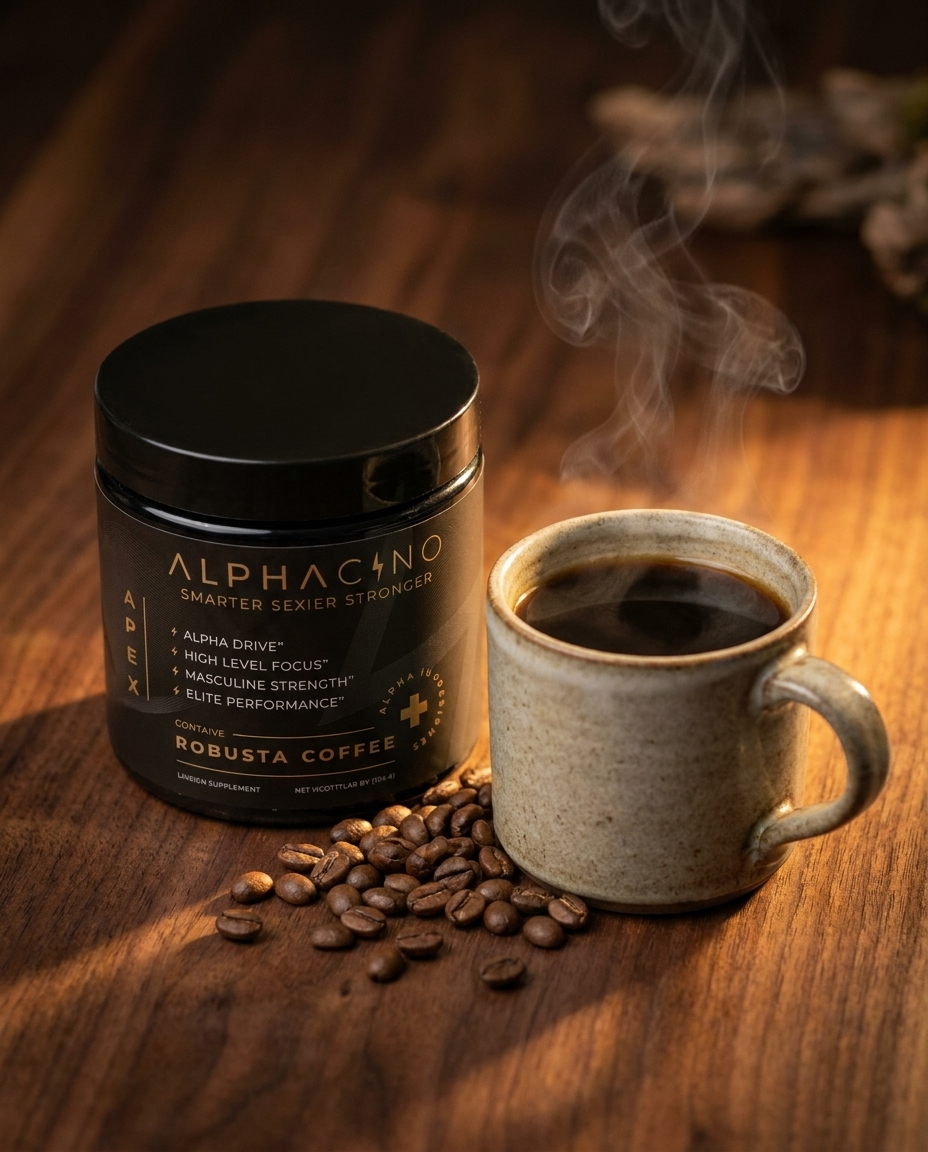
We make Alphacino, so take this section as a maker's case, checked against the same trials. Alphacino is a black robusta instant with a printed 100 mg of caffeine and 100 mg of L‑theanine beside it, the pairing that sharpened attention and softened the edge of caffeine in the trial that tested it48. Its lion's mane is a 500 mg fruiting-body extract, printed, so you can see it is below the trial doses rather than guess, and in this review that cuts against us: Laird's Mushroom Instant prints four times as much. Its ashwagandha is 600 mg of KSM‑66, the exact dose and extract that cut stress scores and cortisol over 60 days in a randomised trial49, and nothing in Laird's range has an equivalent. Its black maca is 224 mg of a 4:1 extract, below the 1.5 to 3 g that improved sexual desire in men over 12 weeks50, and we say so. There is no chaga, cordyceps or maitake in it, no coconut milk, no MCT, and 10 calories a cup13.
So the comparison is not "Laird or Alphacino" but "which cup". Laird is for the person who wants an organic coffee to brew and does not mind that the mushrooms are a sprinkle, or who wants a big lion's mane dose with little caffeine. Alphacino is for the man who wants the lift of a real coffee with the theanine that smooths it, a stress adaptogen at the dose the trial used, and every number on the back of the jar. Our lion's mane coffee guide compares the doses brand by brand, and our best mushroom coffee ranking scores the category on its labels. If that is the cup you want, it is $49.97 for 30 cups, with a 60-day guarantee.
Frequently asked questions
Does Laird mushroom coffee have caffeine?
Yes, except the decaf. The brewed PERFORM, FOCUS and DEFEND coffees are regular Peruvian arabica and give about 100 mg a cup when brewed at the bag's one tablespoon per 8 oz, by the brand's own answer. PERFORM Instant and FOCUS Instant print 70 mg a serving, the Mushroom Instant Coffee prints 45 mg, and PERFORM Decaf is decaffeinated by the Swiss Water Process with no residual figure printed.
How much caffeine is in Laird mushroom coffee?
About 100 mg per 10 g serving of the ground coffee, 70 mg in the PERFORM and FOCUS instants, and 45 mg in the Mushroom Instant Coffee. The brand gives two answers for the ground coffee on the same page, 100 mg per 8 oz under its brewing instructions and 65 to 70 mg per 8 oz in another reply; follow the bag and count on about 100 mg.
What mushrooms are in Laird mushroom coffee, and how much?
PERFORM holds organic chaga, lion's mane, maitake and cordyceps, about 500 mg of the blend per serving with no figure for any one mushroom, from fruiting-body extracts. FOCUS has lion's mane with coffee cherry and rhodiola, DEFEND has reishi and maitake with olive leaf and a vitamin D mushroom powder, and the Mushroom Instant Coffee prints 2,000 mg of lion's mane.
Is Laird mushroom coffee good for you?
It is as good for you as a good organic coffee, which the research record treats kindly at three to four cups a day. The caffeine works; the 500 mg of mushrooms is below every human trial dose for each mushroom, so do not expect a supplement effect from it. The Mushroom Instant Coffee's 2,000 mg of lion's mane is inside the trial range.
Does Laird mushroom coffee have side effects?
The side effects of coffee: a small rise in blood pressure if you are not used to caffeine, disturbed sleep if you drink it within six hours of bed, and withdrawal headaches if you stop. The mushroom risks on record, chaga kidney cases and reishi liver cases, came from powders at many grams a day, far above a coffee's share. People allergic to mushrooms should be careful.
Laird or RYZE?
Laird PERFORM is a brewed arabica with about 100 mg of caffeine and a stated 500 mg of four mushrooms at 59 cents a cup. RYZE is an instant latte with 48 mg of caffeine, six mushrooms with no stated weight, and MCT, at 90 cents to $1.50. Pick Laird if you want coffee that drinks like coffee; pick RYZE if you want something softer.
Is Laird coffee low acid?
The brand describes its Peruvian bean as having a less acidic flavour profile than some popular coffees and tags the product low acid, but it prints no acidity measurement. Treat it as a smooth medium roast rather than a tested low-acid coffee.
Where can you buy Laird mushroom coffee, and what does it cost?
On the brand's store at $20 a 12 oz bag, $16 on subscription, with a store locator for grocery chains. That is about 59 cents a cup brewed. The K-Cups are $15 for 10, the PERFORM Instant $17.99 for 31 servings, and the Mushroom Instant Coffee $24.99 a bag. Every order carries a 30-day money-back guarantee.
Sources
- Laird Superfood. Organic PERFORM Functional Mushroom Coffee, Medium Roast Ground, product page: ingredients, Q&A on the mushroom blend and caffeine, price, subscription terms and the 30-day guarantee, read 3 November 2026. lairdsuperfood.com
- Laird Superfood. Mushroom Instant Coffee product page: 2,000 mg lion's mane, 100 mg CognatiQ coffee fruit extract, 45 mg caffeine per serving, price and FAQs, read 3 November 2026. lairdsuperfood.com
- Laird Superfood. Our Story page: Laird Hamilton's founding of the company in 2015 and the roles of Laird Hamilton and Gabby Reece, read 3 November 2026. lairdsuperfood.com
- Laird Superfood. Organic Decaf Perform Functional Mushroom Ground Medium Roast Coffee product page: Swiss Water Process, four mushrooms, price, read 3 November 2026. lairdsuperfood.com
- Laird Superfood. FOCUS Medium Roast Ground Coffee product page: lion's mane extract, coffee cherry powder and rhodiola extract, price, read 3 November 2026. lairdsuperfood.com
- Laird Superfood. DEFEND Functional Mushroom Coffee, Medium Roast, product page: reishi and maitake extracts, olive leaf powder, agaricus mushroom vitamin D powder, 15% daily value of vitamin D, price, read 3 November 2026. lairdsuperfood.com
- Laird Superfood. Functional Mushroom Coffee K-Cups product page: 10 count, four mushroom extracts, price, read 3 November 2026. lairdsuperfood.com
- Laird Superfood. PERFORM Instant Coffee product page: 70 mg caffeine per serving, 31 servings a bag, four mushroom extracts, price, read 3 November 2026. lairdsuperfood.com
- Laird Superfood. FOCUS Instant Coffee product page: 70 mg caffeine per serving, lion's mane and coffee fruit extracts, price, read 3 November 2026. lairdsuperfood.com
- Laird Superfood. DIGEST Instant Coffee product listing: organic instant coffee with soluble fibre and a probiotic, price, read 3 November 2026. lairdsuperfood.com
- Laird Superfood. Organic Performance Mushrooms product page: 500 mg of each of four mushrooms, caffeine free, drug test and age FAQs, price, read 3 November 2026. lairdsuperfood.com
- RYZE Superfoods. Mushroom Coffee (30 Servings) product page: price, servings and the 48 mg caffeine figure, read 2 November 2026. ryzesuperfoods.com
- Alphacino. Supplement Facts panel, ingredients list, directions and prices, Alphacino Premium Mushroom Coffee, as printed on the jar and shown on the product page, read 3 November 2026. alphacino.com
- McCleary, B. V., et al. (2016). Measurement of β-Glucan in Mushrooms and Mycelial Products. Journal of AOAC International, 99(2), 364 to 373. doi:10.5740/jaoacint.15-0289
- Timm, T. G., Costa, T. M., Alberton, M. D., Helm, C. V., & Tavares, L. B. B. (2023). Mushroom beta-glucans: application and innovation for food industry and immunotherapy. Applied Microbiology and Biotechnology, 107(16), 5035 to 5049. doi:10.1007/s00253-023-12656-4
- Mori, K., et al. (2009). Improving effects of the mushroom Yamabushitake (Hericium erinaceus) on mild cognitive impairment: a double-blind placebo-controlled clinical trial. Phytotherapy Research, 23(3), 367 to 372. doi:10.1002/ptr.2634
- Saitsu, Y., Nishide, A., Kikushima, K., Shimizu, K., & Ohnuki, K. (2019). Improvement of cognitive functions by oral intake of Hericium erinaceus. Biomedical Research, 40(4), 125 to 131. doi:10.2220/biomedres.40.125
- Docherty, S., et al. (2023). The acute and chronic effects of Lion's Mane mushroom supplementation on cognitive function, stress and mood in young adults: a double-blind, parallel groups, pilot study. Nutrients, 15(22), 4842. doi:10.3390/nu15224842
- Chen, S., et al. (2010). Effect of Cs-4 (Cordyceps sinensis) on exercise performance in healthy older subjects: a double-blind, placebo-controlled trial. Journal of Alternative and Complementary Medicine, 16(5), 585 to 590. doi:10.1089/acm.2009.0226
- Hirsch, K. R., Smith-Ryan, A. E., Roelofs, E. J., Trexler, E. T., & Mock, M. G. (2017). Cordyceps militaris improves tolerance to high-intensity exercise after acute and chronic supplementation. Journal of Dietary Supplements, 14(1), 42 to 53. doi:10.1080/19390211.2016.1203386
- Kwon, O., Kim, Y., Paek, J. H., Park, W. Y., Han, S., Sin, H., & Jin, K. (2022). Chaga mushroom-induced oxalate nephropathy that clinically manifested as nephrotic syndrome: a case report. Medicine, 101(10), e28997. doi:10.1097/MD.0000000000028997
- Lee, S., Lee, H. Y., Park, Y., Ko, E. J., Ban, T. H., Chung, B. H., ... & Yang, C. W. (2020). Development of end stage renal disease after long-term ingestion of chaga mushroom: case report and review of literature. Journal of Korean Medical Science, 35(19), e122. doi:10.3346/jkms.2020.35.e122
- Kikuchi, Y., Seta, K., Ogawa, Y., Takayama, T., Nagata, M., Taguchi, T., & Yahata, K. (2014). Chaga mushroom-induced oxalate nephropathy. Clinical Nephrology, 81(6), 440 to 444. doi:10.5414/CN107655
- Deng, G., et al. (2009). A phase I/II trial of a polysaccharide extract from Grifola frondosa (Maitake mushroom) in breast cancer patients: immunological effects. Journal of Cancer Research and Clinical Oncology, 135(9), 1215 to 1221. doi:10.1007/s00432-009-0562-z
- Wesa, K. M., et al. (2015). Maitake mushroom extract in myelodysplastic syndromes (MDS): a phase II study. Cancer Immunology, Immunotherapy, 64(2), 237 to 247. doi:10.1007/s00262-014-1628-6
- Klupp, N. L., Kiat, H., Bensoussan, A., Steiner, G. Z., & Chang, D. H. (2016). A double-blind, randomised, placebo-controlled trial of Ganoderma lucidum for the treatment of cardiovascular risk factors of metabolic syndrome. Scientific Reports, 6, 29540. doi:10.1038/srep29540
- Zhao, H., et al. (2012). Spore Powder of Ganoderma lucidum Improves Cancer-Related Fatigue in Breast Cancer Patients Undergoing Endocrine Therapy: A Pilot Clinical Trial. Evidence-Based Complementary and Alternative Medicine, 2012, 809614. doi:10.1155/2012/809614
- Olsson, E. M., et al. (2009). A randomised, double-blind, placebo-controlled, parallel-group study of the standardised extract shr-5 of the roots of Rhodiola rosea in the treatment of subjects with stress-related fatigue. Planta Medica, 75(2), 105 to 112. doi:10.1055/s-0028-1088346
- Hung, S. K., et al. (2011). The effectiveness and efficacy of Rhodiola rosea L.: a systematic review of randomized clinical trials. Phytomedicine, 18(4), 235 to 244. doi:10.1016/j.phymed.2010.08.014
- Reyes-Izquierdo, T., et al. (2013). Modulatory effect of coffee fruit extract on plasma levels of brain-derived neurotrophic factor in healthy subjects. British Journal of Nutrition, 110(3), 420 to 425. doi:10.1017/s0007114512005338
- Lockyer, S., et al. (2017). Impact of phenolic-rich olive leaf extract on blood pressure, plasma lipids and inflammatory markers: a randomised controlled trial. European Journal of Nutrition, 56(4), 1421 to 1432. doi:10.1007/s00394-016-1188-y
- Keegan, R. J., et al. (2013). Photobiology of vitamin D in mushrooms and its bioavailability in humans. Dermato-Endocrinology, 5(1), 165 to 176. doi:10.4161/derm.23321
- Tripkovic, L., et al. (2017). Daily supplementation with 15 μg vitamin D2 compared with vitamin D3 to increase wintertime 25-hydroxyvitamin D status in healthy South Asian and white European women: a 12-wk randomized, placebo-controlled food-fortification trial. American Journal of Clinical Nutrition, 106(2), 481 to 490. doi:10.3945/ajcn.116.138693
- Pilz, S., et al. (2011). Effect of vitamin D supplementation on testosterone levels in men. Hormone and Metabolic Research, 43(3), 223 to 225. doi:10.1055/s-0030-1269854
- McLellan, T. M., Caldwell, J. A., & Lieberman, H. R. (2016). A review of caffeine's effects on cognitive, physical and occupational performance. Neuroscience & Biobehavioral Reviews, 71, 294 to 312. doi:10.1016/j.neubiorev.2016.09.001
- Laird Superfood. Organic Peruvian Medium Roast Ground Coffee product page: bean altitude, grind, brewing instructions and the figure of approximately 100 mg caffeine per 8 oz, price, read 3 November 2026. lairdsuperfood.com
- U.S. Department of Agriculture, Agricultural Research Service (2018). SR Legacy, via FoodData Central: brewed coffee (fdcId 171890). Serving value calculated from the per-100 g figure and the USDA 8 oz portion. fdc.nal.usda.gov
- EFSA Panel on Dietetic Products, Nutrition and Allergies (2015). Scientific opinion on the safety of caffeine. EFSA Journal, 13(5), 4102. doi:10.2903/j.efsa.2015.4102
- Drake, C., Roehrs, T., Shambroom, J., & Roth, T. (2013). Caffeine effects on sleep taken 0, 3, or 6 hours before going to bed. Journal of Clinical Sleep Medicine, 9(11), 1195 to 1200. doi:10.5664/jcsm.3170
- Grzegorzewski, J., Bartsch, F., Köller, A., & König, M. (2021). Pharmacokinetics of caffeine: a systematic analysis of reported data for application in metabolic phenotyping and liver function testing. Frontiers in Pharmacology, 12, 752826. doi:10.3389/fphar.2021.752826
- U.S. Department of Agriculture, Agricultural Research Service (2018). SR Legacy, via FoodData Central: coffee, brewed, prepared with tap water, decaffeinated (fdcId 171889), 1 mg caffeine per 100 g; the 8 oz figure is calculated from the per-100 g value, read 3 November 2026. fdc.nal.usda.gov
- Ding, M., et al. (2014). Caffeinated and decaffeinated coffee consumption and risk of type 2 diabetes: a systematic review and a dose-response meta-analysis. Diabetes Care, 37(2), 569 to 586. doi:10.2337/dc13-1203
- Poole, R., et al. (2017). Coffee consumption and health: umbrella review of meta-analyses of multiple health outcomes. BMJ, 359, j5024. doi:10.1136/bmj.j5024
- Noordzij, M., Uiterwaal, C. S., Arends, L. R., Kok, F. J., Grobbee, D. E., & Geleijnse, J. M. (2005). Blood pressure response to chronic intake of coffee and caffeine: a meta-analysis of randomized controlled trials. Journal of Hypertension, 23(5), 921 to 928. doi:10.1097/01.hjh.0000166828.94699.1d
- Juliano, L. M., & Griffiths, R. R. (2004). A critical review of caffeine withdrawal: empirical validation of symptoms and signs, incidence, severity, and associated features. Psychopharmacology, 176(1), 1 to 29. doi:10.1007/s00213-004-2000-x
- Yuen, M. F., Ip, P., Ng, W. K., & Lai, C. L. (2004). Hepatotoxicity due to a formulation of Ganoderma lucidum (lingzhi). Journal of Hepatology, 41(4), 686 to 687. doi:10.1016/j.jhep.2004.06.016
- Koivikko, A., & Savolainen, J. (1988). Mushroom allergy. Allergy, 43(1), 1 to 10. doi:10.1111/j.1398-9995.1988.tb02037.x
- Giesbrecht, T., et al. (2010). The combination of L-theanine and caffeine improves cognitive performance and increases subjective alertness. Nutritional Neuroscience, 13(6), 283 to 290. doi:10.1179/147683010X12611460764840
- Chandrasekhar, K., Kapoor, J., & Anishetty, S. (2012). A prospective, randomized double-blind, placebo-controlled study of safety and efficacy of a high-concentration full-spectrum extract of ashwagandha root in reducing stress and anxiety in adults. Indian Journal of Psychological Medicine, 34(3), 255 to 262. doi:10.4103/0253-7176.106022
- Gonzales, G. F., et al. (2002). Effect of Lepidium meyenii (maca) on sexual desire and its absent relationship with serum testosterone levels in adult healthy men. Andrologia, 34(6), 367 to 372. doi:10.1046/j.1439-0272.2002.00519.x