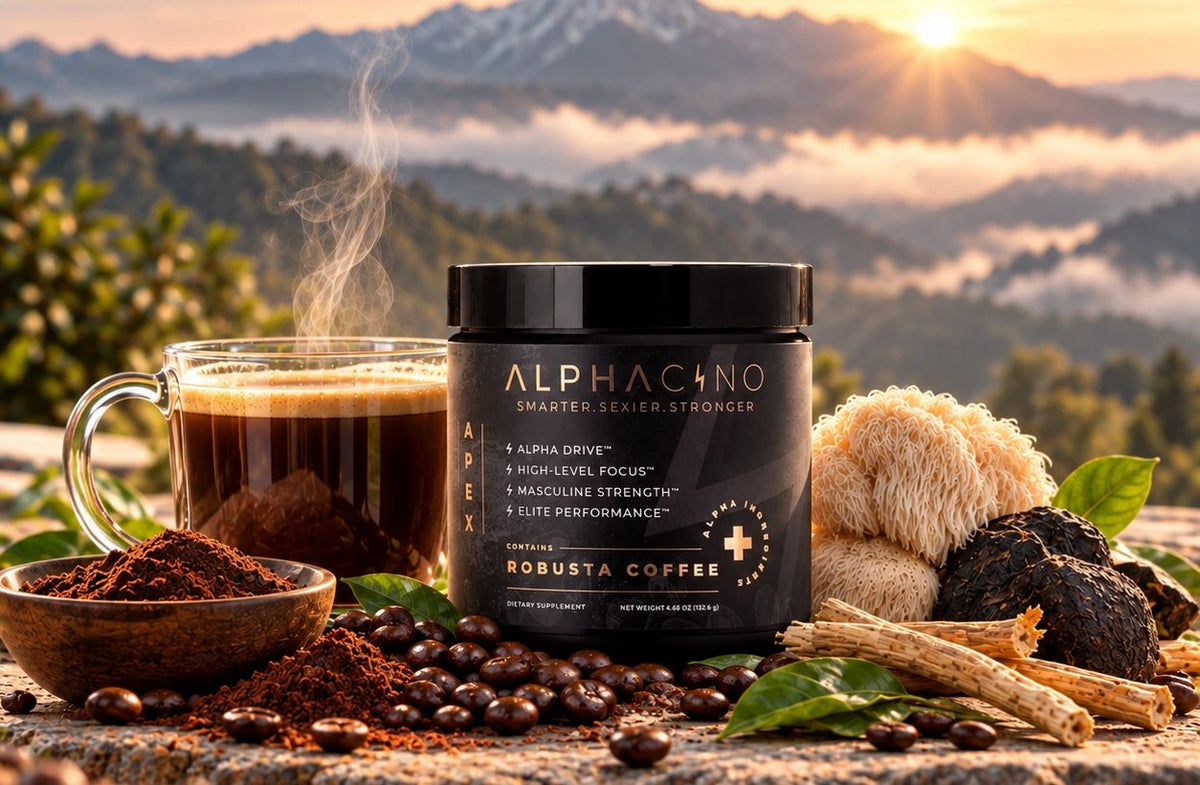
Short answer: S7 is a patented blend of seven plant extracts and powders, green coffee bean, green tea, turmeric, tart cherry, blueberry, broccoli and a leafy green from the cabbage family, standardized to at least 60% polyphenols and sold at a 50 mg dose by the ingredient maker VDF FutureCeuticals12. It contains no nitric oxide and no nitrate. The idea is that its polyphenols mop up the oxidants that destroy the nitric oxide your blood vessels already make, so more of it survives. Three small human studies, all run with the maker, have measured it. The strongest was a 90-day placebo-controlled trial in 42 overweight adults: nitric oxide carried in the blood rose 53% on 50 mg a day and 34% on 25 mg, against 7% on placebo3. None of the three tested what people usually buy a nitric oxide product for: a bigger pump, more endurance, lower blood pressure or better erections. Below: what is in S7, how it is meant to work, what each study found and what it did not test, the 50 mg dose, the caffeine, safety, and why every scoop of Alphacino carries 50 mg of it4.
What is S7?
S7 is an ingredient, not a finished supplement. FutureCeuticals, an ingredient company based in Momence, Illinois, launched it in 2018 for sports nutrition products, with a recommended dose of 50 mg2. Brands buy it and add it to their own formulas, so you meet it on a label as "S7 Blend", usually with its seven ingredients listed underneath, in sports nutrition products and in coffees like ours.
It has a family history. The same research group first tested a much larger blend of 29 fruit and vegetable ingredients, called SPECTRA, on oxidant markers in blood5. S7 is that idea cut down to the seven ingredients the researchers judged most active; the 2018 paper calls it SPECTRA761.
Fifty milligrams is a twentieth of a gram, small next to most supplement doses. The blend is concentrated: the published specification is at least 60% total polyphenols, 30% catechins and 3% curcuminoids1.
The seven ingredients in S7
Here is the list exactly as it appears under "S7 Blend 50 mg" on the Alphacino tub4, with what each plant brings:
| Ingredient on the label | What it is | Main compounds |
|---|---|---|
| Green coffee bean extract | Unroasted coffee beans | Chlorogenic acids, a little caffeine |
| Green tea leaf extract | Unfermented tea leaves | Catechins, including EGCG |
| Turmeric root extract | The yellow curry spice | Curcumin |
| Sour cherry fruit powder | Tart cherry | Anthocyanins |
| Blueberry fruit powder | Whole blueberry | Anthocyanins |
| Broccoli head powder | Whole broccoli | Plant polyphenols |
| Collards leaf powder | Collard greens | Plant polyphenols |
One difference worth knowing: the maker's launch material and the research papers list kale as the seventh plant21, while our tub lists collard leaf4. Kale and collards are close relatives, both leafy forms of cabbage. We print the list as the tub reads.
What 50 mg of S7 actually contains
The 2021 trial published the typical chemical profile of a serving3. These are the figures, as the paper lists them:
| Compound | In 25 mg | In 50 mg | Share of the blend |
|---|---|---|---|
| Catechins | 9.2 mg | 18.4 mg | 36.8% |
| Chlorogenic acids | 6.6 mg | 13.2 mg | 26.2% |
| EGCG | 4.6 mg | 9.2 mg | 18.4% |
| Curcumin | 1.1 mg | 2.1 mg | 4.2% |
| Caffeine | 0.9 mg | 1.7 mg | 3.4% |
| Anthocyanins | 26.3 micrograms | 52.5 micrograms | trace |
Two things follow from that table. S7 is mostly green tea and green coffee polyphenols by weight, with turmeric as a smaller part and the fruit and vegetable powders present in trace amounts. And it is not a stimulant: 1.7 mg of caffeine is under 2% of the 100 mg in a scoop of Alphacino4.
What is nitric oxide, and why do men care about it?
Nitric oxide is a gas made by the thin layer of cells lining your blood vessels, the endothelium. It signals the muscle in the vessel wall to relax, and a relaxed vessel is a wider one. The discovery came in two steps. In 1980 Robert Furchgott showed that isolated arteries only relaxed in response to acetylcholine when their inner lining was intact, because the lining released a relaxing substance7. In 1987 Palmer, Ferrige and Moncada showed that the substance was nitric oxide8.
That is why nitric oxide sits behind so many men's health claims. Wider vessels carry more blood to working muscle, which is the physiology behind the gym word "pump". And in 1992 researchers at Johns Hopkins showed, in rats, that nitric oxide released by nerves in the penis is a physiological mediator of erection: small doses of a drug that blocks the enzyme making it abolished erections9.
The lining that makes nitric oxide also ages. In a study of 238 healthy people with no heart risk factors, the artery's ability to widen in response to blood flow, a standard test of endothelial function, held steady in men up to about 40 and then declined by 0.21% a year; in women it held until the early 50s10. If you are a man past 40, that is the part of this story that applies to you, and the rest of that picture is in mushroom coffee for men over 40.
One practical point about the research: nitric oxide lasts only seconds in the body, so studies cannot measure it directly in a vein. The S7 trials measured nitric oxide bound to haemoglobin in red blood cells, written NOHb, using a specialised spectrometer3. When this page says S7 "raised nitric oxide", that is the measure behind it.
How S7 is supposed to work
Most products sold to raise nitric oxide give the body more raw material. Beetroot juice and leafy greens supply nitrate, which the body turns into nitrite and then nitric oxide. Citrulline and arginine feed the enzyme that makes nitric oxide from scratch. S7 does neither. Its argument is about losing less of what you already make.
Nitric oxide has a weakness: it reacts almost instantly with superoxide, an oxygen radical that cells produce, and the product of that reaction, peroxynitrite, is itself damaging11. Where there is a lot of superoxide, nitric oxide is destroyed before it can relax anything. The 1987 experiment that identified nitric oxide showed the same thing from the other side: its relaxing effect was enhanced by superoxide dismutase, the enzyme that clears superoxide8.
S7's polyphenols are antioxidants, and the claim is that by lowering superoxide and related oxidants in the blood, they leave more nitric oxide free to work. The S7 studies measured both sides of that see-saw, and both moved in the expected direction: oxidant production down, bound nitric oxide up63. The authors of the 90-day trial are careful to say they cannot yet confirm that one caused the other3.
What the S7 studies found
We found three published human studies of S7 in PubMed and the journal databases as of October 2026. Here they are side by side:
| Study | Who took part | Design | Dose | Nitric oxide result |
|---|---|---|---|---|
| Nemzer and colleagues, 20186 | 8 healthy adults | Double-blind, placebo-controlled crossover; single doses | Two doses of S7 (the amounts are not given in the abstract) | Bound nitric oxide rose to 1.7 and 2.3 times the starting level |
| Nemzer and colleagues, 20213 | 42 overweight or slightly obese adults aged 40 to 70 who finished the study | Randomized, double-blind, placebo-controlled; once daily for 90 days | Placebo, 25 mg or 50 mg | Up 53.4% on 50 mg and 33.9% on 25 mg, against 6.7% on placebo; 50 mg beat 25 mg |
| Fink and colleagues, 20251 | 28 adults 18 to 24 days after a moderate COVID-19 infection (the paper calls the blend PB-Blend) | Randomized, double-blind; single dose; no placebo group | 50 mg, compared with 1,000 mg of vitamin C | Up 33% after S7; no rise after vitamin C |
The 90-day trial is the one to weigh most, because it had a placebo group, ran for three months and tested two doses. Besides the nitric oxide result, mitochondrial oxidant production in blood cells fell by about 75% on 50 mg and 54% on 25 mg, while it rose by more than 12% on placebo3. Its participants averaged about 58 years old with a body mass index around 31, which makes it more relevant to a middle-aged man than a study of young athletes would be.
The "230%" you see in S7 marketing comes from the 2018 pilot. The trade coverage of the launch reported that S7 raised nitric oxide by 230% over baseline2; the paper itself reports bound nitric oxide reaching 2.3 times its starting level at the higher dose, in eight people, after one dose6. It is a real result, but it is the smallest study of the three, and the 90-day trial's 53% is the better guide to what daily use does.
What the studies do not show
This is the part most S7 pages skip, so here it is plainly:
- No performance outcome. None of the three studies measured strength, endurance, pump, oxygen uptake or recovery. The 90-day trial's authors list sports performance as a question for future studies3.
- No blood pressure or blood flow outcome. The 2021 paper reports blood pressure only at the start of the study, and the 2025 paper reports blood pressure and artery dilation only at the start; neither reports them after S731.
- No sexual health or testosterone outcome. Nitric oxide matters for erections, but no S7 study looked at them.
- Small samples. 8, 42 and 28 people. The 2021 authors name the small sample as a limitation themselves, and say the results may not apply outside an overweight middle-aged group3.
- All run with the maker. FutureCeuticals staff co-authored all three papers, and the 2025 paper states that FutureCeuticals funded it1. The blood measurements were made with methods from Noxygen, the German lab whose staff are also co-authors. We found no independent replication.
None of that makes the results false. It makes them early, and far thinner than the evidence for nitrate, where the reviews below pool 16 and 80 trials.
S7 benefits, ranked by the evidence
| Claimed benefit | What has been measured | Our verdict |
|---|---|---|
| Raises the nitric oxide in your blood | A 90-day placebo-controlled trial plus two single-dose studies361 | Measured, consistent, small and maker-run |
| Lowers oxidant production in blood cells | The same three studies | Measured, same caveats |
| Better blood flow and "pump" | Not measured | Plausible from the mechanism, untested |
| Endurance or strength | Not measured | Untested |
| Lower blood pressure | Not measured | Untested |
| Erections or libido | Not measured | Untested |
| Testosterone | Not measured | No reason to expect an effect |
If you read a label that promises S7 will build muscle, raise testosterone or fix erections, that label has gone past the evidence. What S7 can honestly claim is a measured rise in the nitric oxide your blood carries, at a dose small enough to fit into a scoop of coffee.
How much S7: is 50 mg enough?
Fifty milligrams is the maker's dose2, the top dose in the 90-day trial and the only dose in the 2025 study. In the 90-day study both 25 mg and 50 mg raised bound nitric oxide over placebo, and 50 mg raised it significantly more than 25 mg did3. No placebo-controlled daily trial has tested more than 50 mg, so there is no evidence that a bigger dose does more.
Timing barely matters. In the single-dose study the effect on oxidant markers was greatest about two hours after taking it1, and the 90-day trial gave one capsule every morning with food3. Daily use is what the long trial tested, so that is what to copy: one 50 mg dose a day, at whatever time you take your supplement or drink your coffee.
Compare that with the other nitric oxide ingredients. The citrulline trial that improved erections used 1.5 g a day12, thirty times the S7 dose, and the nitrate trials use beetroot juice or nitrate salts13. That small dose is the practical reason S7 turns up in coffees and capsules: it fits.
Does S7 have caffeine? Is it a stimulant?
Almost none. A 50 mg serving contains about 1.7 mg of caffeine from its green coffee and green tea3. A scoop of Alphacino has 100 mg of caffeine from its robusta coffee4, so S7 would account for under 2% of it even if it were counted separately. S7 is not a stimulant and does not give you the jolt of a pre-workout; the energy in a cup of Alphacino comes from the coffee, paired with 100 mg of L-theanine. How that compares with other brands is in how much caffeine is in mushroom coffee.
S7 vs beetroot, citrulline and other nitric oxide boosters
| Ingredient | How it raises nitric oxide | Dose in trials | Best human evidence |
|---|---|---|---|
| S7 | Protects the nitric oxide you already make, by lowering oxidants | 50 mg | Bound nitric oxide up 53% after 90 days in 42 overweight adults, against 7% on placebo3 |
| Nitrate (beetroot juice, leafy greens) | Supplies nitrate, which the body converts to nitric oxide | Beetroot juice or nitrate salts | Systolic blood pressure about 4.4 mmHg lower across 16 trials13; a small performance gain in recreationally active young men across 80 trials, none in well-trained endurance athletes14 |
| L-citrulline | Converted to arginine, the raw material for nitric oxide | 1.5 g a day | In 24 men with mild erectile dysfunction, erection hardness improved to normal in 12 while on citrulline, against 2 of the same men on placebo12 |
| L-arginine | The raw material itself | Varies | Much of an oral dose is broken down before it reaches the blood, which is why citrulline is used instead12 |
The honest summary: if you want a measured effect on blood pressure or endurance, nitrate has the stronger evidence, and if erection quality is the goal, citrulline has the trial. S7's case is different. It has blood-marker evidence at a 50 mg dose, it works by a different route from both, and at 50 mg it fits into a daily scoop of coffee. For the men's vitality ingredients more broadly, including what can and cannot move testosterone, see mushroom coffee for men's vitality and testosterone.
Is S7 safe? Side effects
The amounts in S7 are small. The ingredient most often linked to safety concerns is green tea extract: the European Food Safety Authority concluded that 800 mg or more of EGCG a day, taken as a supplement, raised liver enzymes in clinical trials, and that the average green tea drinker in Europe takes in 90 to 300 mg a day from the cup15. A 50 mg dose of S7 contains 9.2 mg of EGCG3, under an eightieth of that threshold, and 2.1 mg of curcumin. The tub also lists green tea leaf extract among its other ingredients; that list carries no amounts4.
The three S7 papers do not report side effects either way; they were small and short and were not designed to find rare ones. Sensible cautions:
- Blood pressure, heart or erectile dysfunction medicines. S7 is not a nitrate, but anything sold to raise nitric oxide is worth mentioning to your doctor if you take these, especially nitrates for chest pain.
- Pregnancy and breastfeeding. S7 has not been studied in either.
- Caffeine is the bigger factor. In a cup of Alphacino, the 100 mg of caffeine matters far more for sleep and jitters than the S7 does. The full picture is in mushroom coffee side effects.
Why S7 is in Alphacino

Every scoop of Alphacino carries 50 mg of S7, the dose used in the trials, alongside 600 mg of KSM-66 ashwagandha, 500 mg of lion's mane fruiting-body extract, 224 mg of black maca 4:1 extract, 100 mg of L-theanine and 100 mg of caffeine from robusta coffee4. We put it there for one reason: it has placebo-controlled human data on nitric oxide at a dose small enough to go into a coffee scoop.
We will also be straight about where it sits. S7 is the smallest line on our label and the one with the thinnest evidence for outcomes you can feel. We do not sell it as a pump, a performance aid or a testosterone booster, and you should not buy Alphacino for S7 alone. The ingredients doing the heavier lifting have their own guides: KSM-66 ashwagandha for men, lion's mane for men and black maca for men, and the whole formula is set against the evidence in mushroom coffee for men's vitality. If you train, the timing of a cup around a workout is in mushroom coffee for the gym.

Alphacino at a glance
Real robusta coffee with 100 mg of caffeine and 100 mg of L‑theanine, 600 mg of KSM‑66 ashwagandha, 500 mg of lion's mane, 224 mg of black maca and 50 mg of S7, every dose printed on the tub.
30 cups a tub: $1.67 a cup, or $1.50 a cup in the 3 pack. 60‑day money-back guarantee.
Frequently asked questions
What is S7?
S7 is a patented ingredient made by VDF FutureCeuticals: a 50 mg blend of seven plant extracts and powders (green coffee bean, green tea, turmeric, tart cherry, blueberry, broccoli and a leafy green, kale or collards) standardized to at least 60% polyphenols. It is sold to other brands to support the body's own nitric oxide.
What is in the S7 blend?
Green coffee bean extract, green tea leaf extract, turmeric root extract, tart cherry, blueberry, broccoli and a leafy green. By weight a 50 mg serving is mostly catechins (18.4 mg), chlorogenic acids (13.2 mg) and EGCG (9.2 mg), with 2.1 mg of curcumin and 1.7 mg of caffeine.
Does S7 really increase nitric oxide?
In the studies so far, yes. In a 90-day placebo-controlled trial of 42 overweight adults, nitric oxide carried in the blood rose 53% on 50 mg a day and 34% on 25 mg, against 7% on placebo. The studies were small and run with the maker, and none measured performance, blood pressure or erections.
What are the benefits of S7?
The measured benefits are a rise in bioavailable nitric oxide and a fall in oxidant production in blood cells. Better blood flow, pump, endurance and lower blood pressure are plausible from that mechanism but have not been tested for S7.
Is 50 mg of S7 enough?
Yes. 50 mg is the maker's dose and the top dose in the 90-day trial, where it raised nitric oxide more than 25 mg did. No daily trial has tested a larger dose. Take it once a day; daily use is what the 90-day trial tested.
Does S7 have caffeine?
Only about 1.7 mg in a 50 mg serving, from its green coffee and green tea. It is not a stimulant. The caffeine in Alphacino, 100 mg a scoop, comes from the robusta coffee.
Is S7 safe?
The amounts are small: a 50 mg serving has 9.2 mg of EGCG, against the 800 mg a day at which green tea supplements raised liver enzymes. The published studies do not report side effects either way. If you take blood pressure, heart or erectile dysfunction medicines, or are pregnant, ask your doctor first.
Is S7 better than beetroot or citrulline?
Different, not better. Nitrate from beetroot has the stronger evidence for blood pressure and endurance, and citrulline has a trial for erection hardness. S7 works by protecting the nitric oxide you already make and has blood-marker evidence at a 50 mg dose, small enough to go into a daily coffee.
Sources
- Fink, B., Hunter, J. M., Pietrzkowski, Z., Fink, R., Brunssen, C., Morawietz, H., & Nemzer, B. (2025). A plant-based dietary supplement exhibits significant effects on markers of oxidative stress, inflammation, and immune response in subjects recovering from respiratory viral infection: a randomized, double-blind clinical study using vitamin C as a positive control. International Journal of Molecular Sciences, 26(11), 5209. doi:10.3390/ijms26115209
- NutraIngredients. (24 October 2018). FutureCeuticals expands sports nutrition range with new NO-boosting ingredient. nutraingredients.com
- Nemzer, B. V., Centner, C., Wiessler, N., Pietrzkowski, Z., Hunter, J. M., Fink, B., & König, D. (2021). A double-blind, placebo-controlled, randomized, longitudinal study on the effects of a plant-based dietary supplement on nitric oxide and mitochondrial metabolic activity. Journal of Food Research, 10(2), 21 to 31. doi:10.5539/jfr.v10n2p21
- Alphacino. Supplement Facts panel as printed on the tub (S7 Blend 50 mg and its seven listed ingredients; caffeine 100 mg; other ingredients), and the product page, read 18 October 2026. alphacino.com
- Nemzer, B. V., Fink, N., & Fink, B. (2014). New insights on effects of a dietary supplement on oxidative and nitrosative stress in humans. Food Science & Nutrition, 2(6), 828 to 839. doi:10.1002/fsn3.178
- Nemzer, B. V., Centner, C., Zdzieblik, D., Fink, B., Hunter, J. M., & König, D. (2018). Oxidative stress or redox signalling: new insights into the effects of a proprietary multifunctional botanical dietary supplement. Free Radical Research, 52(3), 362 to 372. doi:10.1080/10715762.2017.1390228
- Furchgott, R. F., & Zawadzki, J. V. (1980). The obligatory role of endothelial cells in the relaxation of arterial smooth muscle by acetylcholine. Nature, 288(5789), 373 to 376. doi:10.1038/288373a0
- Palmer, R. M., Ferrige, A. G., & Moncada, S. (1987). Nitric oxide release accounts for the biological activity of endothelium-derived relaxing factor. Nature, 327(6122), 524 to 526. doi:10.1038/327524a0
- Burnett, A. L., Lowenstein, C. J., Bredt, D. S., Chang, T. S., & Snyder, S. H. (1992). Nitric oxide: a physiologic mediator of penile erection. Science, 257(5068), 401 to 403. doi:10.1126/science.1378650
- Celermajer, D. S., Sorensen, K. E., Spiegelhalter, D. J., Georgakopoulos, D., Robinson, J., & Deanfield, J. E. (1994). Aging is associated with endothelial dysfunction in healthy men years before the age-related decline in women. Journal of the American College of Cardiology, 24(2), 471 to 476. doi:10.1016/0735-1097(94)90305-0
- Pacher, P., Beckman, J. S., & Liaudet, L. (2007). Nitric oxide and peroxynitrite in health and disease. Physiological Reviews, 87(1), 315 to 424. doi:10.1152/physrev.00029.2006
- Cormio, L., De Siati, M., Lorusso, F., Selvaggio, O., Mirabella, L., Sanguedolce, F., & Carrieri, G. (2011). Oral L-citrulline supplementation improves erection hardness in men with mild erectile dysfunction. Urology, 77(1), 119 to 122. doi:10.1016/j.urology.2010.08.028
- Siervo, M., Lara, J., Ogbonmwan, I., & Mathers, J. C. (2013). Inorganic nitrate and beetroot juice supplementation reduces blood pressure in adults: a systematic review and meta-analysis. Journal of Nutrition, 143(6), 818 to 826. doi:10.3945/jn.112.170233
- Senefeld, J. W., Wiggins, C. C., Regimbal, R. J., Dominelli, P. B., Baker, S. E., & Joyner, M. J. (2020). Ergogenic effect of nitrate supplementation: a systematic review and meta-analysis. Medicine & Science in Sports & Exercise, 52(10), 2250 to 2261. doi:10.1249/MSS.0000000000002363
- EFSA Panel on Food Additives and Nutrient Sources added to Food (ANS). (2018). Scientific opinion on the safety of green tea catechins. EFSA Journal, 16(4), e05239. doi:10.2903/j.efsa.2018.5239