Short answer: if you are switched off by 8 pm, age is rarely the main reason. In working men the usual causes are a quiet sleep debt, a stress load that never stands down, a caffeine habit that only returns you to baseline, too little movement, alcohol that wrecks the second half of the night, and, less often than the marketing suggests, low testosterone. Each has a tell-tale sign and a specific fix. Coffee is a small part of the answer, not the answer.
Work is done, dinner is over, the people you actually want to see are in the room, and there is nothing left. Most men file this under "not 25 any more". Testosterone does decline with age, but gradually; each of the six causes below can empty the tank on its own at any age. They also stack: short sleep raises the stress load, stress disturbs sleep, the fix is a third coffee, and the coffee shortens the next night. Start by spotting which sign you have. (Past 40? See our guide for men over 40.)
The three that feed each other: sleep debt, stress and caffeine
Cause 1: accumulated sleep debt
Most men rule this one out first, because they do not feel that tired. That is the problem. In a laboratory study, adults limited to six hours or less a night for two weeks built up cognitive deficits equivalent to up to two full nights without sleep, yet their own ratings of sleepiness barely rose after the first few days.1 The impairment kept climbing. The feeling of it did not.
The tell: fine on caffeine until mid-afternoon, then a cliff, plus long weekend lie-ins. The fix is dull and effective: seven to nine hours in bed, the adult range the National Sleep Foundation recommends,8 at fixed times, for two weeks before judging anything else.
Cause 2: chronic stress and cortisol load
Cortisol should peak after waking and fall through the day so you can wind down. Chronic pressure, deadlines, money, a phone that never stops, keeps it idling higher and later. A review of stress and sleep found that stress, especially anticipating high demands the next day, is closely tied to shorter, more fragmented sleep, and that short sleep raises cortisol and may make stress worse.2
The tell: tired but not sleepy, with a racing mind at lights-out. The fix is a daily off-ramp: a hard stop on work email, a walk after dinner, a set wind-down. Our KSM-66 guide covers what the ashwagandha trials on stress show and what they do not.
Cause 3: the caffeine tolerance and withdrawal loop
In a controlled study of habitual caffeine users, a morning dose after overnight abstinence restored alertness and reaction time to roughly the level of non-users, and no higher.3 In the authors' words, regular users were faster but not smarter: caffeine was reversing withdrawal, not adding energy. By evening, when the last dose has cleared, you are back where a non-user was all day, minus the sleep the afternoon cup cost you.
The tell: the first cup feels essential rather than pleasant, and one cup has crept to three. The fix is not quitting: keep the total moderate, take a few low-dose days a month, and stop caffeine eight hours before bed: in a controlled trial, 400 mg taken a full six hours before bed still cut measured sleep by more than an hour.9 Our guide to why coffee makes you tired and our timing guide cover the mechanics and the cutoff.

Two habits that decide the rest: movement and alcohol
Cause 4: low daily movement
The instinct when tired is to move less. The evidence points the other way. In a randomised trial of sedentary adults with persistent fatigue, six weeks of easy aerobic exercise, three 20-minute sessions a week, raised energy and lowered fatigue versus no exercise, and the low-intensity group did at least as well.4 You need to stop sitting for ten hours, not train hard.
The tell: stiff and heavy rather than sleepy. The fix is the cheapest on the page: a 10-minute walk after lunch and another after dinner, doubling as the off-ramp from cause 2.
Cause 5: alcohol and the second half of the night
Two evening beers make you drowsy, which feels like help. They help you fall asleep. A review of sleep-laboratory studies found that alcohol shortens the time to drop off and deepens the first half of the night, then fragments the second half with more waking and less REM sleep.5 The night looks long enough on the clock and leaves you flat the next evening.
The tell: asleep fast, awake at 3 or 4 am. The fix is an experiment: two dry weeks, then honest notes on the evenings.
Cause 6: low testosterone, something to test rather than assume
Low testosterone is the cause men are most likely to assume and least likely to check. Fatigue is a genuine symptom of it, but also of everything above, and the two are tangled: in healthy young men, one week of five hours' sleep a night lowered daytime testosterone by 10 to 15 percent.6 A man carrying a sleep debt may get a low reading for that reason alone.
That is why the Endocrine Society guideline says a diagnosis needs both consistent symptoms and an unequivocally low total testosterone, measured fasting in the morning, on at least two occasions.7 Ask your doctor for the test; our guide on coffee before a testosterone blood test covers how to prepare. Do not expect a drink to move the number either; our post on whether mushroom coffee increases testosterone explains why.
The tell: fatigue alongside low libido, fewer morning erections or muscle loss, persisting after sleep and alcohol are fixed. The fix is the test, not a supplement bought on a hunch.
Match the sign to the cause
| Cause | Tell-tale sign | Fix |
|---|---|---|
| Sleep debt | Mid-afternoon cliff; long weekend lie-ins | 7 to 9 h in bed, fixed times, two weeks8 |
| Stress and cortisol load | Tired but not sleepy; racing mind at lights-out | Daily off-ramp: email cutoff, evening walk2 |
| Caffeine loop | First cup feels essential; intake has crept up3 | Moderate total; none within 8 h of bed9 |
| Low movement | Stiff and heavy, not sleepy; low step count | Two 10-minute walks a day4 |
| Alcohol | Asleep fast, awake at 3 am | Two dry weeks, then compare5 |
| Low testosterone | Fatigue plus low libido, fewer morning erections, low mood | Fasting morning blood test, twice7 |
The fixes are boring because the evidence is boring: sleep, movement and fewer drinks outperform anything sold in a capsule. For the day-by-day version, see our guide to natural energy without the crash.

Where Alphacino fits
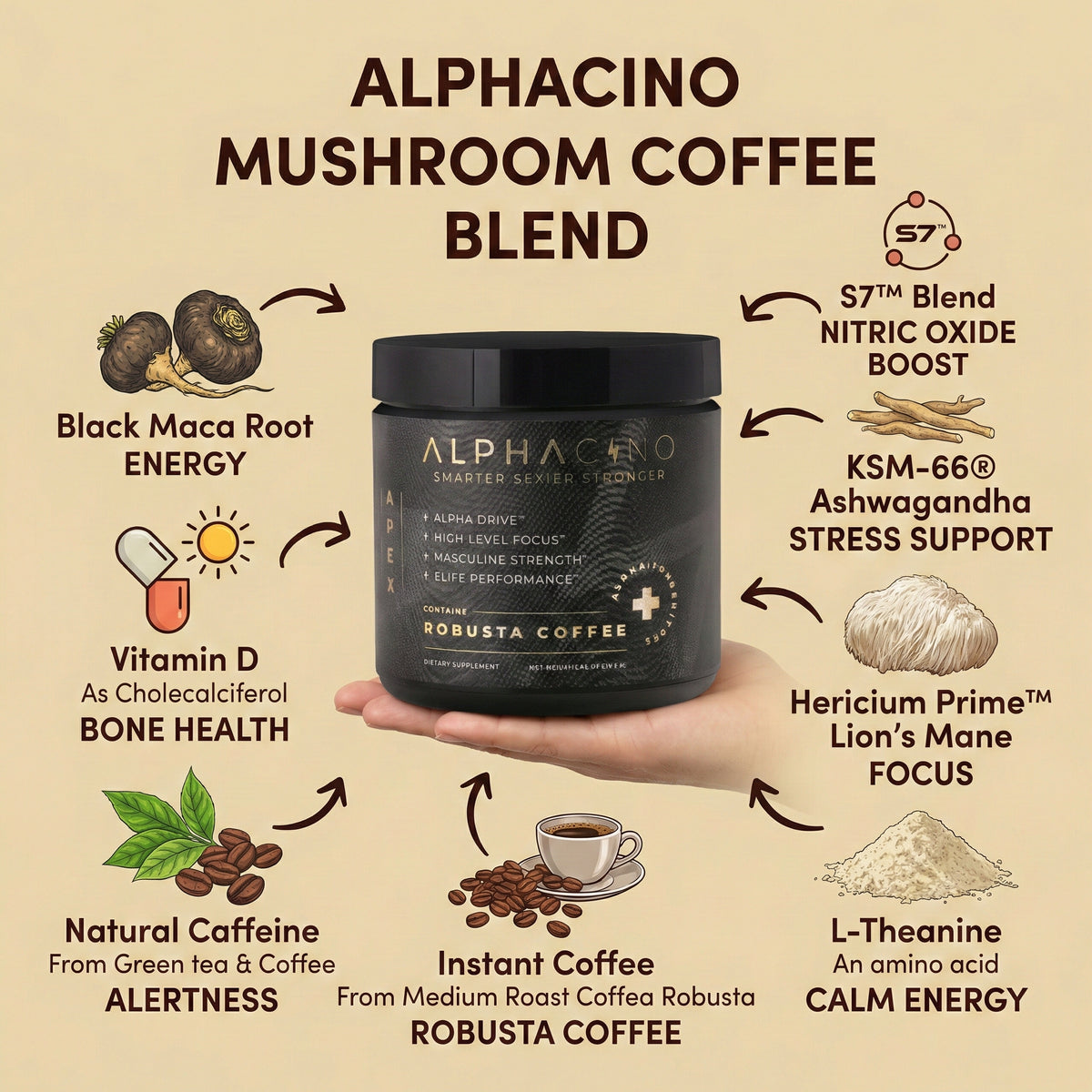
Alphacino was built around cause 3. It keeps the caffeine moderate, from robusta coffee, and pairs it with L-theanine so the lift is steadier than a large plain dose. Around that sit 500 mg Lion's Mane, 600 mg KSM-66 ashwagandha, black maca and the S7 plant blend, chosen for focus, stress and drive rather than a harder jolt. It will not repay a sleep debt, replace a walk, or change a testosterone reading. What it can do is stop your morning cup adding to the stack. It is rated 4.7 by verified buyers and carries a 60-day money-back guarantee. See what is in the cup.
Frequently asked questions
Why do I feel exhausted by 8 pm every night?
Usually a stack of ordinary causes: sleep debt you have stopped noticing, a stress load that never stands down, caffeine that only returns you to baseline, too little movement, and alcohol that fragments the second half of the night. Fix sleep first.
Is feeling drained in the evening just part of getting older?
Rarely on its own. Testosterone declines gradually with age, whereas in a lab study two weeks of sleeping six hours or less a night built up deficits equivalent to up to two full nights without sleep. Rule out sleep, stress, caffeine, movement and alcohol before blaming the calendar.
Can too much coffee make you tired in the evening?
Yes, in two ways. Daily use builds tolerance, so each dose mostly reverses withdrawal rather than adding energy, and in a controlled trial caffeine taken even six hours before bed cut measured sleep by more than an hour. Moderate the total and stop eight hours before bed.
Does alcohol make evening tiredness worse?
Yes. Alcohol helps you fall asleep but disrupts the second half of the night, with more waking and less REM sleep. Two dry weeks is the simplest way to see what it is costing you.
Should I get my testosterone tested if I am always tired?
If fatigue comes with low libido, fewer morning erections or muscle loss and persists after sleep and alcohol are fixed, ask your doctor. A diagnosis needs a fasting morning blood test, clearly low on two occasions, not one afternoon reading.
This article is general information, not medical advice.
Sources
- Van Dongen, H. P. A., Maislin, G., Mullington, J. M., & Dinges, D. F. (2003). The cumulative cost of additional wakefulness: dose-response effects on neurobehavioral functions and sleep physiology from chronic sleep restriction and total sleep deprivation. Sleep, 26(2), 117–126. doi:10.1093/sleep/26.2.117
- Åkerstedt, T. (2006). Psychosocial stress and impaired sleep. Scandinavian Journal of Work, Environment & Health, 32(6), 493–501. doi:10.5271/sjweh.1054
- Rogers, P. J., Heatherley, S. V., Mullings, E. L., & Smith, J. E. (2013). Faster but not smarter: effects of caffeine and caffeine withdrawal on alertness and performance. Psychopharmacology, 226(2), 229–240. doi:10.1007/s00213-012-2889-4
- Puetz, T. W., Flowers, S. S., & O'Connor, P. J. (2008). A randomized controlled trial of the effect of aerobic exercise training on feelings of energy and fatigue in sedentary young adults with persistent fatigue. Psychotherapy and Psychosomatics, 77(3), 167–174. doi:10.1159/000116610
- Ebrahim, I. O., Shapiro, C. M., Williams, A. J., & Fenwick, P. B. C. (2013). Alcohol and sleep I: effects on normal sleep. Alcoholism: Clinical and Experimental Research, 37(4), 539–549. doi:10.1111/acer.12006
- Leproult, R., & Van Cauter, E. (2011). Effect of 1 week of sleep restriction on testosterone levels in young healthy men. JAMA, 305(21), 2173–2174. doi:10.1001/jama.2011.710
- Bhasin, S., Brito, J. P., Cunningham, G. R., et al. (2018). Testosterone therapy in men with hypogonadism: an Endocrine Society clinical practice guideline. The Journal of Clinical Endocrinology & Metabolism, 103(5), 1715–1744. doi:10.1210/jc.2018-00229
- Hirshkowitz, M., Whiton, K., Albert, S. M., et al. (2015). National Sleep Foundation's sleep time duration recommendations: methodology and results summary. Sleep Health, 1(1), 40–43. doi:10.1016/j.sleh.2014.12.010
- Drake, C., Roehrs, T., Shambroom, J., & Roth, T. (2013). Caffeine effects on sleep taken 0, 3, or 6 hours before going to bed. Journal of Clinical Sleep Medicine, 9(11), 1195–1200. doi:10.5664/jcsm.3170