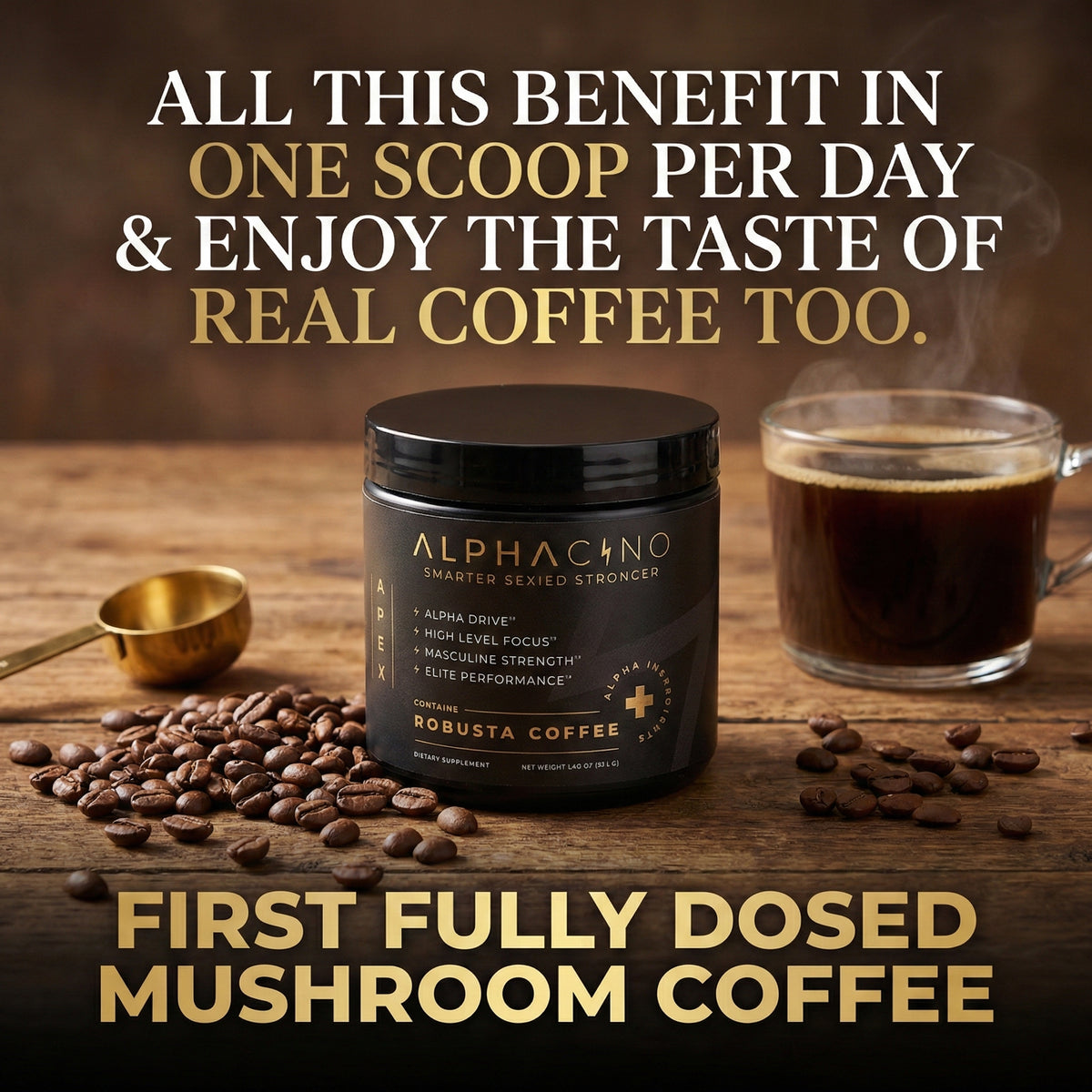
Short answer: I built Alphacino because I was a father running on four coffees a day, wired all morning and wrecked by night, and nothing on the shelf fixed the actual problem. The problem was not coffee. It was the shape of the caffeine curve, the sleep it quietly took, and the stress it stacked on top. So I kept the coffee and rebuilt the cup: robusta, 500 mg Lion's Mane, 600 mg KSM-66 ashwagandha, black maca and L-theanine. Here is the reasoning, and the two changes that mattered most, whether you buy anything or not.
The version of me my family was getting
A few years ago I caught a glimpse of myself that I did not like. I was a husband and a father drinking four cups of coffee a day. Wired all morning. Foggy by mid-afternoon. Worst of all, I was short with the people I love most: snapping at my kids over nothing, half-listening while my wife talked.
I did not want a pill, a powder that tasted like dirt, or a lifestyle overhaul. I wanted my morning coffee to work for me instead of against me. First I had to understand what four cups were doing.

What four coffees a day was actually doing
The short version: caffeine hides tiredness rather than removing it, and the tiredness lands when the caffeine clears.1 Our guide on why coffee makes you tired explains the rebound. What I had not understood was that my fix, another cup, was the problem. Four cups meant four rebounds, each landing on the last, and by 3 pm I was drinking coffee to get back to where I had started.
Why sleep debt and stress made it worse
The afternoon cups were also costing me sleep I could not feel. Caffeine taken as late as six hours before bed shortens the night, and people do not notice the loss.2 The tired guide covers that spiral; for me the point was that a shorter night meant more coffee the next morning.
Stress was the half nobody talks about. In a study of 96 adults, repeated 250 mg doses of caffeine through the day raised cortisol, and habitual use dampened that response but did not abolish it.3 I had a stressful job and small kids. Every extra cup added a stimulant to a body already on alert. Wired then wrecked was the predictable output, and it is the part of the problem a caffeine cutoff alone does not fix.
What was wrong with everything on the shelf
The men's supplement aisle was full of loud labels and quiet doses: a trendy ingredient at a fraction of what any trial used, just enough to print on the front. If a product does not state milligrams per serving, assume there are not enough to matter. Our breakdown of the masculinity coffee trend shows how often that is the case. Nobody was making real coffee with ingredients at the doses the studies used, every one printed on the tin. So I would.
What I put in the cup, and why each dose
I am not a chemist. I am stubborn, and I had one rule: every ingredient goes in at a dose I can point to a human trial for, or I say where it falls short.
Robusta coffee, because the ritual is the point
Robusta carries more caffeine per gram than arabica, so one cup gives a meaningful dose and then I stop. One cup, one curve, done by mid-morning.
L-theanine, to change the shape of the curve
In a placebo-controlled study, caffeine plus L-theanine improved attention-task performance compared with placebo, and produced effects that caffeine alone did not: faster simple reaction time and lower ratings of tiredness and headache.4 We include it alongside the caffeine, the pairing the trials tested. More in our L-theanine and caffeine guide.
600 mg KSM-66 ashwagandha, for the stress load
This is the ingredient most often under-dosed. The key trial gave 64 chronically stressed adults 300 mg of KSM-66 twice a day for 60 days. Serum cortisol fell about 28 percent against 8 percent on placebo, and perceived stress scores fell 44 percent.5 That is 600 mg a day, so 600 mg is what goes in. It works over weeks, not minutes. Who should skip it is in our KSM-66 guide for men.
500 mg Lion's Mane, with honest limits
Lion's Mane has the most hype and the thinnest evidence in healthy adults. A small 2023 pilot found a single 1.8 g dose sped up a Stroop attention task an hour later, and 28 days of use showed a trend toward lower self-reported stress.6 We use 500 mg of extract: a reasonable bet on early evidence, not a proven effect. More in our Lion's Mane guide for men.
Black maca, as a supporting ingredient
Black maca has one solid trial: 175 adults took 3 g a day of black or red maca extract for 12 weeks, and the black maca group reported better mood and energy scores than placebo.7 Our maca dose sits below that amount, so it is a supporting ingredient, not the headline. Our black maca guide explains how to reach the studied range. Red maca scored slightly better than black on those measures in the same trial, which is one reason maca is a supporting ingredient here, not the headline.
| Ingredient | Dose in Alphacino | What the trial found | Honest caveat |
|---|---|---|---|
| Robusta coffee | One cup of caffeine | Blocks adenosine; 2.5 to 4.5 h half-life1 | Keep it at least 6 h clear of bed2 |
| L-theanine | Paired with the caffeine | Better attention, lower tiredness/headache ratings vs placebo4 | Smooths the curve; does not extend it |
| KSM-66 ashwagandha | 600 mg | Cortisol down ~28%, stress scores down 44% over 60 days5 | Takes weeks; not for everyone |
| Lion's Mane | 500 mg extract | Faster attention task at 1 h; stress trend at 28 days6 | Small pilot; evidence is early |
| Black maca | Below the 3 g trial dose | Better mood and energy scores at 12 weeks7 | Supporting role, not headline |
Where Alphacino fits
Alphacino is the cup described above, with the doses printed on the label. It replaced my four coffees with one. The honest pitch: not a new life, just a better-designed cup and a shorter caffeine day. It is rated 4.7 by verified buyers and comes with a 60-day money-back guarantee. If it is not working after two months, email us, keep the bag, and get your money back.
The two changes I actually made
I will not promise you a result, only what I did. Going from four cups to one, and giving the ashwagandha the weeks it needs, is most of the story. The rollercoaster flattened, I slept, and I had patience at dinner again. Not superhuman. Just enough left in the tank for the people who matter. Neither needs a purchase:
- One cup, early. I went from around 400 mg a day to one cup before 9 am, and let the afternoon go without. My last caffeine now sits at least six hours before bed, the trial's threshold;2 I give it eight.
- Caffeine with L-theanine, every time. Green tea alongside your coffee, or a 200 to 250 mg capsule, gets you close to the trial combination (250 mg L-theanine with 150 mg caffeine).4
The number I track now is how I am at 6 pm, not how sharp I am at 9 am. For a full morning routine, see our morning routine for focus and energy.

Frequently asked questions
Why did you build Alphacino?
I was a father drinking four coffees a day, wired in the morning and wrecked by night, and nothing on the shelf used real doses. I wanted one cup of coffee that dealt with the caffeine crash, the sleep loss and the stress load at the same time.
How long before I know if Alphacino is working?
Give it 60 days. The caffeine and L-theanine effects are same-day, but the ashwagandha trial ran 60 days, which is why the guarantee runs that long.
Why 600 mg of KSM-66 ashwagandha?
Because that is the daily dose used in the 60-day trial that found cortisol and perceived stress fell versus placebo. Many products use a fraction of it.
Does Lion's Mane at 500 mg actually do anything?
The evidence in healthy adults is early. A small pilot found faster attention-task performance an hour after a dose and a trend toward lower stress at 28 days. I include it as a reasonable bet, not a proven effect.
What can I try without buying Alphacino?
Cut to one or two morning cups, stop caffeine six to eight hours before bed, and pair your coffee with green tea or an L-theanine capsule. If you try ashwagandha, give the trial dose 60 days.
This article is general information, not medical advice.
Sources
- Fredholm, B. B., et al. (1999). Actions of caffeine in the brain with special reference to factors that contribute to its widespread use. Pharmacological Reviews, 51(1), 83–133. PMID 10049999
- Drake, C., et al. (2013). Caffeine effects on sleep taken 0, 3, or 6 hours before going to bed. Journal of Clinical Sleep Medicine, 9(11), 1195–1200. doi:10.5664/jcsm.3170
- Lovallo, W. R., et al. (2005). Caffeine stimulation of cortisol secretion across the waking hours in relation to caffeine intake levels. Psychosomatic Medicine, 67(5), 734–739. doi:10.1097/01.psy.0000181270.20036.06
- Haskell, C. F., et al. (2008). The effects of L-theanine, caffeine and their combination on cognition and mood. Biological Psychology, 77(2), 113–122. doi:10.1016/j.biopsycho.2007.09.008
- Chandrasekhar, K., Kapoor, J., & Anishetty, S. (2012). A prospective, randomized double-blind, placebo-controlled study of safety and efficacy of a high-concentration full-spectrum extract of ashwagandha root in reducing stress and anxiety in adults. Indian Journal of Psychological Medicine, 34(3), 255–262. doi:10.4103/0253-7176.106022
- Docherty, S., Doughty, F. L., & Smith, E. F. (2023). The acute and chronic effects of Lion's Mane mushroom supplementation on cognitive function, stress and mood in young adults: a double-blind, parallel groups, pilot study. Nutrients, 15(22), 4842. doi:10.3390/nu15224842
- Gonzales-Arimborgo, C., et al. (2016). Acceptability, safety, and efficacy of oral administration of extracts of black or red maca (Lepidium meyenii) in adult human subjects: a randomized, double-blind, placebo-controlled study. Pharmaceuticals, 9(3), 49. doi:10.3390/ph9030049